49 works in this view — arrow keys or swipe to move between them.
Dance in Art
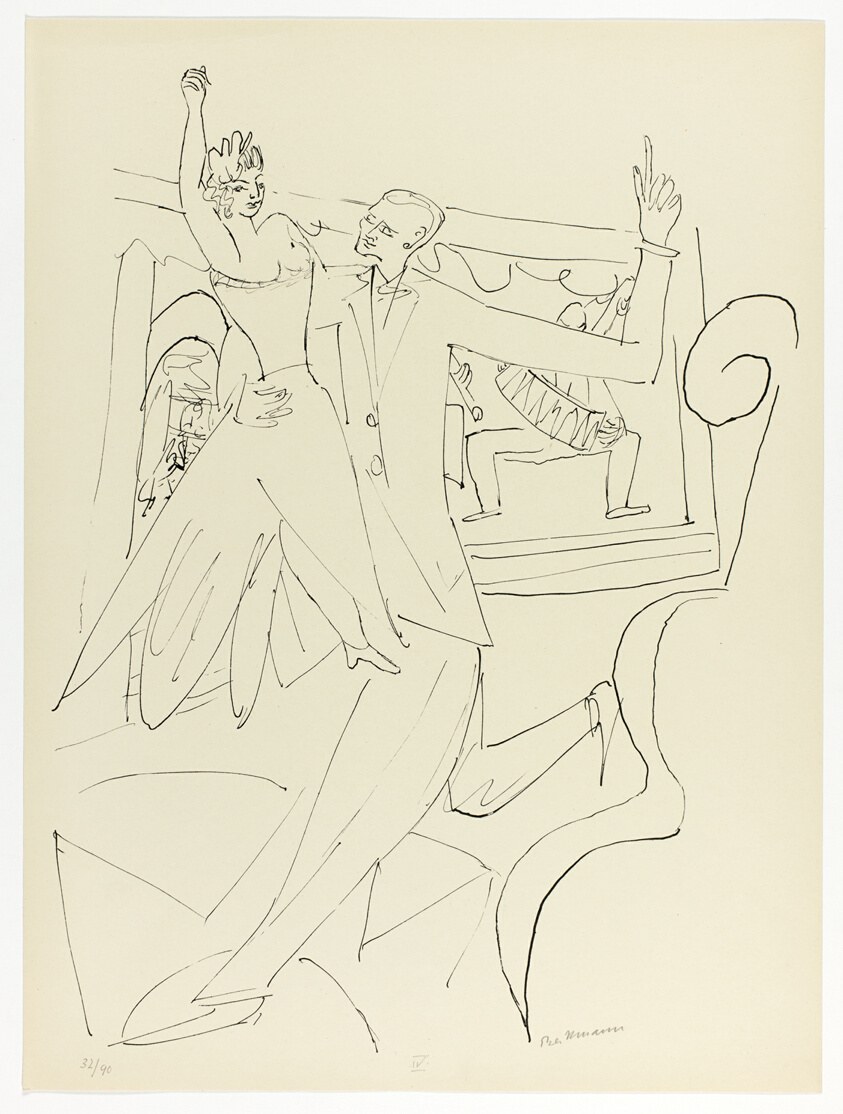
Tango, plate four from Day and Dream
Max Beckmann German, 1884-1950
- Medium:
- Lithograph on cream wove paper
- Collection:
- Prints and Drawings
- Source:
- Art Institute of Chicago
- Rights:
- Rights reserved by the holding institution — do not reuse without permission. Source record ↗
- Recorded as:
- AIC — rights reserved
This image documents how a major European modernist artist saw tango: not as exotic or quaint, but as the signature dance of contemporary urban life, deserving the same serious attention as high art subjects. It shows the tango as an arena for representing psychology, bodily intimacy, and social change—themes that preoccupied early twentieth-century visual artists. For dance historians, it is evidence that tango mattered not as a footnote to ballroom dance but as a central symbol of modernity itself.
What you are looking at
A lithograph sketch depicting an energetic tango scene in what appears to be an early twentieth-century ballroom or dance hall. Two couples occupy the composition: in the foreground, a woman in a sleeveless dress with her arm raised expressively dances with a man in a suit; behind them, a second couple is partially visible. The setting is suggested by simple linear marks indicating walls and what may be bench seating along the perimeter. The figures are rendered in quick, gestural line work characteristic of Beckmann's expressionist style—loose and economical but charged with movement and psychological intensity. The woman in the foreground dominates the composition with her upraised arm and the sweep of her skirt; her partner leans toward her in close contact. The drawing captures a moment of social intimacy and physical engagement, with the spare background allowing the dancers' bodies to command full attention.
The dancing
The primary couple stands in close ballroom hold, with the man's torso angled toward the woman and her right arm extended upward in an expressive gesture. Her left arm appears to reach toward her partner's shoulder or frame. The woman's weight is shifted, with her lower body suggested beneath the swinging lines of her skirt, which is drawn with rapid, curved strokes suggesting movement. The man's posture is upright but engaged, leaning slightly into the dance. A second couple visible in the background appears less distinct but maintains similar close positioning. The line work throughout conveys urgency and weight transfer rather than decorative precision.
The dance depicted
This is Argentine tango or a ballroom tango of the early twentieth century, identifiable by the close embrace, the woman's characteristic raised-arm frame, and the intimate partner connection. The tango emerged from Buenos Aires in the 1880s–90s and became a sensation in European and American ballrooms in the 1910s–20s. The expressionist rendering—with its angular, gestural quality—captures the psychological drama that made tango notorious: it was danced as a form of intimate social rebellion, often in working-class venues before becoming fashionable in middle-class ballrooms. Beckmann's sketch emphasizes the tension and emotional charge of the dance rather than its technical steps.
How it was made
This is a lithograph, a planographic printing technique in which the image is drawn on a limestone plate using greasy crayon or ink, then chemically treated so that ink adheres only to the drawn areas. Lithography allowed for expressive, sketch-like line work and relatively rapid production, making it ideal for distributing artistic commentary and modern imagery to a broader public. The loose, economical line in this print—with minimal shading and no attempt at photographic realism—is characteristic of Beckmann's graphic practice and of expressionist printmaking generally. The technique's accessibility meant that images of urban leisure and dance could reach viewers beyond the gallery or wealthy collector.
About this work
This lithograph from Beckmann's *Day and Dream* portfolio presents tango as a subject of modern urban life and psychological intensity. It belongs in a dance history collection not as a document of technical form but as evidence of how tango was perceived and represented in European modernism: as emotionally charged, socially transgressive, and central to twentieth-century metropolitan experience. Beckmann was working in Berlin during a period when tango dominated popular dance culture and artistic imagination alike. The print captures a specific moment in the popularization of tango—after its shock value but before it became merely conventional—when it still signified modernity, desire, and the collision of working-class and bourgeois social worlds.
How to look at it
Look at the woman's raised arm and the tilt of her torso: this is the distinctive upward reach of the tango frame, a gesture that immediately signals the dance's emotional and formal character. Notice how Beckmann uses line weight and density to suggest the woman's swinging skirt and the momentum of the couple's movement, without depicting specific steps or positions. The sparse background and the way the figures dominate the composition reflect Beckmann's modernist priority: the psychological and sensual content of the dance matters more than its ballroom setting. The second couple in the background, rendered more faintly, suggests repetition and the social nature of the dance while keeping focus on the foreground pair.
The artist
Max Beckmann (1884–1950) was a German painter and printmaker associated with the Expressionist and Neue Sachlichkeit (New Objectivity) movements. He was deeply engaged with urban subject matter, modern life, performance, and psychology. Beckmann worked extensively in lithography and created numerous print portfolios, of which *Day and Dream* (1946) was one of his final and most introspective. His dance subjects appear across his oeuvre—he was fascinated by cabarets, circuses, and ballrooms as sites where modern society revealed its desires and contradictions. Beckmann's approach to dance was neither romantic nor documentary; he used it to explore the intersection of individual psychology, sexuality, and social performance.
The period
Tango became a global phenomenon in the 1910s–20s, initially scandalizing respectable society with its close embrace and association with Argentine working-class and immigrant culture. By the 1920s–30s, when Beckmann was establishing himself, tango had become central to European modernism—it appears in the work of painters, writers, and composers as a symbol of modernity, eroticism, and social upheaval. In visual art, the tango subject allowed artists to explore contemporary themes of desire, class conflict, and the fluidity of identity. Beckmann's *Day and Dream* portfolio (1946) was made after World War II and his exile from Nazi Germany, a period when he was reflecting on European culture, memory, and the gap between daytime rationality and nocturnal fantasy—themes the tango subject embodied perfectly.
Where it lives
This lithograph is part of the *Day and Dream* portfolio, held in the Prints and Drawings collection of the Art Institute of Chicago. *Day and Dream* is a series of prints made late in Beckmann's career, created as a suite and intended for circulation as an artistic statement rather than as isolated individual works.
Dance in this work
Questions about this work
Is this Argentine tango or ballroom tango?
The image itself does not distinguish between them definitively—the close embrace and the woman's raised arm appear in both forms. Historically, Beckmann was likely witnessing a ballroom tango in 1920s–30s Berlin, where Argentine tango had been adopted into middle-class ballroom dance. However, the emotional and psychological intensity Beckmann conveys aligns with the tango's roots in Argentine working-class culture and its reputation for passionate, intimate expression.
Why is the drawing so sketchy and unfinished-looking?
This is not incompleteness but a deliberate aesthetic choice. Expressionist artists, including Beckmann, used economical, gestural line work to convey psychological and emotional content rather than documentary detail. The sketch-like quality suggests urgency, improvisation, and the immediacy of lived experience—fitting for a subject about modern urban dance.
What does the title 'Day and Dream' suggest about this tango image?
The portfolio as a whole contrasts rational daylight experience with nocturnal fantasy and the unconscious. Tango, danced primarily in evening venues and associated with desire and social transgression, fits the 'dream' half of this duality. The portfolio suggests that modernist Beckmann saw the ballroom as a space where repressed desires and authentic feeling emerge—a kind of waking dream.
More dance artwork





