49 works in this view — arrow keys or swipe to move between them.
Dance in Art
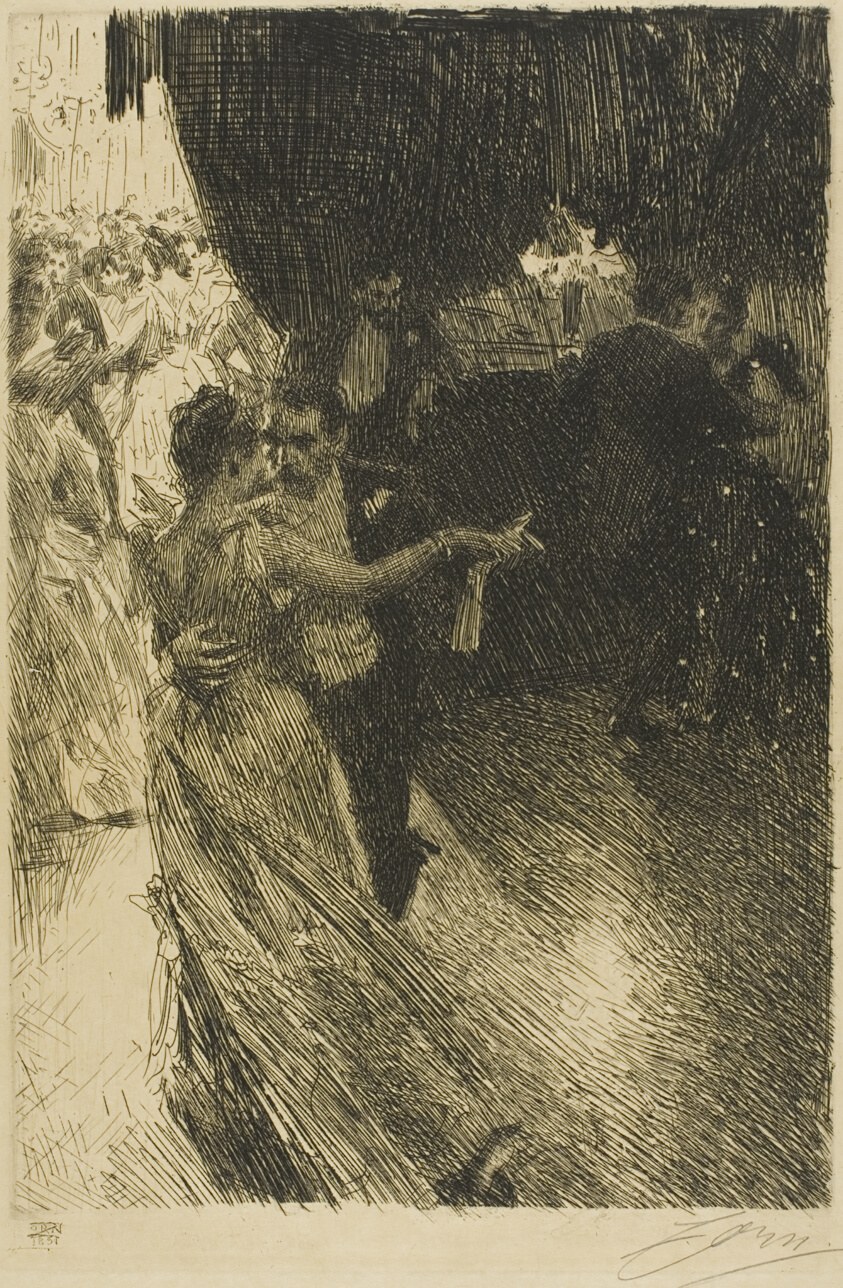
The Waltz
Anders Zorn Swedish, 1860-1920
- Medium:
- Etching on cream wove paper
- Collection:
- Prints and Drawings
- Source:
- Art Institute of Chicago
- Rights:
- Public domain — free to use, share and adapt.
- Recorded as:
- CC0 (Public Domain)
For dance historians, this etching documents the waltz's place in fin-de-siècle leisure culture and reveals how visual artists of the period conceived of ballroom dance—not as exhibition but as an intimate social ritual enacted within formal constraints. For printmakers and those interested in etching technique, it exemplifies how Zorn used mark density to achieve atmospheric and psychological effect, transforming a technical limitation (the linear nature of the etched line) into a vehicle for mood and meaning.
What you are looking at
A darkened ballroom or theater interior, rendered almost entirely in shadow through dense parallel etching lines. In the left foreground, a group of spectators—barely visible as pale silhouettes—watches from the margin of the space. At center and right, a couple dances in the gloom: the man is a dark shape, the woman's form emerging slightly more distinctly as she turns in his embrace, her pale dress catching what little light the composition permits. The room is suggested only by the architectural mass of heavy drapery or walls pressing down from above in nearly black cross-hatching. The contrast between the watchful, still figures at the edge and the moving bodies at the center creates a sense of intimate performance observed in near-total darkness—a waltz glimpsed by firelight, or in a room lit only for the dancers themselves.
The dancing
Two figures occupy the dance space: a man in dark clothing, seen from behind, and a woman in a pale dress turning within or emerging from his hold. The woman's silhouette shows a turned torso and what appears to be skirts in motion—the dress reads as layered and full, of the period's fashionable cut. Their relative positions suggest a closed ballroom embrace, though the darkness and Zorn's loose handling of form make precise reading of the frame difficult. The posture of both suggests an active moment mid-movement rather than a posed pause.
The dance depicted
This is almost certainly a waltz, as the title confirms. The composition captures the Gilded Age waltz as a private or semi-private event—a ballroom moment that belongs to the dancers themselves and to those privileged to witness it, not to public spectacle. The dance appears to be Viennese waltz or the broader Waltz style of the 1890s, performed by an urban couple of evident social standing. What matters visually is not the technical execution but the emotional tenor: the waltz as an intimate exchange within a formal setting, the dancers absorbed in their movement while others observe from the shadows.
How it was made
This is an etching, a print medium that allowed Zorn to achieve extraordinary richness through the controlled repetition and layering of fine lines. Etching permitted the gradation from near-white to near-black through differential mark density—here used to dramatic effect to render the ballroom as a space of mystery and selective illumination. The medium's capacity for delicate parallel hatching produces an almost atmospheric quality; the dense cross-hatching that fills the upper and right portions of the composition is virtually indistinguishable from cast shadow, making the ballroom itself feel airless and close. Etching was a collector's medium, circulated among connoisseurs and print enthusiasts; this work belongs to a tradition of fine-art printmaking for educated audiences rather than mass publication.
About this work
Zorn's *The Waltz* is a study of social dance filtered through late nineteenth-century printmaking technique and sensibility. It presents the waltz not as spectacle or technique but as an interior emotional event—a moment of connection between two dancers observed in almost-darkness by the society surrounding them. The work sits at a moment when the waltz had become the foundational ballroom dance of European and American urban society, yet artistic attention had begun to move from the physical mechanics of the dance toward its psychological and social dimensions. Zorn, one of the era's supreme etchers, used the print medium's capacity for tonal subtlety to render the ballroom as a space of selective illumination and half-visibility, where the dance itself becomes an act of withdrawal from observation even as it is observed.
How to look at it
Begin with the composition's division between illuminated margin and dark center. The pale figures at the left are society—the frame, the context, the watching eye. The dancers at center-right occupy a space seemingly illuminated from within, or lit by a source the viewer cannot see. Notice how Zorn has used line density to create this effect: where the spectators are defined by relatively spare hatching, the ballroom walls and floor are nearly black with accumulated marks. The woman's dress reads as a pale accent in this darkness, almost glowing; her turned form suggests active motion. The moment chosen is not a pause but a pivot—the viewer has caught the waltz mid-turn, at the instant of maximum visual interest. Attend to the boundary between the two spatial zones and to how Zorn's technique—the basic tool of etching, the repeated line—creates both formal structure and psychological atmosphere.
The artist
Anders Zorn (1860–1920) was a Swedish painter, sculptor, and printmaker of international reputation. He was celebrated chiefly as a portrait painter and as one of the finest etchers of his generation—his etchings were widely collected in Europe and America. Zorn traveled extensively, worked in France and Italy, and maintained a cosmopolitan engagement with urban leisure culture. His prints often capture moments of intimate social interaction: dancers, bathers, theater scenes, domestic interiors. He worked with extreme technical refinement and a romantic sensibility that valued the suggestive over the explicit; his subjects often emerge from shadow or sketch as much as they are fully defined. *The Waltz* typifies his approach: a socially coded moment rendered through the most sophisticated manipulation of his chosen medium.
The period
In 1891, the waltz had dominated European and American ballroom culture for nearly a century, yet its meaning was shifting. Where early Romantic representations celebrated the waltz as thrilling and transgressive (the close hold still contentious in some quarters), by the 1890s it had become institutionalized—the dance of respectable society, taught in dancing schools, central to the social season. Simultaneously, artistic attention to contemporary life was intensifying; the Realist and early Symbolist movements had made modern leisure a worthy subject for serious art. Zorn's generation of printmakers—among them Toulouse-Lautrec—found in the waltz and in ballroom scenes a way to capture the psychology of urban modernity: the mixture of public and private, the performance of social identity, the emotional undercurrent of formal interaction. The etching medium itself was experiencing a revival among fine artists in the 1880s and 1890s, valued as an alternative to academic painting and as a vehicle for intimate, sophisticated artistic expression.
Where it lives
This etching is held in the Prints and Drawings collection of the Art Institute of Chicago, where it is catalogued as part of the museum's holdings of Northern European prints from the late nineteenth century. As a fine-art print in a major public collection, it has been preserved for scholarly and public viewing and is reproducible for research and educational purposes.
Dance in this work
Questions about this work
How can I tell this is a waltz and not another ballroom dance?
The title identifies it as such. Visually, the two-figure embrace and the woman's turned, pivoting posture are consistent with waltz movement. The composition suggests the characteristic 3/4 rhythm through its emphasis on rotation and the moment of maximum turn. However, Zorn has not rendered the dance with anatomical precision; he chose instead to capture the emotional and social experience of the waltz.
Why is the image so dark?
Zorn deliberately used the etching medium's capacity for tonal range to render the ballroom as a space of selective illumination. The darkness is not a technical accident but a compositional choice that isolates the dancers and heightens the sense of an intimate moment observed across social distance. The technique also reflects Symbolist aesthetics of the 1890s, which valued suggestion and atmosphere over explicit description.
Was this waltz a real ballroom dance or an artistic invention?
The waltz depicted here represents the actual ballroom waltz of the 1890s—a standardized, taught dance central to urban leisure culture. However, Zorn's representation of it is artistic interpretation rather than documentary record. He has chosen a moment and lighting condition that emphasizes the psychological and social dimensions of the dance rather than its technical form.
Who would have owned or seen this print?
Etching was a collector's medium in the 1890s, circulated among print connoisseurs, artists, and educated collectors. This work would have been purchased through print dealers or exhibitions, framed, and displayed in the homes or collections of people with knowledge of and investment in contemporary printmaking. It was not a mass-produced or popular image, but a refined object for a sophisticated audience.
More dance artwork





