49 works in this view — arrow keys or swipe to move between them.
Dance in Art
The Waltz
Anders Zorn Swedish, 1860-1920
- Medium:
- Etching on ivory laid paper
- Collection:
- Prints and Drawings
- Source:
- Art Institute of Chicago
- Rights:
- Public domain — free to use, share and adapt.
- Recorded as:
- CC0 (Public Domain)
Zorn's etching documents the waltz at the height of its cultural prestige, before the new dances of the early 20th century (tango, foxtrot, jazz) began to challenge its supremacy. For historians of ballroom dance, the image is valuable proof of how the waltz was actually held, how the skirt moved in rotation, and how the dance was experienced as a social ritual within an audience of peers. For art historians, it exemplifies the late-19th-century fascination with capturing transient moments of elegance and movement.
What you are looking at
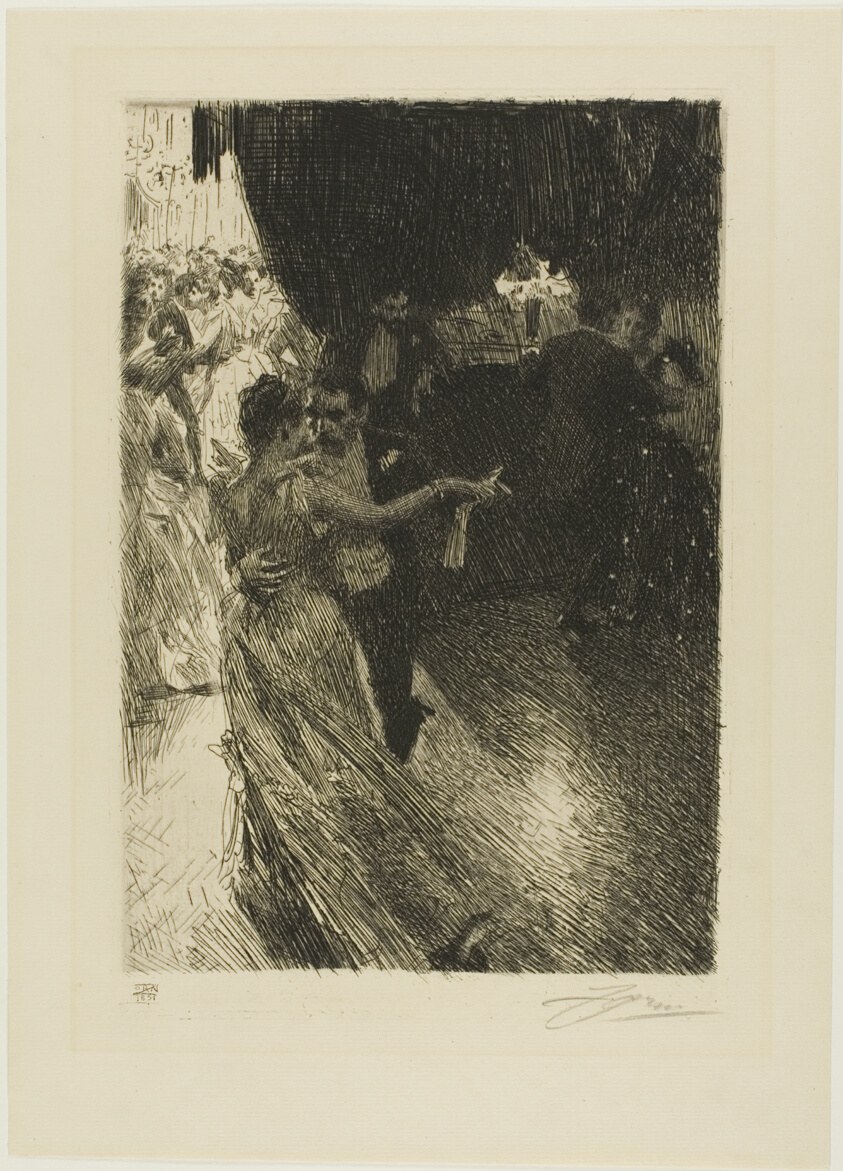
An intimate interior scene captures a moment of waltz in what appears to be a dimly lit ballroom or drawing room. The composition is divided by strong light and shadow: at left, a brightly lit couple in formal dress—the woman in a flowing pale gown, the man in dark evening clothes—are caught mid-turn. The woman's skirt swirls around them as they pivot. At right, the space recedes into deep shadow where several other figures are barely distinguishable, suggesting an attending audience or other dancers waiting their turn. The light source, presumably from a chandelier or candles, casts dramatic shadows across the floor and throws the principal dancers into sharp relief against the darkened ballroom. The etching technique creates a shimmering, atmospheric quality—the hatching and cross-hatching suggest movement, fabric, and the transient nature of the moment.
The dancing
The lead couple holds the closed ballroom position: the man's right hand at the woman's waist, her left hand on his shoulder, their outer arms extended at roughly shoulder height in the frame position characteristic of the waltz. Their bodies are turned away from the viewer, caught mid-rotation, with the woman's weight clearly on her left side and the man supporting the turn. The woman's full skirt, depicted with flowing lines, billows outward from the spin—a three-quarter view shows how the fabric follows the rotational momentum. In the shadowed background, at least three other figures are visible, some apparently standing, one possibly dancing, creating a sense of an active ballroom rather than an isolated pair.
The dance depicted
This is almost certainly a representation of the waltz, one of the most prestigious ballroom dances of the late 19th century. The closed hold, the three-quarter turn pose, and the woman's splayed skirt—all hallmarks of the waltz—confirm the identification. The waltz had emerged from Central Europe earlier in the century and by the 1890s remained the signature dance of formal ballrooms across Europe, danced by the educated and prosperous classes at evening assemblies and private balls. The intimate scale of this scene and the presence of observers suggests a private gathering rather than a public dance hall. Zorn has captured not the full rotational movement but the suspended moment of the turn, emphasizing the elegance and formality that made the waltz fashionable despite earlier moral objections to the closed hold.
How it was made
This is an etching on laid paper, a printmaking technique that allowed fine linear control and tonal subtlety through hatching and cross-hatching. The technique is particularly suited to creating atmospheric effects—the dense parallel lines at right create the enveloping shadow, while the more open linework at left preserves the luminosity of the dancers. Etchings were relatively modest in cost compared to paintings, allowing wide circulation among middle-class collectors and print enthusiasts, and were often bound into albums or folios. The plate-printing process, which requires the artist to work in reverse, demands considerable skill, and the subtle gradations of tone here show technical mastery. As a reproductive medium, the etching made this image of fashionable dance available to viewers across Europe.
About this work
Anders Zorn's *The Waltz* is a snapshot of late-19th-century ballroom culture, distilled into the suspended moment of a turn. The etching captures not narrative movement but the formal elegance of the waltz in its moment of greatest visual drama—the couple in full pivot, surrounded by the shadowed witnesses of a private ball. This is a work about class, taste, and the refined pleasure of the ballroom, rendered with the technical precision and atmospheric sensitivity that made Zorn's prints highly sought after among European collectors. The image confirms that by the 1890s, the waltz had become the emblematic dance of polite society, worthy of fine-art attention.
How to look at it
The viewer should attend to the artist's choice of the rotational moment: this is not the procession around the room that made up much of the waltz, but the dramatic instant of the turn, when the woman's skirt splays and the couple's bodies rotate together. The contrast between the bright left side and the shadowed ballroom emphasizes the isolation of the dancing couple within their formal ritual—they are both intimate and observed. Notice how the etching lines themselves seem to follow the direction of movement and fabric flow, creating a sense of motion even in a static image. The barely visible observers in shadow remind us that the waltz, for all its intimacy of hold, was fundamentally a social performance.
The artist
Anders Zorn (1860–1920) was a Swedish painter and printmaker of international reputation, best known for his oils and watercolors of figure subjects, portraits, and Scandinavian landscapes. He was equally skilled in etching and produced over 300 prints during his career. His work is characterized by brilliant light effects, loose handling, and an interest in contemporary social life—he painted both peasant festivals and refined urban scenes with equal attention. His prints circulated widely in Europe and were much collected; he was awarded numerous honors and maintained studios in Stockholm, Paris, and London. His interest in capturing fleeting moments of social life and light made the ballroom waltz a natural subject for his technique.
The period
The 1890s were the height of the waltz era in European ballroom culture. The dance had shed its earlier reputation for impropriety and had become established as the foundation of formal ball dancing, taught in dancing academies and danced by royalty and aristocracy. However, the decade also saw the emergence of new dances from the Americas and the colonies—the two-step, the one-step, ragtime rhythms—that would soon transform ballroom practice. Zorn was working during this moment of transition, when the waltz still dominated but its monopoly was beginning to crack. In art, the 1890s saw increased interest in depicting contemporary urban and social life, often with an emphasis on light, atmosphere, and the fleeting instant—Zorn's etching sits within this broader artistic concern with capturing modernity.
Where it lives
The work is held in the Prints and Drawings collection at the Art Institute of Chicago. It is a print, not a unique work, and would have been one of multiple impressions pulled from the etched plate during Zorn's lifetime or posthumously.
Dance in this work
Questions about this work
How do we know this is a waltz and not some other ballroom dance?
The closed hold—man's right hand at woman's waist, her left on his shoulder—with extended outer arms is the characteristic frame of the waltz. The three-quarter turn pose and the explosive swirl of the woman's skirt are also specific to the waltz's rotational movement. Other ballroom dances of the period (quadrille, cotillion) either did not use a closed hold or had different figures and frames.
Why is so much of the picture in shadow?
The shadow serves both aesthetic and social purposes. Artistically, it creates dramatic contrast that emphasizes the lit dancers and gives the print atmospheric depth. Socially, it suggests the ballroom as a space of controlled light and observation—the dancers are spotlit by the chandelier while the waiting observers remain in relative darkness, a visual metaphor for the social ritual of the ball.
What does this tell us about how the waltz was actually danced?
The image confirms the closed hold at mid-body, the perpendicular frame of the extended arms, and the woman's reliance on the man's support during the turn. The full spread of the woman's skirt shows that skirts were voluminous enough to swirl dramatically, and that the rotation was fast enough to lift and fan the fabric. The formal posture and composed expressions show that the waltz was danced with restraint and control, not wild energy.
Was Zorn primarily a printmaker?
No, Zorn was best known as a painter, particularly in oils and watercolor. However, he was equally skilled at printmaking and produced over 300 etchings in addition to his paintings. His prints were highly valued by collectors and allowed his work to circulate more widely than paintings alone could achieve.
More dance artwork





