49 works in this view — arrow keys or swipe to move between them.
Dance in Art
The Waltz
Anders Zorn Swedish, 1860-1920
- Medium:
- Etching on ivory laid paper
- Collection:
- Prints and Drawings
- Source:
- Art Institute of Chicago
- Rights:
- Public domain — free to use, share and adapt.
- Recorded as:
- CC0 (Public Domain)
This etching preserves the waltz at a moment of its cultural dominance and technical maturity, capturing in fine detail the posture, hold, and frame that defined the dance for the European ballroom public. For historians of dance, it is invaluable visual evidence of how the waltz was actually danced and held in the period immediately before film and photography made such documentation routine; for viewers of art, it shows how a major artist of the period saw dance—not as spectacle but as an intimate, graceful, and eminently visual form of human connection.
What you are looking at
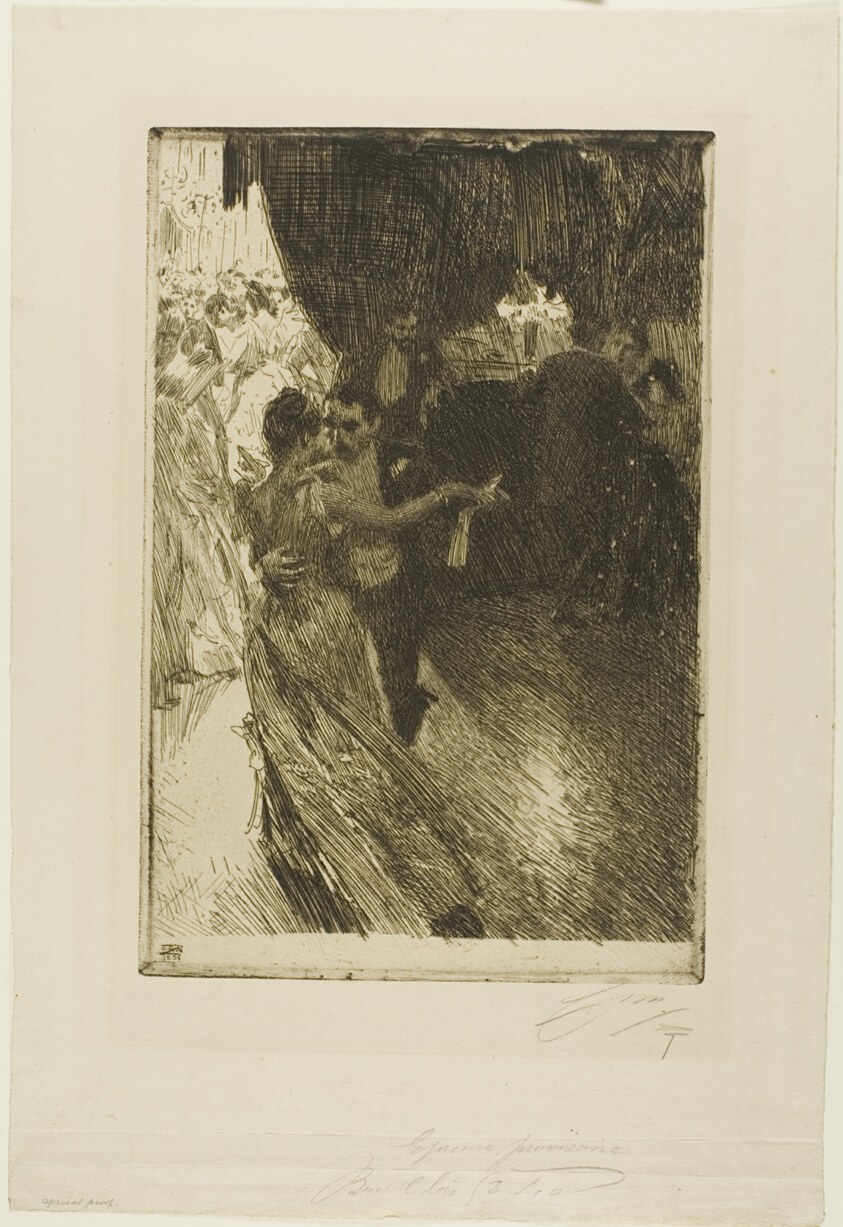
An intimate interior scene rendered in fine etching lines captures a moment of waltz in what appears to be a fashionable gathering or ballroom. Two couples occupy the composition: in the foreground, a man and woman in a closed waltz hold dominate the left side, the woman's form silhouetted against lighter drapery behind them, her body leaning into the turn. To the right and receding into deeper shadow, a second couple continues the dance, less distinct but clearly participating in the same measure. The setting is defined by heavy drapery—dark velvet or damask sweeping across the upper portion of the composition—and architectural elements suggesting an interior of some formality. The lighting is dramatic and uneven, created entirely through the density and direction of etched lines: the figures nearest the viewer catch what light there is, while the background dissolves into dense cross-hatching. The mood is one of contained energy and social propriety; this is not a public spectacle but an elegant private or semi-private moment of the upper class at leisure.
The dancing
The lead couple exhibits the closed hold fundamental to European ballroom dance of the period: the man's right hand at the woman's waist, her left arm extended, their right hands joined at roughly shoulder height. Both bodies are tilted into a gentle sway, the woman's weight appears to be on her back leg as she leans away from her partner—a hallmark of waltz frame. Her skirt, rendered with swift decisive lines, fans outward in the turn, showing the momentum of the rotation. The second couple's positioning is less explicit but consistent: they too are in closed hold and mid-rotation. The woman's posture throughout suggests the upright carriage and controlled hip action required by early 20th-century ballroom technique.
The dance depicted
This is unambiguously a waltz. The closed position, the three-quarter-time lilt suggested by the bodies' rhythm and lean, and the woman's extended skirt caught mid-twirl all confirm it. The catalogue record identifies this as *The Waltz*, dated 1891, in an era when the Viennese waltz had been the dominant social dance of European ballrooms for nearly a century and the slower English Waltz was beginning to emerge as a refined alternative. The scene depicts the waltz as it was danced in fashionable Swedish or continental European society in the 1880s–90s: a dance of decorum and partnership, not display or improvisation. The artist has chosen to show not the beginning or pause but the moment of deepest engagement—both couples mid-turn, absorbed in the music and each other.
How it was made
This is an etching, a printmaking technique in which a copper plate is bitten by acid to create fine grooves that hold ink. Zorn was a master of etching and used the technique's capacity for tonal variation through line density to create dramatic effects here. The shallow, delicate lines in the lit areas of the faces and the woman's dress contrast sharply with the dense parallel hatching that creates the dark drapery and shadows. This technique allowed for intimate, detailed work suitable for a smaller educated audience familiar with prints as high art—not a commercial reproduction but a collector's object. The medium also suited Zorn's interest in catching transient moments of light and movement; etching's sensitivity to subtle gradations of tone allowed him to suggest the fleeting quality of the dance.
About this work
This etching documents the waltz as it was practiced in refined European society at the close of the 19th century. Zorn captures not a formal or public performance but an intimate glimpse of two couples mid-turn in what appears to be a private or semi-public ballroom. The work demonstrates both technical mastery—the use of line and tone to create depth, atmosphere, and the suggestion of movement—and genuine observation of ballroom practice. The waltz in this period was at the height of its social prestige, having evolved over a century from scandalous innovation to the emblem of elegant partnership and restraint. Zorn's etching preserves this moment not as documentary record but as intimate aesthetic observation: the way light falls on a woman's face as she turns, the geometry of hands and arms in the closed position, the drama of heavy curtains framing the dancers. It belongs in a gallery of dance in art because it shows how the visual arts engaged with dance as a subject of beauty and social meaning, and because it captures a specific historical form—the waltz of the 1890s—with enough precision that a student of the dance can read the technique from the bodies.
How to look at it
Look first at the hands and the closed position: the geometry of arms and the point of connection between the partners are the bones of the waltz. Observe how the woman's body leans away from her partner's, creating the characteristic waltz frame and counter-balance. Follow the woman's skirt: it is caught mid-flare, the rush of fabric showing the momentum of the turn and the speed of the dance. Note Zorn's use of light and shadow—the way the etched lines are sparse and delicate where light touches the dancers' faces and bodies, and dense and heavy in the drapery and background. This technical choice mirrors the structure of the waltz itself: the dancers are lit and prominent, the setting is atmospheric and secondary. The moment chosen is not the beginning or the pause, but the sustained mid-turn, which gives the waltz its characteristic sense of continuous motion and partnership.
The artist
Anders Zorn (1860–1920) was a Swedish painter and printmaker of exceptional technical facility, celebrated in his lifetime for both oil paintings and etchings. He trained in Stockholm, Paris, and London, and was deeply influenced by the Impressionists' interest in light and fleeting moments. Zorn was prolific in etching—he created over 300 prints—and his technical virtuosity in the medium was widely recognised; his etchings, like his paintings, often captured scenes of contemporary life and leisure with an eye for intimate psychological and physical detail. He was a figure of the international salon world and moved in high society; this gave him access to and sympathy with the ballroom scenes he depicted. His etchings in particular were sought by collectors and were circulated among the educated classes throughout Europe.
The period
In 1891, when this etching was made, the waltz had already dominated European ballrooms for nearly eighty years. It had evolved from the Viennese waltz—fast, energetic, and once considered scandalous for its closeness—into a family of related dances adapted to different national tastes and musical tempos. The English Waltz, slower and more controlled than its Viennese ancestor, was becoming the preferred form in Britain and among the cosmopolitan elite. In the visual arts, the 1890s saw a continued interest in scenes of modern leisure and high society, particularly in the work of artists influenced by Impressionism and the emerging modern movement. Dance was a frequent subject—the waltz in particular, as a marker of refinement and leisure, appeared in paintings, prints, and illustrations throughout the period. Zorn's etching sits within this broader artistic engagement with dance as a sign of contemporary urban culture and elegance.
Where it lives
The work is held in the Prints and Drawings collection of the Art Institute of Chicago. As an etching on laid paper, it is a fine art print, likely created in a limited edition and circulated among collectors; such works were valued by museums and private collectors as demonstrations of technical mastery and as intimate windows onto contemporary life and leisure.
Dance in this work
Questions about this work
What is the closed position and why does it matter for the waltz?
The closed position—in which the man's right hand is at the woman's waist, their bodies upright and facing the same direction, right hands joined at shoulder height—became standard for the waltz in the 19th century and remains fundamental today. It was once revolutionary because it required partners to touch and face one another in a way no previous dance had demanded. In this etching, both couples demonstrate the closed position with the slight backward lean and upright frame typical of the late 19th-century waltz.
How can you tell this is a waltz and not another ballroom dance?
The closed hold is a strong indicator, but the clincher here is the woman's skirt: it is caught mid-flare in the turn, a characteristic silhouette of the rotating waltz. The posture of the dancers—upright, leaning slightly away from each other, bodies rotating—also matches waltz technique. By 1891, the waltz held in this position was the dominant social dance in European ballrooms.
Why did Zorn choose etching for this subject?
Etching allowed Zorn to capture transient moments of light and movement with extraordinary sensitivity. The technique's capacity to vary tone through line density meant he could create dramatic effects—the lit faces of the dancers, the deep shadow of the drapery, the suggestion of movement through the direction and weight of his lines. Etchings were also valuable collector's items, circulating among the educated classes rather than the masses, which suited the refined subject of the ballroom waltz.
Is this a public ball or a private gathering?
The image does not definitively distinguish between them. The formality of dress and the quality of the setting suggest at least a semi-public or fashionable gathering—a salon or private ball among the upper classes. The intimacy of Zorn's viewpoint and the focus on just two couples suggests he is documenting a moment of private or semi-private leisure rather than a spectacle.
More dance artwork





