49 works in this view — arrow keys or swipe to move between them.
Dance in Art
Texas Waltz
Luis Jimenez (American, 1940-2006) printed by Landfall Press (American, founded 1970)
- Medium:
- Color lithograph on white wove paper
- Collection:
- Prints and Drawings
- Source:
- Art Institute of Chicago
- Rights:
- Rights reserved by the holding institution — do not reuse without permission. Source record ↗
- Recorded as:
- AIC — rights reserved
The Texas Waltz is a living regional tradition largely absent from art historical accounts of American dance, which tend to privilege concert forms and African American vernacular styles. Jimenez's decision to lithograph this moment—with its careful attention to bodies, costume, and the specific material culture of Western dance—insists on the validity and visual interest of this tradition. For dancers and historians, it is evidence of what has been danced and valued in Chicano and country communities.
What you are looking at
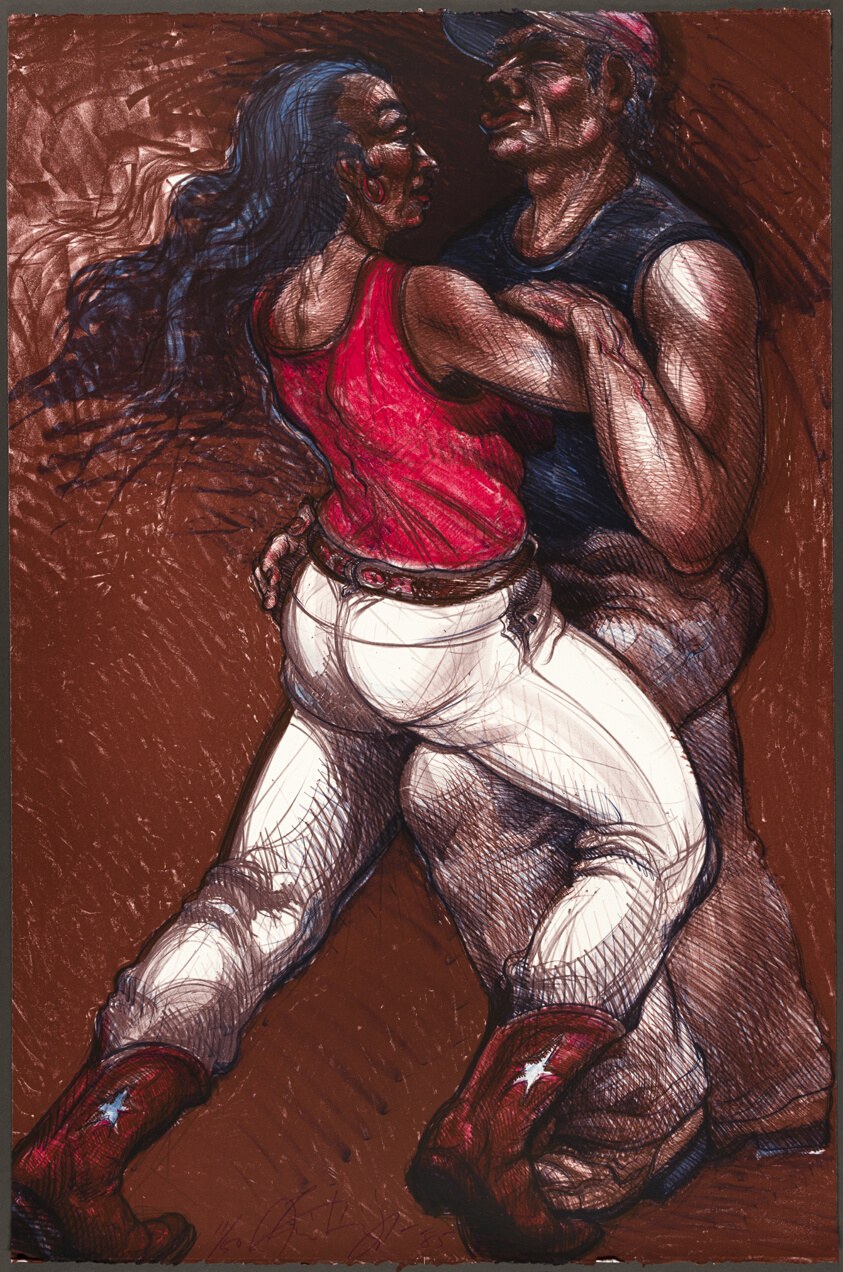
Two dancers in an intimate embrace dominate the composition, set against a deep russet background that anchors the figures in warm shadow. The dancer on the left, portrayed with long dark hair, wears a bright red sleeveless tank top and white trousers; the figure on the right, muscular and shirtless, wears dark trousers and cowboy boots with red and white detailing. Both wear red boots with prominent spurs or decorative heels, suggesting Western or country dress. Their bodies are pressed close, heads nearly touching in profile as they face each other, their posture suggesting the held frame of ballroom dance. The composition is vertical and crowded, filling the picture plane with the dancers' torsos and limbs. The lithograph's hatching and line work create strong modeling on the muscular bodies, and the selective use of color—the vivid red of the tank top standing against the monochromatic drawing of the rest—creates visual focus and intensity.
The dancing
The two figures are in a close, upright frame typical of ballroom dance, with bodies nearly parallel and heads turned toward each other in conversation or connection. The weight appears distributed evenly, suggesting a moment of pause or transition between steps rather than mid-movement. The positioning is frontal and confrontational, the dancers meeting as equals rather than in the traditional lead-follow asymmetry. Their physical contact is intimate and weighted—not the lifted, ethereal quality of classical ballet but the earthy, grounded physicality of social dance.
The dance depicted
The title *Texas Waltz* and the Western costume details—cowboy boots, spurs, the country styling—point toward a specific American regional dance tradition. The Texas Waltz is a slow, progressive partner dance performed to waltz time, popular in country and Western dance halls. The close frame and intimate positioning in this image suggest the held partnership and rotation characteristic of waltz, though the seated or heavily weighted quality of the pose reads more as a moment of connection than active turning. The dancers appear to be at rest or in the closing moment of a dance rather than mid-phrase.
How it was made
This is a color lithograph, a printmaking process that allowed Jimenez to work with drawn line and layered color fields. The technique is evident in the bold contour lines defining the figures, the hatched shading that models the bodies in three dimensions, and the selective application of red and blue pigment over a reddish-brown ground. Lithography's capacity for both linear precision and painterly color made it ideal for this kind of figurative work and allowed multiple impressions to be distributed. The work was printed by Landfall Press, a Chicago-based fine art printshop founded in 1970 that collaborated with significant contemporary artists.
About this work
This 1985 lithograph by Luis Jimenez depicts two dancers in Western dress locked in the close frame of a Texas Waltz, a regional American partner dance rooted in country and ballroom tradition. The image captures not the spectacle of movement but the intimate stillness of connection between dancers—a moment of recognition or rest. Jimenez's practice was deeply engaged with Chicano identity, labor, and vernacular culture; here he documents a specific dance tradition tied to the American Southwest and Mexican-American communities, rendering it in fine art form with the same seriousness afforded to concert dance. The work sits at the intersection of social dance documentation and portraiture, recording both a dance form and the bodies and lives of those who perform it.
How to look at it
Look at the moment Jimenez chose to capture: not the turning or traveling of the waltz, but the held stillness of the frame itself—the dancers facing each other, weighted and present. Notice how the red tank top and the red boots create a color circuit through the composition, tying the two figures together visually. Observe the careful rendering of the bodies: the musculature, the weight distribution, the way the dancers touch—this is not idealized or ethereal, but actual and present. The pose suggests either the beginning or the end of the dance, or a moment of pause, where the dance itself becomes secondary to the relationship between the dancers.
The artist
Luis Jimenez (1940–2006) was a Chicano artist born in El Paso, Texas, whose practice ranged across painting, drawing, sculpture, and printmaking, all in service of documenting and celebrating Mexican-American working-class and cultural life. He worked extensively with southwestern themes—the borderlands, labor, rodeo, low-rider culture—and was committed to printmaking and public art as means of reaching broad audiences. His style combined expressionistic line work with attention to musculature and physicality, influenced by Mexican muralism and social realist traditions. Jimenez studied at the University of Texas and in Mexico, and his work was exhibited nationally by the 1970s; he was artist-in-residence at several institutions.
The period
In 1985, when this work was made, American fine art was engaging more deliberately with vernacular culture and identity politics. Chicano art and Chicana/o Studies were emerging as critical fields; the Chicano Art Movement of the 1960s–80s had established the legitimacy of Mexican-American cultural production as a subject for serious art. Meanwhile, country and Western dance was experiencing renewed visibility in American popular culture, though it remained socially and aesthetically marginalized relative to concert dance. Printmaking, particularly lithography, was experiencing a renaissance as a medium for fine art, supported by workshops like Landfall Press that allowed artists to make high-quality editions.
Where it lives
The work is held in the Prints and Drawings collection of the Art Institute of Chicago, acquired from Landfall Press, the Chicago printshop that produced the edition. As a color lithograph on wove paper, it is one of a numbered edition, not a unique work, and would have been available to collectors and institutions at the time of publication.
Dance in this work
Questions about this work
What is the Texas Waltz?
The Texas Waltz is a slow, progressive partner dance performed to waltz time, rooted in country and Western dance traditions of Texas and the Southwest. It shares the basic box step and rotational quality of standard ballroom waltz but is danced in country dance contexts and often to country music. It is distinct from the Austrian or International Standard waltz.
Why did Jimenez choose this dance to paint?
The Texas Waltz is part of Mexican-American and Chicano cultural practice in the Southwest, and Jimenez's entire practice was dedicated to documenting the lives, labor, and culture of Mexican-American communities. By rendering this regional, vernacular dance in fine art form with the seriousness accorded to concert dance, he asserts its cultural value and visibility.
Is this a specific moment from a real dance, or a generalized scene?
The image captures the essential structure of the waltz frame—the close partnership, the facing position, the weighted stance—but freezes it in a moment of connection rather than active movement. It functions as both a portrait of a dance and a portrait of dancers, emphasizing the relationship between partners over the mechanics of the step.
What does the Western costume tell us?
The red boots with spurs, the tank top, and the styling situate this dance firmly in country and Western culture and in the American Southwest. The costume is not theatrical or abstracted but appears to be the actual dress worn to dance in country venues, emphasizing Jimenez's documentary interest in lived cultural practice.
More dance artwork





