49 works in this view — arrow keys or swipe to move between them.
Dance in Art
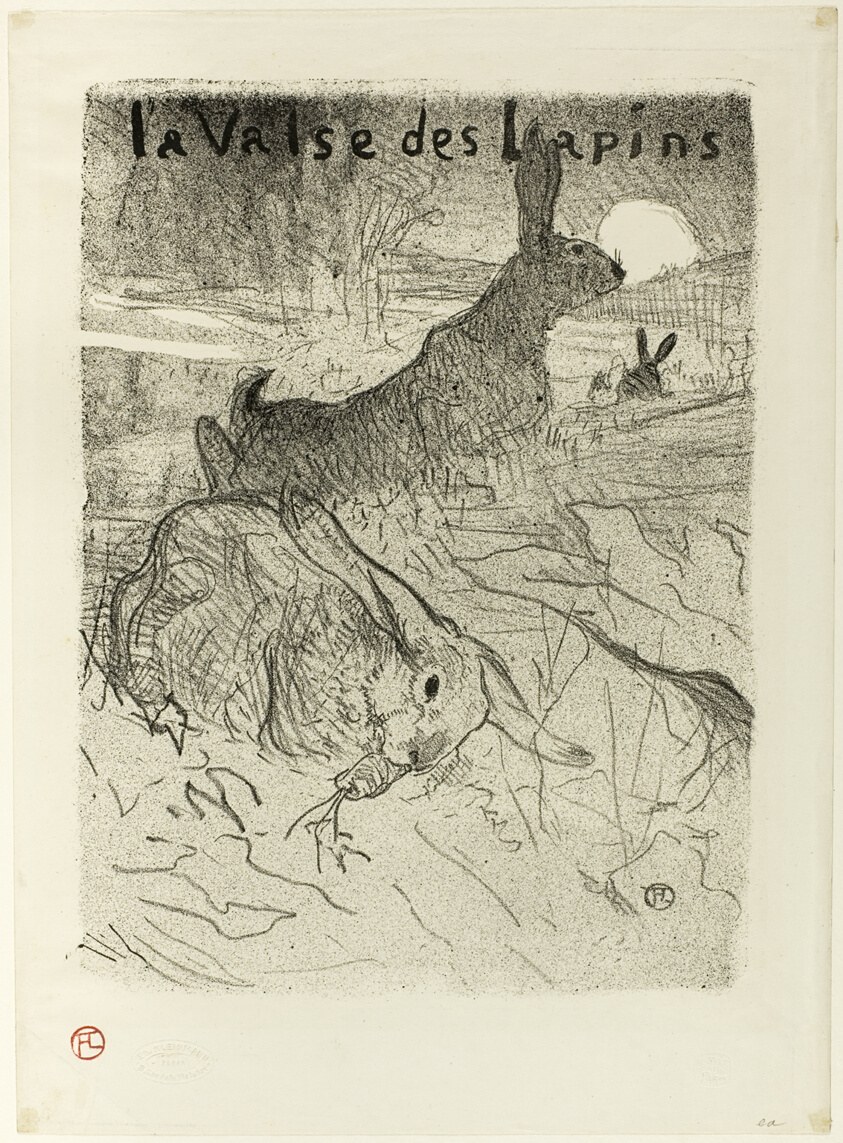
The Rabbits' Waltz
Henri de Toulouse-Lautrec French, 1864-1901
- Medium:
- Lithograph on cream wove paper
- Collection:
- Prints and Drawings
- Source:
- Art Institute of Chicago
- Rights:
- Public domain — free to use, share and adapt.
- Recorded as:
- CC0 (Public Domain)
The work is evidence of how thoroughly the waltz had penetrated late 19th-century European culture: it was so recognizable and so laden with social meaning that an artist could invoke it instantly by depicting it performed by animals. For historians of dance in art, it documents both the visual conventions of ballroom dance in this period and the symbolic weight that the waltz carried.
What you are looking at
A lithograph depicting anthropomorphic rabbits in formal dress engaged in a waltz. The composition centers on a pair of rabbits in the foreground executing the dance: the male figure, rendered with careful cross-hatching to show his fur and formal coat, leads while his partner follows, her body angled into the turn. Their posture suggests the upright carriage and closed frame of late 19th-century ballroom dance. The background is suggested with loose, sketchy linework indicating an interior space—a fence or railing is visible, and a moon or window glows in the upper right. A third rabbit watches from the right side of the composition. The entire scene is executed in Toulouse-Lautrec's characteristic expressionist style, with dense stippling in the shadows contrasting against the cream paper, lending the image both intimacy and a slightly unsettling quality despite its whimsical subject.
The dancing
Two rabbits occupy the primary dancing pair: the leader (left) is solidly built with visible musculature, his body tilted forward into the dance with his arms extended in the closed hold typical of the waltz. His partner responds with a counterbalance, her body following his lead, her silhouette lighter and more delicately rendered. Both figures display the upright posture, turned-out legs, and extended frame expected of ballroom dancers of the period. A third rabbit at right watches with alert posture. The holds and positions are anatomically adapted to the animals' forms but unmistakably ballroom in their geometry.
The dance depicted
This is a waltz, as the title makes explicit. The image captures the moment mid-turn, with the characteristic swaying and rotational motion of the Viennese or Parisian waltz as danced in the 1890s. The work is a satire or fantasy—animals in formal dress performing the height of bourgeois social ritual—but the dance itself is rendered with genuine understanding of ballroom technique. The closed position, the leader's forward momentum, and the follower's counterbalance are all accurate to the period's waltz instruction. This is not a caricature of the dance itself, but rather a witty commentary on ballroom culture through the substitution of animal for human figures.
How it was made
The work is a color lithograph (printed from stone), a reproductive medium that allowed multiple impressions and broad circulation. Toulouse-Lautrec was a master of lithography and used it extensively for poster designs and prints; its grainy surface and ability to capture both bold lines and subtle tonal modulations made it ideal for his expressive, often darkly humorous subjects. The printing process required separation of colors and inking sequences, here resulting in a predominantly black and sepia tonality with the warm cream of the paper providing the highlights. This technique positioned the work for theatrical and commercial audiences rather than collectors of unique works.
About this work
This is a satirical lithograph of the 1890s in which Toulouse-Lautrec reimagines the waltz—the quintessential ballroom dance of European high society—as a performance by anthropomorphic rabbits. The work belongs to a tradition of animal grotesquerie in art and a long history of using animals to comment on human folly and pretension. Yet the dance itself is rendered with technical accuracy and a certain tenderness: the artist understands the waltz and respects its formal properties even as he evacuates its pretension by placing it in the mouths of animals.
For dance historians, the image documents how the waltz was performed and understood at the fin de siècle—the upright carriage, the closed hold, the turning motion—while also revealing how ballroom dance functioned in the cultural imagination as a marker of bourgeois respectability. The choice to satirize the waltz specifically (rather than, say, a folk dance) tells us that it was the dominant social dance of the Parisian leisure class that Toulouse-Lautrec moved among and frequently mocked.
How to look at it
Observe the moment the artist has frozen: not a single turn but the swaying motion mid-waltz, with the figures in counterbalance and the leader's body tilted forward into the turn. This captures the essential geometry of the waltz—the closed frame, the rotational momentum, the leader's and follower's complementary angles—and demonstrates that the artist understood the dance technically. Notice also the rendering: the leader's fur and coat are rendered with dense cross-hatching that gives him solidity and weight, while the follower is rendered more lightly, with less modeling. This is a deliberate choice in how the sexes are visually differentiated. The satire operates at the level of subject (animals waltzing) rather than the depiction of the dance itself, which is rendered with respect for the form.
The artist
Henri de Toulouse-Lautrec (1864–1901) was a French painter, printmaker, and lithographer best known for his depictions of Parisian nightlife, theatrical performance, and entertainment venues. Born into aristocracy but socially estranged, he found his subjects in the cabarets, dance halls, and circuses of Montmartre, where he was a frequent and acute observer. His work is characterized by bold composition, expressive line, and a mordant wit directed at both the performers and the audiences he depicted. He was a prolific lithographer and helped establish the medium as a fine art form; his prints and posters influenced the development of modern graphic design. The choice to depict rabbits waltzing is entirely consistent with his sardonic sensibility and his interest in performance and ritual.
The period
The waltz had become the dominant ballroom dance across Europe by the 1890s, having gradually displaced older forms like the quadrille. By this period, it was the expected dance of bourgeois courtship, formal balls, and social aspiration. In Paris, the fin de siècle saw a flourishing of entertainment and spectacle—the Moulin Rouge opened in 1889, the year of the Exposition Universelle—and dance was everywhere: in cabarets, music halls, formal balls, and the opera. Toulouse-Lautrec's work of this decade records this world with both affection and critique. The image dates to 1895, a moment when the waltz was at the height of its social prestige but also increasingly the object of artistic satire and caricature. Animal grotesquerie was a long-standing tradition in printmaking and illustration, often used for social commentary; Toulouse-Lautrec here joins that tradition with characteristic economy and wit.
Where it lives
The work is held by the Art Institute of Chicago in its Prints and Drawings collection. It is catalogued as a lithograph on cream wove paper from 1895. Toulouse-Lautrec was highly productive in the lithographic medium, and his prints are widely held in public collections; this work is a relatively modest example of his printmaking practice, neither a grand poster nor a highly finished color lithograph, but rather a single-sheet print likely created for exhibition or sale as a fine art print.
Dance in this work
Questions about this work
Why did Toulouse-Lautrec paint rabbits dancing?
He didn't paint it; this is a lithograph. But the subject reflects his interest in satire and social commentary. By depicting rabbits performing the waltz—the most prestigious ballroom dance of bourgeois society—he created a visual joke about pretension and ritual. The animals allow him to keep a distance from his subject while making his critique clear. The work belongs to a long tradition of using animals to comment on human folly.
Is this waltz accurate, or is it a caricature of how people actually danced?
It is accurate. The posture, the closed hold, the rotational movement, and the counterbalance between the two figures all reflect how the waltz was actually danced in the 1890s. Toulouse-Lautrec demonstrates real knowledge of ballroom technique. The humor comes from the subjects (rabbits) rather than from any distortion of the dance itself.
What is a lithograph and why would an artist use this medium?
Lithography is a printmaking technique based on the principle that oil and water don't mix. An image is drawn on a stone with a greasy crayon, then the stone is wetted and inked; the ink adheres only to the drawn areas. The stone can then be printed many times, making it an economical medium for distributing images widely. Toulouse-Lautrec favored lithography because it allowed bold, expressive lines and subtle tonal effects, and because it reached a broad audience—both commercial posters and fine art prints were possible.
When and where would people have seen this print?
The work was created in 1895, during the height of Toulouse-Lautrec's productive years. It would have been available as a fine art print, likely sold or exhibited through galleries or print dealers in Paris. Unlike his large color posters, which advertised cabarets and entertainment venues, this print was a more modest object—a single-sheet work on cream paper, intended for collectors or enthusiasts of his work. It circulated in the Parisian art world of the fin de siècle.
More dance artwork





