49 works in this view — arrow keys or swipe to move between them.
Dance in Art
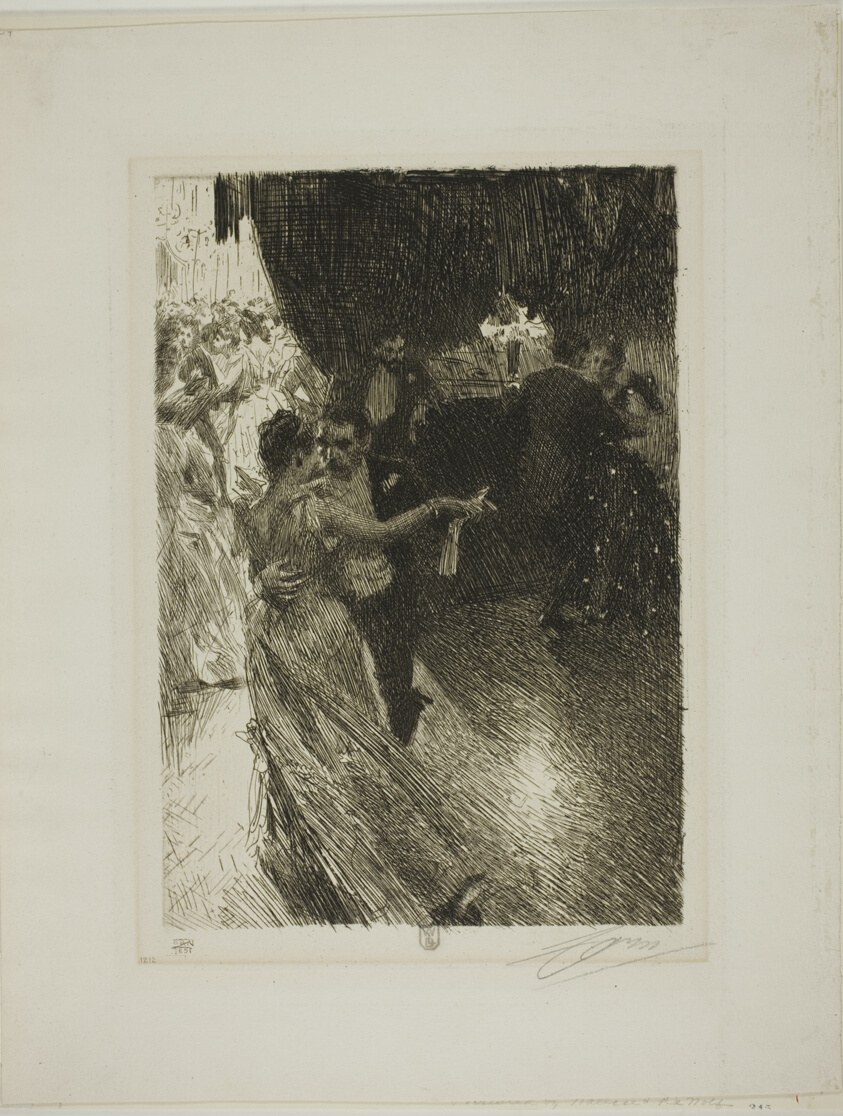
The Waltz
Anders Zorn Swedish, 1860-1920
- Medium:
- Etching on ivory laid paper
- Collection:
- Prints and Drawings
- Source:
- Art Institute of Chicago
- Rights:
- Public domain — free to use, share and adapt.
- Recorded as:
- CC0 (Public Domain)
This is one of the finest artistic documents of late 19th-century ballroom practice: it shows the waltz in its social context, the dress of the period, the ballroom space, and—crucially—the actual bodies and their relative positions. For historians of dance, Zorn's command of the moment of rotation makes visible something often lost in photographs: the quality of weight and momentum. For viewers encountering the waltz today, this print shows why the dance was considered both elegant and transgressive.
What you are looking at
A waltz in progress in an interior space lit by strong overhead light. Two couples occupy the floor: in the foreground, a man in dark formal dress clasps a woman in a light gown with her arm raised; behind them, a second couple dances deeper into shadow. The architecture suggests a ballroom or assembly hall—tall walls and what may be a doorway or alcove on the left. The artist has used dense cross-hatching to create dramatic contrasts between the brightly lit figures and the dark, almost impenetrable space surrounding them, giving the scene an intimate yet theatrical quality. The composition is tightly framed and vertical, emphasizing the height of the room and the formality of the occasion.
The dancing
The foreground couple holds in what appears to be the closed ballroom position standard to the waltz: the man's right hand at the woman's back, her left hand on his shoulder, and their free hands joined. Both bodies lean slightly into the turn. The woman's weight is poised on the balls of her feet, and her skirts—substantial and voluminous—swirl around her legs, caught in the moment of rotation. The second couple behind them mirrors this hold and frame, though their forms dissolve into shadow. All four dancers appear to be in mid-rotation through a waltz turn.
The dance depicted
This is unambiguously a waltz, almost certainly the Viennese or Vienna Waltz that dominated fashionable European ballrooms from the late 18th century onward. The title confirms it; the period dress, the ballroom setting, the closed position, and the rotational movement all match the conventions of the ballroom waltz as danced by the European aristocracy and upper middle class in the 1890s. The artist has chosen to show the turning action at its peak—the moment of maximum sweep and visibility of the woman's skirts—which was the moment that made the waltz both thrilling and, to conservative critics, dangerously intimate.
How it was made
This is an etching on laid paper—a printmaking technique in which the artist draws directly into an acid-resistant ground on a copper plate with a needle, then uses acid to bite lines into the metal. The technique allows for precise linear control and can produce fine detail, but Zorn uses it here expressively, with vigorous cross-hatching and areas of dense parallel lines that create bold contrasts rather than subtle gradation. Etchings are printed in editions and circulated widely, making this a work intended for multiple viewers and likely reproduced in portfolios or periodicals for collectors and art audiences.
About this work
Anders Zorn's *The Waltz* is a print capturing a moment of social dance in a ballroom interior, almost certainly based on observation of Scandinavian or European high society in the 1890s. Zorn was known for his penetrating social scenes and his mastery of light and movement; this work demonstrates both. The waltz itself was by 1891 no longer scandalous but was still the dominant form of fashionable ballroom dancing, and this image preserves something of its appeal: the formal discipline, the intimate proximity of the partners, the spiral momentum of the turn. The work belongs in a gallery of dance imagery because it captures not just the steps or the costume, but the *feeling* of the waltz—the speed, the light-headedness of rotation, the visibility of the female dancer's body in motion.
How to look at it
Look first at the woman's skirts: the artist has caught them mid-swirl, their volume and curve telling you the speed and direction of the rotation. Then trace the couple's frame—the geometry of their connection and the angle of their bodies—which shows you that this is a standard closed position, not a figure being led passively but an active partnership. Notice how the artist uses light and dark: the foreground couple is almost entirely visible, but the second couple behind them dissolves into hatched shadow, suggesting the depth of the ballroom and the continuity of the dance across space. Finally, observe the artist's hand: the energy of the line work, especially in the skirts and the background, conveys movement and urgency that a more careful, finished technique might lose.
The artist
Anders Zorn (1860–1920) was a Swedish painter, sculptor, and printmaker of international reputation. He was trained in conventional academic drawing but became known for his rapid, assured line work and his ability to capture figures in motion with a few sure marks. He worked extensively as a society portraitist and in the 1890s and early 1900s produced many etchings of contemporary life, often focusing on leisure, bathing, and social gatherings. His approach to printmaking was intuitive and direct—he favoured the needle's immediacy over careful planning—and this suited his interest in capturing fleeting moments of social life.
The period
In 1891, when this etching was made, the Viennese waltz was nearly a century old but remained the staple of fashionable ballroom dancing across Europe. It had lost its air of scandal—that belonged to the 1820s–30s—and had become the mark of correct upper-class sociability. At the same time, new dances from the Americas and the colonies (the cakewalk, proto-jazz forms) were beginning to appear in cabarets and music halls, creating a two-tier dance culture: the ballroom waltz for respectable society, and ragtime and syncopated dances for entertainment and lower-class venues. Zorn's choice to depict the waltz in a formal interior suggests he saw it as the exemplary dance of his world. In the visual arts, the 1890s saw intense interest in capturing movement—Eadweard Muybridge's photographic studies had been published in the 1880s, and artists were experimenting with how to represent motion in still images.
Where it lives
The work is held in the Prints and Drawings collection at the Art Institute of Chicago. It is catalogued as an etching on ivory laid paper, which was a standard support for fine prints of the period.
Dance in this work
Questions about this work
Why are the woman and man so close together?
That was the waltz position—the defining feature of the dance. By 18th-century standards, the closed position (with the man's hand on the woman's back) was shockingly intimate, and some people called it indecent. By 1891, it was simply normal. But Zorn captures why it had been controversial: the proximity and the physical contact required between partners were unprecedented in ballroom dancing.
Who danced the waltz in 1891?
The aristocracy and upper middle class—anyone of respectable social standing who attended balls, assemblies, and formal dances. It was *the* dance of polite society. The working classes had their own dances and gathering places, but the waltz belonged to the world of formal dress, ballrooms, and social introduction.
Is this a real scene or invented?
We do not know whether Zorn drew this from a specific ball or assembled it from observation and memory. What matters is that every element—the dress, the position, the ballroom setting, the light—corresponds to how waltzes were actually danced. This is a convincing historical document whether or not it depicts a particular evening.
What is an etching and why did the artist choose it?
An etching is made by drawing into a copper plate with a needle, then using acid to bite the lines into the metal. It allows for fine, expressive line work and can be printed in editions. Zorn chose etching because it was fast, allowed him to work directly from observation or memory, and produced prints that could be sold or circulated to other artists and collectors.
More dance artwork





