49 works in this view — arrow keys or swipe to move between them.
Dance in Art
Spain: Flamenco Dancers
Inge Morath American, born Austria, 1923–2002
- Medium:
- Gelatin silver print
- Collection:
- Photography and Media
- Source:
- Art Institute of Chicago
- Rights:
- Rights reserved by the holding institution — do not reuse without permission. Source record ↗
- Recorded as:
- AIC — rights reserved
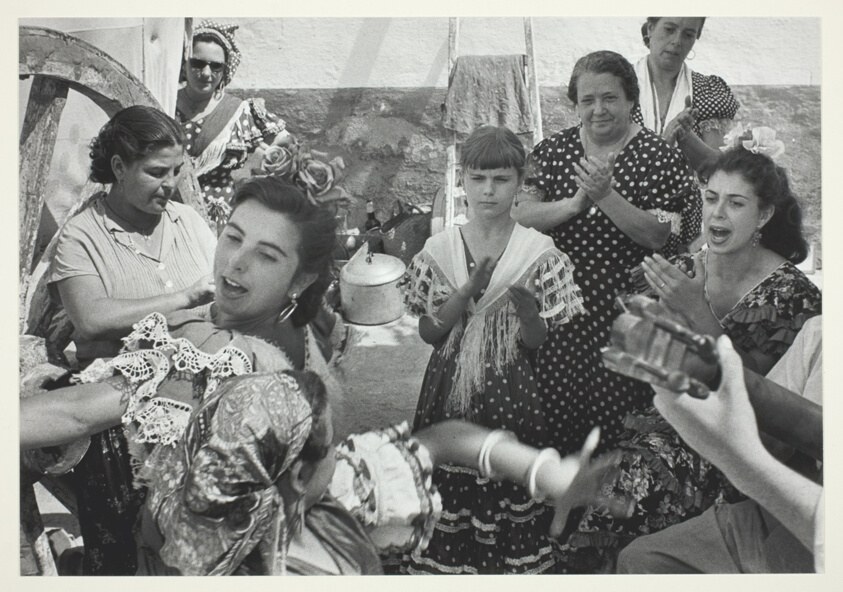
This photograph documents flamenco as living practice rather than stage art, capturing women and children in spontaneous community celebration. It provides rare visual evidence of how flamenco was actually danced and experienced in village life during the 1940s, outside concert halls or formal contexts. For historians of dance and culture, it offers a crucial counter-archive to the famous solo performers and theatrical versions that dominate the historical record.
What you are looking at
A black-and-white photograph captures an animated group of women gathered outdoors in what appears to be a rural or village setting, with rough stone walls visible in the background. The women are arranged in a loose circle, their bodies animated and in motion. At the center, a woman in a patterned dress with elaborate white lace collar detail and dark polka-dot fabric is captured mid-expression, her face animated and mouth open as if singing or calling out. To her right stands a younger boy in light-colored clothing. The other women surrounding them wear printed dresses typical of the 1940s, and several have their hands raised or extended in gestures of participation. The lighting is natural and bright, casting clear shadows and emphasizing the spontaneity of the moment. A metal pot sits visible on the ground, suggesting a domestic or communal gathering. The overall composition conveys energy, participation, and what appears to be folk celebration or musical performance.
The dancing
The figures are arranged informally rather than in formal dance positions, standing and moving within a loose circular formation. Several women have raised arms and open, expressive faces. The central woman's pose—mouth open, face animated—suggests vocalization or call-and-response rather than purely instrumental dance. There is no closed partnering hold visible; instead, the grouping suggests circle dancing or participatory folk gathering. The body positions and arm extensions are relaxed and organic rather than codified or technically precise, consistent with community or vernacular dance practice.
The dance depicted
This appears to document flamenco or Spanish folk celebration, most likely Sevillanas or another participatory folk dance tradition rather than concert flamenco. The outdoor village setting, the domestic gathering, the women's animated expressions and raised arms, and the apparent call-and-response or vocal element are consistent with community fiesta or celebration dancing. The photograph captures vernacular practice—the dance as lived and social—rather than staged performance. The style visible is informal circle or group participation rather than the solo or partnered showcase positions of theatrical flamenco.
How it was made
This is a gelatin silver print, a photographic medium that was the standard for documentary and journalistic work from the 1930s through 1960s. The clarity of detail, the natural light, and the spontaneous framing suggest this was taken during an actual gathering rather than posed in a studio. Gelatin silver prints allowed photographers like Morath to capture unguarded moments and bring documentary credibility to their images; the medium itself became associated with photojournalism and social documentation. The accessibility of this medium meant such images could be reproduced widely in newspapers, magazines, and exhibitions.
About this work
This photograph by Inge Morath documents a moment of Spanish folk celebration, likely from the 1940s, capturing the lived practice of flamenco or related folk dance traditions in a village setting. Rather than the formal postures of concert flamenco, it shows community participants—women and children—gathered in spontaneous celebration, with vocal and physical expression taking priority over technical display. The work sits within a documentary photography tradition that valued authentic cultural capture and social witness.
The image is valuable because it records flamenco not as theater but as social practice: the dance as embedded in everyday life, as participatory and multigenerational, and as inseparable from music and vocalization. Morath's framing emphasizes the informal, egalitarian nature of community dancing, in contrast to the professionalized and individualized versions more commonly photographed or preserved.
How to look at it
Notice the informality of the gathering—there is no stage, no spotlight, no formal costumes or makeup. The central woman's open mouth and animated face suggest that singing or vocalization is as important as footwork; flamenco is a vocal and musical practice, not a silent dance. Observe the loose circular formation and the lack of formal partnering; this is participatory circle dancing, not showcase performance. Pay attention to how the younger generation (the boy) is integrated into the adult activity, suggesting flamenco as a social and familial transmission. The casual stance and relaxed arm positions—quite different from the controlled, articulate positions of theatrical flamenco—show how differently the dance was held and moved in vernacular practice.
The artist
Inge Morath (1923–2002) was an Austrian-American photographer and photojournalist known for her humanistic approach to documentary photography. She worked extensively in Europe and beyond, documenting daily life, cultural practices, and social conditions. Her photographs often centered on women, children, and ordinary moments of community life, approaching her subjects with empathy and visual sophistication. Morath was committed to capturing authentic cultural practice rather than staged or exoticized versions, and she worked across magazine journalism, exhibition photography, and book projects throughout her long career.
The period
In the 1940s, flamenco was undergoing significant shifts. The Spanish Civil War (1936–1939) and Franco's dictatorship had profoundly disrupted cultural life, and the postwar period saw both repression and, paradoxically, state-sponsored valorization of 'authentic' Spanish culture. Documentary photographers of this era were increasingly interested in capturing folk traditions before modernization erased them—a preservationist impulse that shaped how traditional cultures were photographed and presented. Simultaneously, flamenco was beginning its gradual shift from primarily participatory village practice toward professionalized concert performance, making photographs of community flamenco increasingly historically significant as records of disappearing social forms.
Where it lives
This is a gelatin silver print from the collection of the Art Institute of Chicago's Photography and Media department. The work is catalogued as a documentary photograph from Morath's travels in Spain in the 1940s.
Dance in this work
Questions about this work
Is this flamenco dancing?
Most likely, yes—the Spanish village setting, the women's animated expressions, the raised arms, and the apparent vocalization are all consistent with flamenco or related Spanish folk traditions. However, this is vernacular, community flamenco rather than the concert style most people know. It shows flamenco as participatory social practice rather than theatrical performance.
Why does this look so different from flamenco I've seen performed?
Concert flamenco privileges technical display, formalized positions, and often solo performance. This photograph captures community dance—looser, more participatory, integrated with everyday life and family. The dance looks less 'finished' because it is not staged or refined for an audience.
Who was Inge Morath?
An Austrian-American photographer and photojournalist (1923–2002) known for humanistic documentary work. She photographed across Europe and the Middle East, with a particular interest in capturing daily life, cultural practices, and ordinary people's experiences. She was committed to authentic documentation rather than exotic or sensationalized representation.
What is a gelatin silver print?
The standard photographic printing process used from the 1870s through the late twentieth century. Silver halide crystals suspended in gelatin create the image. It was the dominant medium for photojournalism and documentary photography, allowing clear detail and good reproducibility for publication in newspapers and magazines.
More dance artwork





