49 works in this view — arrow keys or swipe to move between them.
Dance in Art
Dancer
Valerio Adami Italian, born 1935
- Medium:
- Color etching and aquatint in red, orange, pink, black, and green on white wove paper
- Collection:
- Prints and Drawings
- Source:
- Art Institute of Chicago
- Rights:
- Rights reserved by the holding institution — do not reuse without permission. Source record ↗
- Recorded as:
- AIC — rights reserved
The work documents a moment when visual artists saw in dance not a subject to document but a formal problem to investigate—how to represent motion, weight, and bodily presence using the tools of abstraction and printmaking. For dancers and choreographers of that generation, it suggests how their movement language was being understood and valued by the visual arts world.
What you are looking at
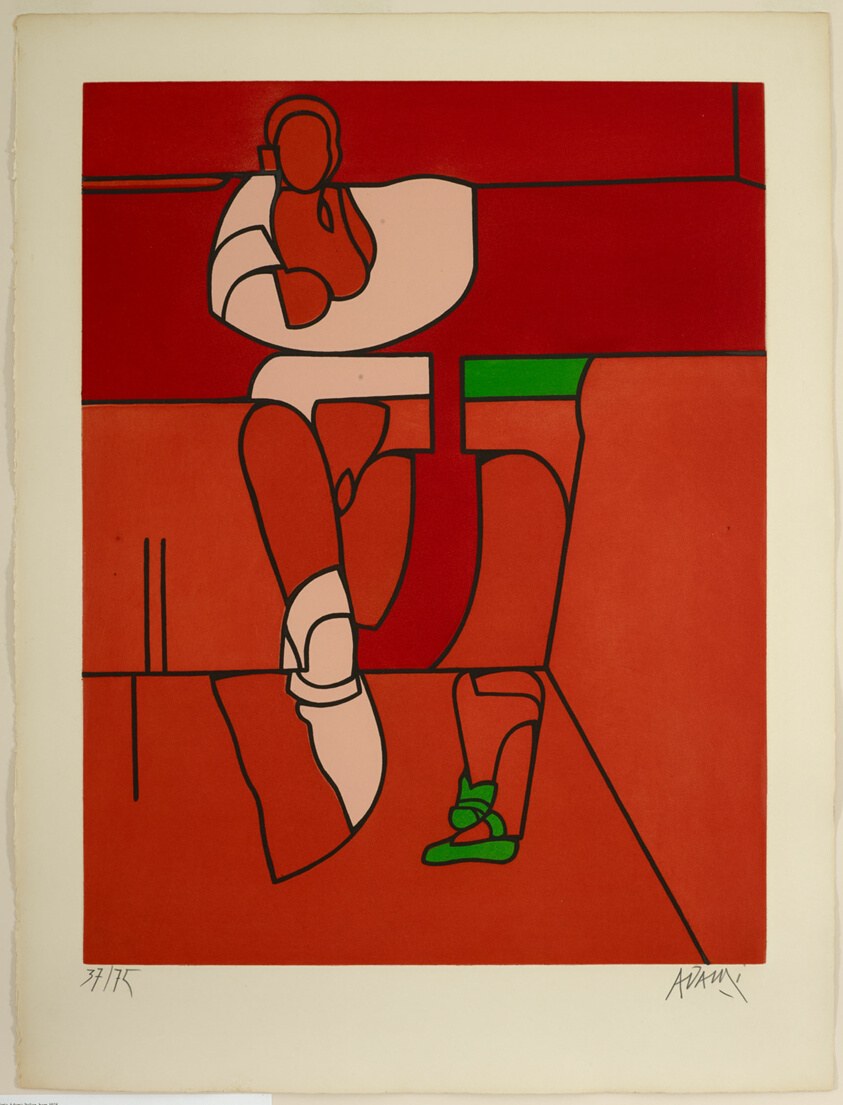
A stylized figure in dynamic motion dominates this composition, rendered in bold outlines against a geometric field of red and orange rectangles. The dancer is shown in a fragmentary, abstracted manner across three horizontal registers: the upper torso with raised arm appears at top; the torso and legs occupy the middle and lower zones. The body is articulated with thick black contour lines that segment the anatomy into discrete parts, as if showing movement through sequential positions or multiple exposures. Flesh tones contrast sharply with the warm background. Two small areas of green—one near the waist, one at the foot—puncture the predominantly red palette. The composition reads as simultaneously static and in flux: the geometric grid of the background suggests a structured, almost architectural space, while the abstracted figure conveys urgent physical energy.
The dancing
A single dancer, shown in fragmented view across the vertical field. The upper body tilts with one arm extended and raised; the legs are splayed in a wide stride or lunge. The segmented rendering makes it impossible to determine a unified hold or frame, but the posture suggests an open, expansive movement with weight distributed asymmetrically. The black outlines are heavy and decisive, emphasizing the skeleton of the pose rather than graceful line. No pointe work, no turned-out legs in classical alignment—the stance reads as modern, grounded, or deliberately crude.
The dance depicted
The work does not represent any identifiable historical dance style or technique. The abstraction and fragmentation suggest the artist's interest in capturing movement itself—the energy and geometry of the body in space—rather than documenting a specific dance form. The figure's wide, low stance and asymmetrical weight distribution suggest modern or contemporary dance vocabularies, or possibly the somatic exploration of the early-to-mid twentieth century. Without narrative, costume, or setting cues, it functions as an essay in how line and color can signify bodily motion.
How it was made
Color etching and aquatint on wove paper. Aquatint's particular strength is the creation of flat fields of solid color with crisp boundaries—here exploited to make the geometric red and orange planes read as hard and architectural. The color etching allows multiple passages of pure hue to sit without gradient. The black contour lines were likely drawn in resist or printed separately, creating the bold graphic quality. This is a print made for circulation in multiples; the record indicates edition 37/115, so approximately 115 impressions were produced. The technique enabled Adami to work at scale and in color without the labor of oil painting, and to reach a broader audience.
About this work
This 1973 etching by Valerio Adami presents a single dancer abstracted into geometric and linear components, rendered against a field of color planes that suggest both architectural space and pure pictorial form. The figure is not identifiable as any historical dance; rather, it is a formal investigation of how the moving body can be represented through line, color, and compositional fragmentation. Adami, an Italian painter known for pop and figurative work, translates the dancer's energy into the vocabulary of twentieth-century abstraction and printmaking. The work belongs to a period in which dancers and visual artists were increasingly collaborating and cross-pollinating: the figure's open, exploratory stance aligns with the somatic and postmodern dance experiments of the era, while the graphic treatment reflects contemporary developments in printmaking and color field composition.
How to look at it
Look at how the artist has fragmented the body across the vertical field: the eye travels upward and downward to assemble the figure, mirroring how a viewer might track a moving dancer through space. Notice the weight of the black outlines—they feel urgent and energetic, not delicate. The color planes behind and around the figure do not recede; they compete for attention, making it ambiguous whether the figure is dancing in space or against a flat architectural grid. The posture itself is unfinished: the stride is wide, the balance uncertain. The artist has chosen to freeze not a moment of static repose but one of potential or transition.
The artist
Valerio Adami (born 1935 in Ravenna, Italy) is a painter and printmaker associated with pop art and figurative art movements. He is known for works featuring bold outlines, flattened color fields, and figural subjects rendered with a cool, graphic sensibility. His prints and paintings often feature the human body in isolation or in narrative situations, treated with a mixture of formal rigor and pop culture directness. He has worked extensively in color etching and printmaking, media that allow for the crisp, high-contrast effects seen here.
The period
In the early 1970s, contemporary dance was moving away from both classical ballet and the dominant modern dance vocabularies (Graham, Limón, Horton) toward more experimental, somatic, and conceptual approaches. Artists like Merce Cunningham had established the principle of dance-as-pure-movement independent of music or narrative. Visual artists responded to this shift: printmakers and painters began to engage with the body and motion as formal problems rather than as subject matter for representation. The etching technique itself was enjoying a renaissance among contemporary artists in the 1970s, partly as a reaction against earlier abstraction and partly as a way to merge figuration, color, and graphic boldness.
Where it lives
The work is held in the Prints and Drawings collection of the Art Institute of Chicago, sourced from the institution's acquisition records. It is a color etching and aquatint on white wove paper, printed in an edition of at least 115 impressions; this is impression 37.
Dance in this work
Questions about this work
What dance is this depicting?
No identifiable historical dance style or technique. The work is an abstraction exploring how line and color can represent the moving body, likely influenced by the contemporary and experimental dance practices of the early 1970s rather than any codified technique.
Why is the figure broken into pieces?
The fragmentation is a formal strategy. By showing the body across different registers and as discrete segments outlined in black, Adami creates a tension between movement and stillness, and between the body as anatomy and the body as pure gesture. The viewer must assemble the figure mentally, an act that echoes how we perceive moving bodies in real time.
Why would a painter make this a print rather than a painting?
Printmaking, especially color etching, allowed Adami to work with bold, flat color and crisp graphic lines, and to produce multiple copies for broader circulation. The technique's graphic clarity suits the bold contours and geometric color fields. It also aligned him with contemporary printmaking revival and with artists interested in reaching audiences beyond the exclusive gallery market.
What do the green marks mean?
They are small accents—one appears near the waist, one at the foot. They may denote points of contact or pivot, or they may function simply as chromatic punctuation to break the dominance of red and orange. The work does not provide explicit narrative or symbolic keys, so their meaning remains open.
More dance artwork





