49 works in this view — arrow keys or swipe to move between them.
Dance in Art
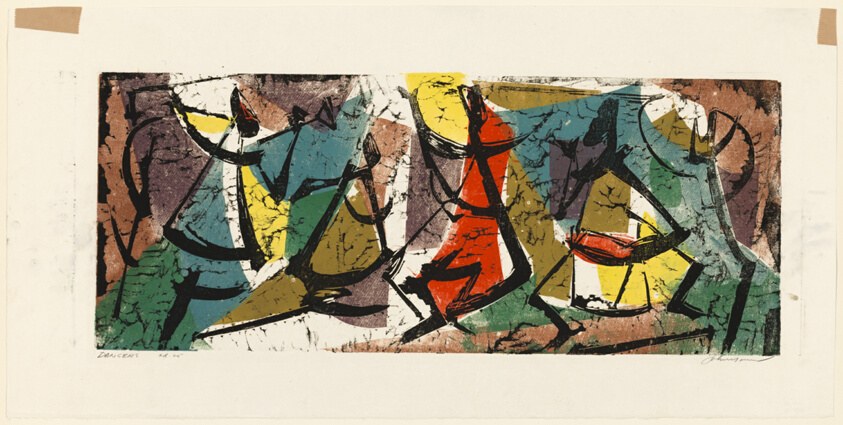
Dancers
John Chin Young American, 1909-1997
- Medium:
- Colored woodcut on white Japanese paper
- Collection:
- Prints and Drawings
- Source:
- Art Institute of Chicago
- Rights:
- Rights reserved by the holding institution — do not reuse without permission. Source record ↗
- Recorded as:
- AIC — rights reserved
For dance historians, this print is valuable evidence of how modernist visual artists perceived and abstracted the contemporary dance body in the early 20th century. It shows dance not as narrative spectacle or technical display but as pure kinetic form worthy of serious artistic study—a conviction that shaped the period's most influential choreographers and artists.
What you are looking at
A dynamic composition of four figures in vigorous movement across a shallow stage space, rendered in bold woodcut technique with areas of flat color—ochre, teal, yellow, red, and forest green—separated by thick black outlines. The figures occupy a compressed, abstracted landscape with angular brown and white forms suggesting architectural or natural setting. The dancers are caught mid-motion: the leftmost figure lunges forward in profile, arms raised in a wide arc; the next two figures are in close proximity with limbs interlocking or nearly touching; the rightmost dancer completes the sequence with a backward-tilting posture and extended arms. All four wear simplified, geometric garments rendered as solid color blocks. The composition reads as a moment of rapid, angular movement—less concerned with anatomical precision than with capturing the kinetic energy and spatial relationships of bodies in dance.
The dancing
The four dancers occupy varied spatial planes and employ asymmetrical, open-frame positions rather than closed partnering holds. Weight appears shifted and dynamic across all figures—no one stands neutral or stable. The leftmost dancer's raised arms and forward lunge suggest extension or reach; the central pair display proximity and possible contact but not locked hold; the rightmost figure's back-tilted frame and extended arms convey momentum or counterbalance. Footwork is abstracted away entirely; the woodcut technique reduces legs to simplified forms. The bodies read as flexible and engaged rather than upright or formal.
The dance depicted
This work depicts modern or contemporary theatrical dance rather than a codified ballroom or folk tradition. The angular, asymmetrical postures, the absence of closed partnership, and the sense of spatial play suggest early 20th-century modernist or expressionist dance idiom. The four-figure composition with no obvious leader or hierarchy is consistent with ensemble or group improvisation. The geometric abstraction and emphasis on kinetic thrust over narrative align with the aesthetic of early modernist dance in the 1920s–1930s, when artists were breaking from classical ballet and exploring movement as pure form. The specific identity of this dance cannot be determined from the visual evidence alone, but the style indicates theatrical modernism rather than social dance.
How it was made
This is a colored woodcut (also called woodblock print), a relief printing technique in which different colors are applied to separate carved blocks or to a single block in successive passes. The bold black outlines and flat color fields—characteristic of woodcut—create a bold, graphic quality and suggest the work was designed for circulation as a reproducible print rather than a unique artwork. The technique was favored by modernist artists for its expressive intensity and for its link to avant-garde movements in graphic design. Woodcut naturally flattens form and encourages abstraction, so Young's choice to work in this medium supports and amplifies the anti-naturalistic rendering of the dancers' bodies.
About this work
John Chin Young's 1929 woodcut *Dancers* captures a moment of abstract, modernist movement through the graphic language of the relief print. Four figures in geometric dress engage in dynamic, open-form movement across a compressed stage space, their bodies rendered in bold flat color and heavy black outlines. The work belongs to the international modernist moment of the late 1920s, when artists across painting, printmaking, and dance itself were rejecting academic convention in favor of formal abstraction and kinetic expression. Young's print records not a specific named dance but an aesthetic principle: the idea that movement itself, divorced from narrative or virtuosic display, could be a subject for serious artistic attention.
As a woodcut, the work was conceived for public circulation and speaks to the role of printmaking in disseminating modernist visual ideas. The composition and line suggest familiarity with contemporary dance practice—whether through direct observation, collaboration, or the pervasive influence of modernist dance ideas in artistic circles of the period. The work sits at the intersection of visual modernism and the early modern dance movement, at a moment when artists in different media were finding common cause in the pursuit of essential, non-representational form.
How to look at it
Focus first on the gestures and spatial relationships rather than trying to identify anatomy. Notice how Young uses thick black outline and flat color to create a sense of movement across the page—the eye travels from left to right, pulled by the sequence of poses. Observe the asymmetry: no two dancers occupy the same attitude or plane. The angular, non-balletic positions should cue you that this is not depiction of a social or classical dance form. The geometric abstraction is deliberate; Young is not struggling to depict the body realistically but choosing to render it as pure form in motion. The woodcut's bold, graphic quality reinforces the sense of urgency and modernist experimentation.
The artist
John Chin Young (American, 1909–1997) was a printmaker, painter, and designer active in the mid-20th century. Little detailed biographical information is readily available, but his work suggests engagement with modernist aesthetic principles and printmaking techniques. The 1929 date places this work in the early phase of his career, during a period of intense formal experimentation in American visual arts. Young's choice of woodcut as a medium for this dance subject aligns him with the broader modernist interest in printmaking as a vehicle for avant-garde expression.
The period
The late 1920s were a watershed moment for modernist dance in America and Europe. Martha Graham, Doris Humphrey, and other pioneers were breaking decisively from classical ballet, developing movement vocabularies based on contraction, release, and geometric abstraction. Simultaneously, visual artists—informed by Cubism, Expressionism, and other modernist movements—were increasingly interested in depicting movement and the dancing body. The German Expressionist tradition in particular had developed a visual language for abstracted, emotionally charged movement. Young's 1929 woodcut sits squarely in this moment, when the formal concerns of visual modernism and those of modern dance were converging. Printmaking itself was experiencing a revival as a serious medium for avant-garde expression, particularly in America, where the WPA and other initiatives would soon institutionalize print practice. The bold graphic style and abstraction of Young's composition reflect this artistic moment.
Where it lives
This work is held in the Prints and Drawings collection at the Art Institute of Chicago (AIC). As a print on Japanese paper, it is a reproducible work designed for circulation, though this particular impression is a discrete object within the museum's collection. The choice of Japanese paper reflects the period's admiration for Asian printmaking traditions and their influence on Western modernist practice.
Dance in this work
Questions about this work
Is this depicting a real dance or a made-up one?
The specific identity of the dance cannot be determined from the image alone. What we can see is a style of movement—modern, abstract, non-balletic, ensemble-based—consistent with early modernist theatrical dance of the 1920s–1930s. Young may have been responding to a specific performance or choreographer, or may have been exploring movement as an abstract formal idea. The woodcut medium does not preserve the kind of documentary detail that would nail down a precise identification.
Why is it a woodcut rather than a painting?
Woodcut was a medium of choice for modernist artists because of its graphic boldness and its capacity for reproduction. It allowed the work to circulate beyond a single collector and aligned Young with avant-garde print movements. The technique's inherent flattening and graphic quality suited the formal abstraction he was pursuing. Woodcut also had historical prestige through its association with German Expressionism and Asian art traditions, both influential on modernist practice.
Who danced like this in 1929?
In 1929, Martha Graham was developing her foundational technique, emphasizing contraction, release, and geometric positioning. Doris Humphrey and others were exploring similar territory. The open-frame, asymmetrical postures in Young's composition align more with modernist exploration than with the rigid geometries of the Ballets Russes or the naturalism of classical ballet. It is possible Young was observing or responding to works by pioneering modern dancers, though no direct documentation exists.
More dance artwork





