49 works in this view — arrow keys or swipe to move between them.
Dance in Art
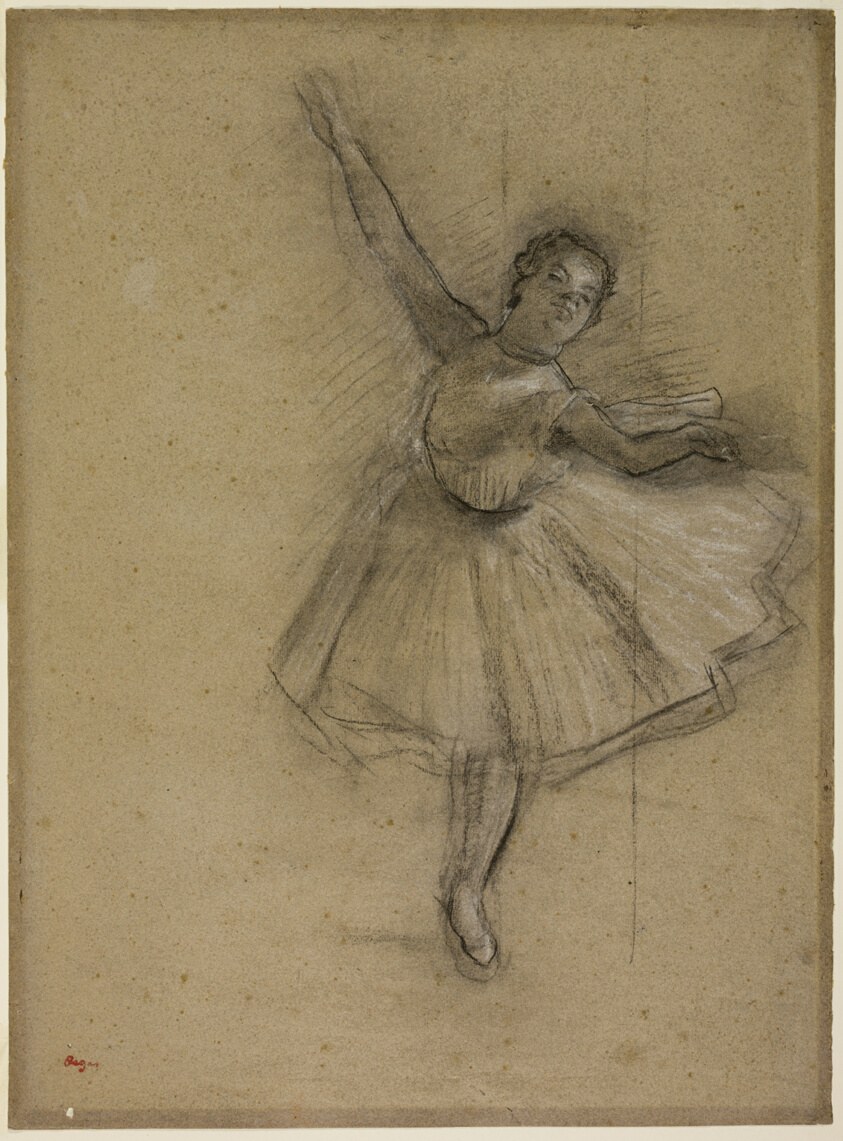
Dancer Turning
Edgar Degas French, 1834-1917
- Medium:
- Charcoal, heightened with white chalk, with stumping, on pinkish-gray laid paper with blue fibers (discolored to brownish-gray)
- Collection:
- Prints and Drawings
- Source:
- Art Institute of Chicago
- Rights:
- Public domain — free to use, share and adapt.
- Recorded as:
- CC0 (Public Domain)
This drawing documents the ballet body at a moment when Romantic and Classical styles were being synthesized and when the female dancer had become the dominant figure in European theatrical dance. For dancers and teachers, it is a record of how a major visual artist understood the technique and the body—what he chose to emphasize, what he omitted, and what moment he found worth fixing in time. For historians, it is evidence of the circulation of ballet imagery and the role of drawing in disseminating and standardizing the ballet aesthetic.
What you are looking at
A single female dancer is captured mid-movement against a plain background, her body angled in a dynamic pose that suggests rotation or turning. She wears a tutu—a short, voluminous skirt rendered in soft charcoal and white chalk with careful attention to its layered structure and the way it catches light as it lifts around her. Her upper body is in a fitted jacket or bodice with visible ribbing or pleating. Her right arm is raised and extended, her left arm lower, framing an off-balance moment of the turn. Her head is tilted back slightly, her gaze directed upward, giving the figure an expression of concentration or abandon. The paper itself, discolored to brownish-gray, is left largely empty around the figure, emphasizing her isolation and the focus on the body in motion. The drawing technique combines precise linear definition with soft stumping and blending, creating volume and three-dimensionality in the fabric while maintaining the immediacy of a sketch.
The dancing
A single dancer poised in or approaching a pirouette, her weight shifted onto what appears to be one supporting leg while the other is lifted. Her arms are positioned to frame a rotational movement—one raised to roughly shoulder height or above, the other lower—suggesting the port de bras typical of ballet technique. Her torso is slightly inclined, her head thrown back in the manner of a dancer spotting through a turn or expressing the emotional quality of the movement. There is no visible pointe shoe detail, though the drawing's scale and technique would not necessarily capture such specifics; the dancer appears to be on or near demi-pointe.
The dance depicted
This is almost certainly a study of ballet, most likely Romantic or Classical ballet technique based on the costume and the moment of movement chosen. The tutu, the formal upper-body alignment, and the turn itself are central to nineteenth-century theatrical ballet vocabulary. The artist has selected a moment of visible effort and off-balance tension—the peak of a turn—rather than a moment of static balance, suggesting both close observation of the live dancer and an interest in capturing the body's struggle against gravity and the demands of technique. The style and composition are consistent with ballet as practiced and taught in Paris in the 1870s.
How it was made
This is a drawing in charcoal and white chalk on discolored laid paper, a technique that allowed rapid capture of movement while preserving fine detail and tonal subtlety. The use of stumping—dragging or blending the charcoal—creates soft transitions and volume, particularly in the tutu and the figure's torso, while linear marks define contours and structure. This hybrid of line and tone is characteristic of academic studio practice and allows the artist to suggest both the dancer's bodily structure and the ephemeral quality of fabric and motion. The technique suggests this was made from life or from close study of a living model, not from imagination.
About this work
This is a studio drawing of a ballerina mid-turn, made in the 1870s when ballet was being intensively documented by artists across Europe. The work captures a moment of technical execution and expressive abandon—the instant of a pirouette when control and release meet. It belongs in a dance archive as evidence of how ballet was understood and valued by visual artists of the period, and as testimony to the centrality of the female dancer's body to nineteenth-century theatrical culture. The drawing is neither a finished exhibition work nor a casual sketch, but rather a study—the kind of work that fed into larger compositions and that served as record and reference within an artist's practice.
How to look at it
Attend first to the moment of the turn: the dancer is not stable or symmetrical, but caught mid-rotation, her balance uncertain, her effort visible. Notice how the artist has used the white chalk not just to define the tutu's form but to suggest the way fabric catches and reflects light as it moves. Look at the head thrown back and the upward gaze—this is a choice about expression and emotion, not just a record of technique. The emptiness of the page around the figure makes the dancer's isolation and focus visible; there is no stage, no audience, no context—only the body and its work.
The artist
Edgar Degas (1834–1917) was a French painter and draftsman who made the ballet his primary subject from the 1860s until his death. He attended rehearsals and performances in Paris, made studies of dancers in classrooms and backstage, and produced hundreds of drawings, pastels, and paintings of ballet subjects. His approach was neither romantic nor sentimental: he was interested in the body in work, in the discipline and mechanics of technique, and in the play of light on fabric and flesh. His drawings served as studies for larger works but also stand as independent records of movement and of the lived experience of being a dancer.
The period
In the 1870s, ballet in Paris was centered on the Opéra and dominated by the Classical technique codified in the early nineteenth century. The tutu had become standardized as the dancer's costume, and the vocabulary of pointe work, turning, and elevated positions was at its height of technical refinement. Simultaneously, Realism and Naturalism were dominant movements in French art, and artists like Degas were seeking to document modern life with unprecedented immediacy and candor. Ballet presented a paradox—it was highly artificial and codified, yet dependent on the apparently effortless virtuosity of living bodies. Degas' drawings capture this tension between artifice and authenticity.
Where it lives
This work is held in the Prints and Drawings collection of the Art Institute of Chicago. It is catalogued as a charcoal and chalk drawing on laid paper, dating to 1871. The collection holds numerous works by Degas, many of which document ballet and theater.
Dance in this work
Questions about this work
Is this a finished work or a study?
It is a study—a drawing made from observation or memory for the artist's own reference and development. It is not signed or dated on the sheet, and while it is highly finished in technique, it served as material for larger compositions rather than as a work intended for exhibition. Drawings like this one were central to Degas' practice: they were his primary means of capturing movement and storing it for later use.
How did Degas get access to dancers to draw?
Degas attended rehearsals and performances at the Paris Opéra and had informal access to rehearsal spaces, where he could sketch dancers in motion and at rest. He also worked from memory and from studies made in the studio. His position as a respected artist and his persistent interest in the subject gave him unusual freedom to observe the working lives of dancers, who were otherwise isolated from public view outside of performance.
What style of ballet is this?
This is Classical ballet as practiced in the 1870s Paris Opéra—the tradition descended from the early nineteenth century and codified in the technique still taught today. The tutu, the use of pointe work (implied), and the vocabulary of the turn are all hallmarks of this style. Degas did not document the newer Romantic ballets of an earlier era, but rather the polished, technical ballet of his own time.
Why is the dancer's head thrown back?
This is consistent with how a dancer would naturally position the head during a spot turn—the head remains fixed on a point until the body has rotated far enough that the head must quickly snap around to find the spot again. It is also an expressive gesture; throwing the head back can suggest surrender, effort, or the emotional quality of the movement. Degas may have emphasized it to convey both the technical reality and the aesthetic intention of the moment.
More dance artwork





