49 works in this view — arrow keys or swipe to move between them.
Dance in Art
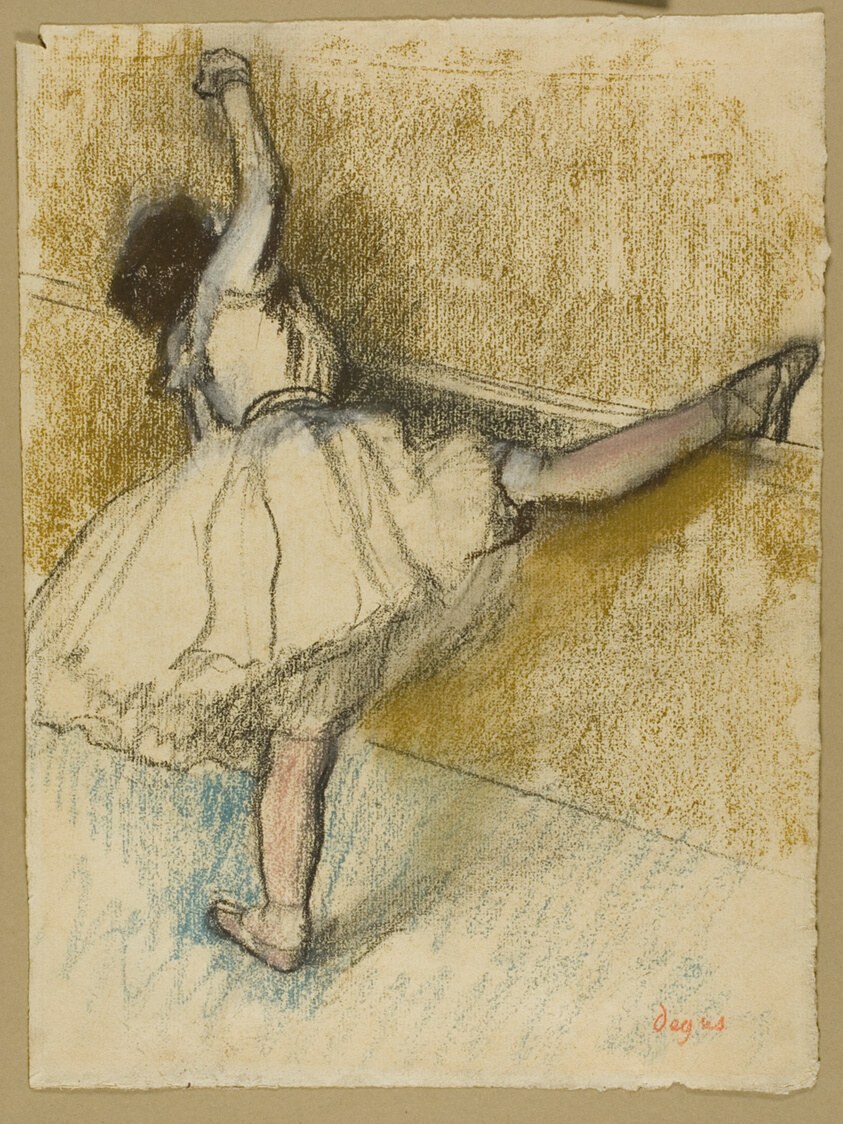
Dancer Stretching at the Bar
Edgar Degas French, 1834-1917
- Medium:
- Pastel with estompe on cream laid paper
- Collection:
- Prints and Drawings
- Source:
- Art Institute of Chicago
- Rights:
- Public domain — free to use, share and adapt.
- Recorded as:
- CC0 (Public Domain)
This image documents the physical vocabulary of ballet training, not performance—a perspective that was relatively novel in the 1870s and that shifts how we understand what dancers actually did. The pastel technique and the focus on the unguarded, unglamorous moment of stretching offer a counterweight to the tutus and stage lighting of contemporary ballet imagery, showing instead the honest, arduous work of the dancer's body. For historians of dance and of labor, it is invaluable evidence of what ballet training looked like at this moment.
What you are looking at
A single female dancer in a light-colored dress is captured mid-stretch at what appears to be a ballet practice barre. She leans back with her torso extended and her left leg raised high and extended behind her, while her right arm reaches upward, the movement suggesting a moment of deep stretching rather than choreography. The background is rendered with loose hatching in warm ochre and pale tones, created with pastel, giving the studio setting an atmospheric, unfinished quality. The floor beneath her is suggested by a darker zone in cool blue-gray, and the overall composition focuses entirely on the solitary figure and her physical extension. The artist has left much of the paper visible, especially in the upper right, creating an intimate, sketch-like quality rather than a fully rendered scene.
The dancing
The dancer's body demonstrates significant flexibility and control. Her standing leg is straight and weighted, supporting her frame as she leans backward into an extended stretch. The raised leg achieves considerable height and extension, suggesting trained flexibility. Her arms frame the movement—one reaching upward while her head tilts back—with the posture suggesting fatigue or deep focus in the work of stretching. The loose, linear quality of the draftsmanship captures the sense of a momentary pose rather than a held ballet position.
The dance depicted
This is a rehearsal study from ballet practice, depicting the kind of daily stretching and conditioning work that sustains a dancer's body. The barre is the central studio apparatus for warming up and developing strength and flexibility. The particular pose—a supported extension backward with the leg lifted—is consistent with barre exercises designed to build turnout, extension, and back flexibility. This work belongs to the training and preparation side of ballet rather than to staged performance, and it shows the artist's interest in capturing the private, unglamorous labor that underpins the spectacle.
How it was made
The work is rendered in pastel with estompe (blending), a technique that allows soft transitions between tones and creates the atmospheric quality visible here. Pastel's capacity for rapid adjustment and its tonal range made it ideal for capturing the subtle modeling of the female figure and the effects of studio light. The paper has been left largely visible, particularly in the upper portion, which is characteristic of pastel studies and sketch work—a working method that allowed artists to explore movement and form without commitment to complete coverage. This suggests a work made from life or from memory of studio observation, circulated within artistic circles rather than exhibited formally.
About this work
This is a pastel study of a ballet dancer at the barre, rendered in the late 1870s by an artist intensely invested in capturing the physical reality of dance training. Rather than depicting a performance or a pointe moment, it shows the unglamorous work of daily practice—the stretching, conditioning, and body maintenance that makes performance possible. The work sits at the intersection of figure study and dance documentation, using the accessible medium of pastel to record a fleeting moment of physical exertion. It belongs to a broader late-19th-century practice of depicting dancers off-stage and in rehearsal, a genre that redefined how art audiences understood dance labor.
How to look at it
Notice the stretch itself—the angle of the body, the height of the leg, the reach of the arm. This is not a position held for aesthetic effect but a deep, active extension, the kind of work that leaves a dancer fatigued. The artist has chosen the moment of maximum extension, the point of deepest work. The loose hatching and visible paper around the figure create a sense of the figure emerging from or dissolving into the studio space, a technique that conveys the ephemeral nature of the moment. The pastel is worked heavily in the figure but left sketchy in the background, inviting the eye to focus on the body's geometry and effort.
The artist
Edgar Degas (1834–1917) was a French painter and printmaker whose practice was centered on the observation of human bodies in motion and at rest. He was obsessed with the ballet, attending rehearsals and making hundreds of studies of dancers in the Paris Opéra. Unlike many of his contemporaries, Degas had privileged access to the dancers' working space and used that access to create works that moved beyond the idealization of performance toward a frank study of the body at work. He explored pastel, charcoal, pencil, and monotype in rapid succession, developing techniques suited to capturing movement and the effects of artificial light in the studio.
The period
In the 1870s, ballet in Paris was undergoing significant change. The Romantic era had faded; classical technique was being codified and intensified. The Paris Opéra Ballet was the center of the dance world, and its dancers—particularly its women—were subjects of intense artistic and popular interest. However, that interest was often voyeuristic and gendered. Degas's choice to depict dancers in rehearsal, stretching, resting, and training—rather than in glamorous performance—was a deliberate reorientation of the gaze. It coincided with the development of photography and with Impressionism's interest in capturing fugitive moments and the effects of light. Pastel, which allowed rapid work and rich color without the finish of oil painting, became a favored medium for artists interested in immediacy and movement.
Where it lives
The work belongs to the Prints and Drawings collection of the Art Institute of Chicago, one of the major holdings of Degas's work on paper. Within that collection, it represents his extensive practice of drawing and pastel study from observation and memory of ballet rehearsal and performance.
Dance in this work
Questions about this work
How do we know this is a real moment from rehearsal and not an invented pose?
We cannot know with certainty, but the work's sketchy technique, the unglamorous nature of the pose, and the consistency of this pose with actual ballet training all suggest it was drawn from observation or memory of studio work rather than from imagination. Degas attended rehearsals regularly and made extensive studies on the spot.
What is the barre and why is it important to ballet?
The barre is a rail, typically wooden and at about waist height, installed along the walls of a ballet studio. Dancers hold it for balance and support while warming up and practicing exercises that build turnout, strength, and flexibility in the hips, legs, and feet. It is the foundation of daily training.
Why did Degas paint dancers so often?
Degas had unusual access to the Paris Opéra and its rehearsal studios, and he was fascinated by the problems of depicting the human figure in motion and in unusual attitudes. Dancers provided him with an ideal subject: bodies trained to hold difficult positions, lit by studio light, and available to study off-stage and unperformed.
Is this a finished work or a study?
It occupies a middle ground. The pastel is worked with care and intention, particularly in the figure, but the composition is not fully resolved and much of the paper is left bare. In Degas's practice, such works were often exhibited and valued as finished pieces, even though they retain the immediacy and incompleteness of studio studies.
More dance artwork





