49 works in this view — arrow keys or swipe to move between them.
Dance in Art
Dancers
Pablo Picasso Spanish, 1881-1973
- Medium:
- Lithograph on ivory wove paper
- Collection:
- Prints and Drawings
- Source:
- Art Institute of Chicago
- Rights:
- Rights reserved by the holding institution — do not reuse without permission. Source record ↗
- Recorded as:
- AIC — rights reserved
This lithograph demonstrates how modernist artists repurposed dance and the dancer as formal subjects rather than as representations of actual performance. The work is significant for anyone studying how abstraction emerged from the classical figure and how the 1950s avant-garde continued to debate the relationship between drawing, sculpture, and bodily movement. Picasso's economical line and disregard for anatomical realism in favor of exploratory gesture prefigure later developments in contemporary dance notation and choreographic scoring.
What you are looking at
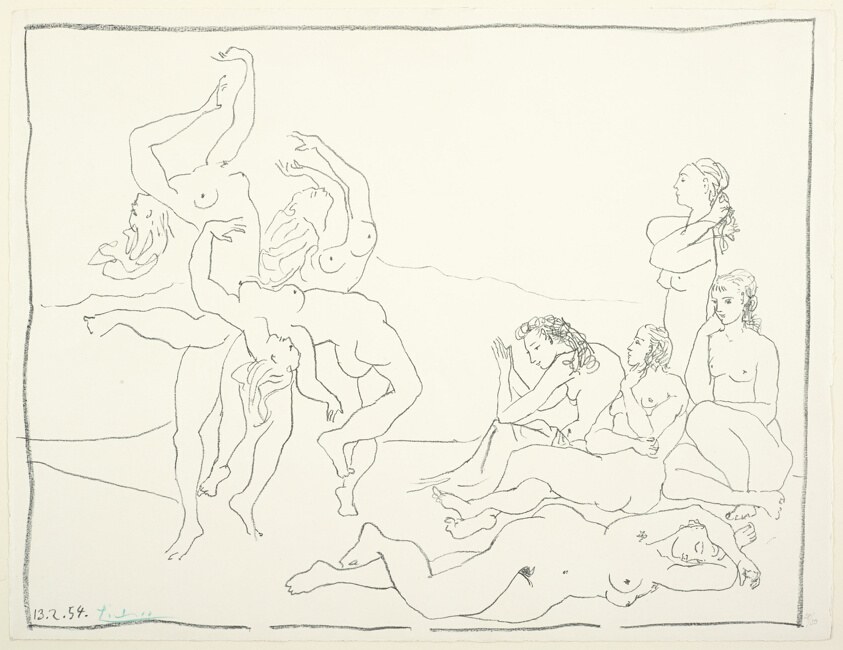
A lithograph presents a dense composition of female nudes arranged across the picture plane in various poses of apparent dance or movement. On the left, a cluster of three or four intertwined figures twist and reach upward in dynamic, nearly acrobatic postures; one woman arches backward dramatically while another raises her arms overhead. The center and right side scatter further figures in seated, reclining, and kneeling positions. The setting is ambiguous—there is a horizon line suggesting an open space, but no architectural frame or clear stage. The women are unclothed except for brief classical drapery or headpieces. The drawing style is economical: Picasso renders the figures in fluid, continuous line with minimal shading, allowing the paper to read as both background and atmosphere. The composition feels less like a narrative scene than an assemblage of sculptural possibilities—a study in the human form in motion rather than a coherent dance event.
The dancing
The bodies are rendered with anatomical precision but in poses that test the limits of classical proportion. Most striking are the twisted, inverted, and hyperextended postures: spines arch, limbs cross and knot, heads tip far back. Several figures appear to be supporting or balancing others, creating a sense of acrobatic or partnered effort. The nearness of the figures to one another—overlapping, sometimes merging into composite forms—creates visual density rather than ballroom distance. Arms and legs reach into space with directional urgency. Weight appears distributed across the page rather than grounded; several bodies seem to float or pivot rather than stand.
The dance depicted
This is not representational dance as it would have been performed on a stage. Rather, Picasso uses dance as a pretext for exploring the female body in motion—a modernist study of movement potential and sculptural form. The twisted, gravity-defying poses suggest acrobatic or gymnastic training rather than any specific choreographic tradition. The composition may reference classical sources (the drapery, the mythological female nudes) or improvisation; without a title specifying a dance form or narrative, the work resists categorical identification. It reads as an investigation into how dance and the plastic arts can overlap—how the dancing body becomes a formal problem rather than a social or theatrical fact.
How it was made
This is a lithograph, a planographic printing process that allows the artist to draw directly onto a stone surface in greasy crayon or ink. Picasso's technique here emphasizes the fluidity of the medium: the lines are continuous, gestural, and confident. Lithography was valued for its ability to capture the artist's hand directly and to permit multiple impressions, making works available to a broader audience than unique paintings or drawings. The relative simplicity of Picasso's line—he does not labor the forms with cross-hatching or tonal subtlety—suits lithography's directness. The work belongs to a tradition of modernist printmaking in which the drawing surface and the printing surface remain visually evident.
About this work
This 1954 lithograph presents a composition of dancing or moving female nudes rendered in Picasso's characteristic fluid line. The figures are interlocked in poses that suggest acrobatic partnering or sculptural exploration rather than ballroom convention or theatrical narrative. The work sits at the intersection of classical figuration and modernist abstraction: the bodies are legible and anatomically informed, but their arrangement privileges formal investigation—spatial density, gestural variety, the problem of representing motion in a static medium—over coherence or story. For audiences interested in how twentieth-century artists engaged with dance, this work exemplifies a distinctly modernist approach: dance not as spectacle or social practice, but as a paradigm for studying the moving body in space.
How to look at it
Attend to the moment Picasso has chosen: not a step or a stationary pose, but the instant of maximum tension or torsion in the body. Notice how the overlapping, interlocking arrangement creates a visual rhythm that moves around the page—there is no single focal point, but rather a sequence of interrelated forms. Observe the contrast between the precision of anatomical rendering (the articulation of joints, the clarity of limbs) and the impossible poses themselves. The classical drapery and headpieces anchor the figures to art-historical tradition, while the twisted spines and weightless gestures push toward modernist invention. The sparse, unmodulated background emphasizes that this is not a stage or landscape, but a field for formal investigation.
The artist
Pablo Picasso (1881–1973) was a Spanish painter, sculptor, printmaker, and ceramicist who fundamentally shaped twentieth-century modernism. He worked across media with restless invention, moving between figuration and abstraction, and between historical and contemporary subjects. Dance was a recurrent theme throughout his career: he designed sets and costumes for the Ballets Russes, depicted dancers and acrobats in paintings and prints, and explored the relationship between static and moving forms. By 1954, when this lithograph was made, Picasso had already moved away from his Cubist fragmentation toward a renewed engagement with classical figuration—albeit still filtered through modernist distortion. His late work maintained this tension between tradition and innovation.
The period
In the 1950s, modernist artists and theorists were reconsidering the classical nude figure after decades of abstraction and expressionism. There was renewed interest in drawing, in gesture, and in the relationship between the plastic arts and performance. Dance, particularly as represented in printmaking and drawing, offered artists a way to explore movement and the body without committing to pure abstraction. This period also saw the emergence of American Abstract Expressionism and the continued influence of European modernism. Lithography experienced a renaissance as an artistic medium in mid-century Europe, valued for its directness and its capacity to reach audiences beyond the gallery. Picasso's engagement with lithography in the 1950s was part of this broader revival.
Where it lives
This lithograph is held in the Art Institute of Chicago's Prints and Drawings collection. The work is part of the museum's holdings of twentieth-century European printmaking and reflects the period's widespread adoption of lithography as a fine-art medium.
Dance in this work
Questions about this work
Is this a specific dance Picasso was watching?
Not necessarily. The poses are often impossible for a real dancer to hold, and there is no narrative or theatrical setting. Picasso seems to be using dance and the moving body as a formal subject—exploring how to represent motion and physical exertion through line drawing rather than documenting a particular choreography or performance.
Why are all the figures female nudes?
The female nude was a foundational subject in Western art and a particular fascination throughout Picasso's career. In this work, the unclothed body offers maximum clarity for studying form, gesture, and anatomical detail. The classical references (drapery, mythological associations) connect the composition to Old Master traditions even as modernist treatment of the body pushes against those traditions.
How does lithography affect what we see here?
Lithography allowed Picasso to draw directly and fluidly without the mediation of paint or stone carving. The technique privileges the gestural line and allows for direct, economical mark-making. The ability to print multiple copies made such works accessible to collectors beyond the museum or salon, establishing lithography as a major fine-art medium in the twentieth century.
More dance artwork





