49 works in this view — arrow keys or swipe to move between them.
Dance in Art
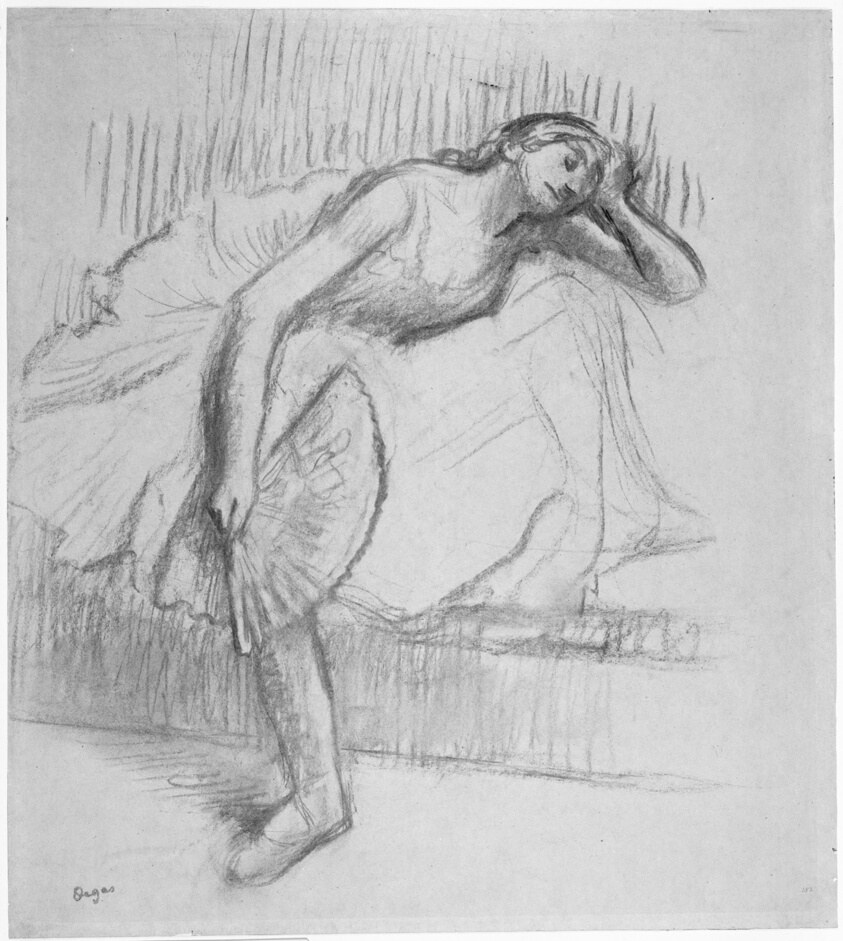
Dancer Resting with a Fan
Edgar Degas French, 1834-1917
- Medium:
- Charcoal with stumping, on tan wove tracing paper, laid down on cream wood-pulp laminate board
- Collection:
- Prints and Drawings
- Source:
- Art Institute of Chicago
- Rights:
- Public domain — free to use, share and adapt.
- Recorded as:
- CC0 (Public Domain)
Degas revolutionized the visual representation of dancers by moving beyond the idealized spectacle to show bodies in unguarded, everyday moments. This drawing demonstrates his sustained interest in the dancer as a subject of artistic investigation, not mere decoration—a perspective that shaped how dancers were understood and valued in art for generations to come. For historians and practitioners, it offers evidence of the physical and professional culture of late-19th-century theatrical dance.
What you are looking at
A young dancer reclines languidly on what appears to be a cushioned seat or divan, her body angled backward in a pose of ease and fatigue. She wears a simple, gossamer garment that drapes loosely around her form. In her right hand, held aloft near her face, she grasps a large fan with prominent ribbing—a practical accessory of the period. Her left arm rests across her body. The setting is rendered minimally: loose, parallel hatching suggests fabric or drapery in the background, while a horizontal line grounds the figure in space. Her head is tilted back in a gesture of rest, chin slightly raised, hair loosely arranged. The drawing technique itself—charcoal with stumping—creates soft gradations of tone that model her body and suggest the textures of fabric around her.
The dancing
A single female figure dominates the composition. Her body is in a reclined, asymmetrical pose: torso arched backward in repose, weight distributed through the seat beneath her. One leg appears extended or folded, the other bent. Her right arm is raised and extended, hand holding the fan near her face in a gesture at once practical and theatrical. The posture suggests exhaustion or deliberate languor rather than active dancing—a body at rest after exertion, or poised between moments of movement. The line quality is fluid and assured, capturing the weight and mallability of flesh.
The dance depicted
This is not a depiction of active dance but of a dancer in repose—a standard subject in late 19th-century French art and literature, especially in the work of Edgar Degas. The fan, simple costume, and reclined pose are consistent with backstage scenes of theatrical ballet or music-hall performance. The resting dancer became a motif that allowed artists to observe the body in unguarded moments, away from the spotlight's formality. Without visible pointe shoes, turned-out positions, or a tutu, it is impossible to specify the precise dance tradition, but the theatrical context is unmistakable.
How it was made
The work is executed in charcoal with stumping on tan wove tracing paper, then laid down on a cream wood-pulp laminate board—a technique that allowed for rapid execution and subtle tonal variation. Charcoal with stumping (where the medium is blended with a tortillon or stump) permits soft, nuanced modeling of form and atmosphere, ideal for capturing flesh, fabric, and mood in quick studies. This technique situates the work as a studio study or preparatory drawing rather than a finished exhibition piece, suggesting it was made for artistic practice or as material for a larger work. The use of tracing paper indicates the artist may have intended to transfer the image, a common practice in Degas's studio.
About this work
This is a charcoal study of a single reclining dancer, rendered in the graceful and unsentimental manner characteristic of Edgar Degas's late-19th-century dance subjects. The work captures not performance but respite—the exhausted or languorous body of a professional dancer resting between rehearsal or show. The minimalist setting and intimate scale suggest a backstage moment, observed without theatrical pretense. It belongs in a dance art collection because it documents both the physical reality of the dancer's body and the culture of Parisian theatrical life at the end of the 19th century, when dance and its practitioners became central subjects for visual artists seeking to depict modern life.
How to look at it
Attend to the posture of exhaustion: the way the body settles into the seat, the arch of the back, the drape of the simple garment. Notice how Degas has chosen a moment of inactivity and repose, yet the body remains eloquent and full of character—the fan held with a kind of gestural grace even as the figure rests. The drawing technique itself rewards close looking: the stumped charcoal creates a surface that is both precise and suggestive, allowing the viewer's eye to complete what the artist has only indicated. The minimal setting prevents any distraction from the figure; everything in the composition directs attention to the dancer's form and the subtle modeling of her body.
The artist
Edgar Degas (1834–1917) was a French Impressionist painter and sculptor who made dancers his signature subject over the last four decades of his career. He attended rehearsals, sketched from the wings, and created hundreds of paintings, pastels, prints, and drawings exploring every angle of the ballet world—performance, practice, exhaustion, and discipline. His interest was neither sentimental nor moralistic but intensely observational; he sought to capture the modern body in motion and repose. He worked across media with remarkable facility, and his drawings, often made as studies or independent works, are marked by assured line and sophisticated tonal control.
The period
In the 1880s and 1890s, ballet was undergoing significant change. The Romantic ballet of the mid-19th century was giving way to new forms, and Paris remained a center of dance innovation and spectacle. The rise of Impressionism and Post-Impressionism shifted artistic attention toward contemporary life, movement, and the effects of light—subjects that made dancers, with their combination of artifice and genuine physical strain, ideal subjects. At the same time, dancers in Paris occupied an ambiguous social position, admired for their art but often regarded with suspicion. Degas's unflinching depictions helped legitimize them as serious subjects for high art, comparable to history or religious painting.
Where it lives
The work is held in the Prints and Drawings collection of the Art Institute of Chicago. It remains part of the museum's permanent collection of works on paper, a category that includes studies, preparatory works, and finished drawings by major artists. As a charcoal drawing on paper, it represents the type of intimate, studio-based work that was often kept by artists and collectors rather than exhibited publicly during the artist's lifetime.
Dance in this work
Questions about this work
Is this a finished work or a study?
It appears to be a complete work in its own right, though executed with the spontaneity and economy of a studio drawing. Degas often did not distinguish sharply between studies and finished works; his drawings were valued as independent artistic statements. The technique—charcoal with stumping—was well-suited to exhibition and collection, and this piece was treated as a finished work when acquired by the museum.
Why did Degas draw dancers so obsessively?
Degas was fascinated by the human body in motion, the effects of artificial light on form, and the underlying discipline and exhaustion of professional performance. Dancers also embodied modernity—contemporary subjects that allowed him to explore color, composition, and movement in ways historical or religious subjects could not. His extensive studies reveal a commitment to understanding the mechanics and culture of dance as deeply as any historian or practitioner.
What kind of dancer is this, and what is she wearing?
Without visible pointe shoes or a tutu, it is difficult to specify the exact dance tradition depicted. The simple, loose garment and theatrical setting suggest a professional performer, likely from Paris's ballet or music-hall world. The costume could indicate rehearsal dress, a dressing-room scene, or the simplified garments of certain theatrical traditions of the period.
What does the fan tell us?
The fan is both a practical accessory—useful for cooling in warm theaters and dressing rooms—and a prop with theatrical and social significance. Its prominence in the composition suggests it was important to the artist's vision, perhaps as a marker of the figure's gender, status, and the artifice of performance. For Degas, such accessories often anchored his figures in a specific social and historical moment.
More dance artwork





