49 works in this view — arrow keys or swipe to move between them.
Dance in Art
Dancer
Gino Severini Italian, 1883-1966
- Medium:
- Charcoal, with stumping on tan wove paper
- Collection:
- Prints and Drawings
- Source:
- Art Institute of Chicago
- Rights:
- Rights reserved by the holding institution — do not reuse without permission. Source record ↗
- Recorded as:
- AIC — rights reserved
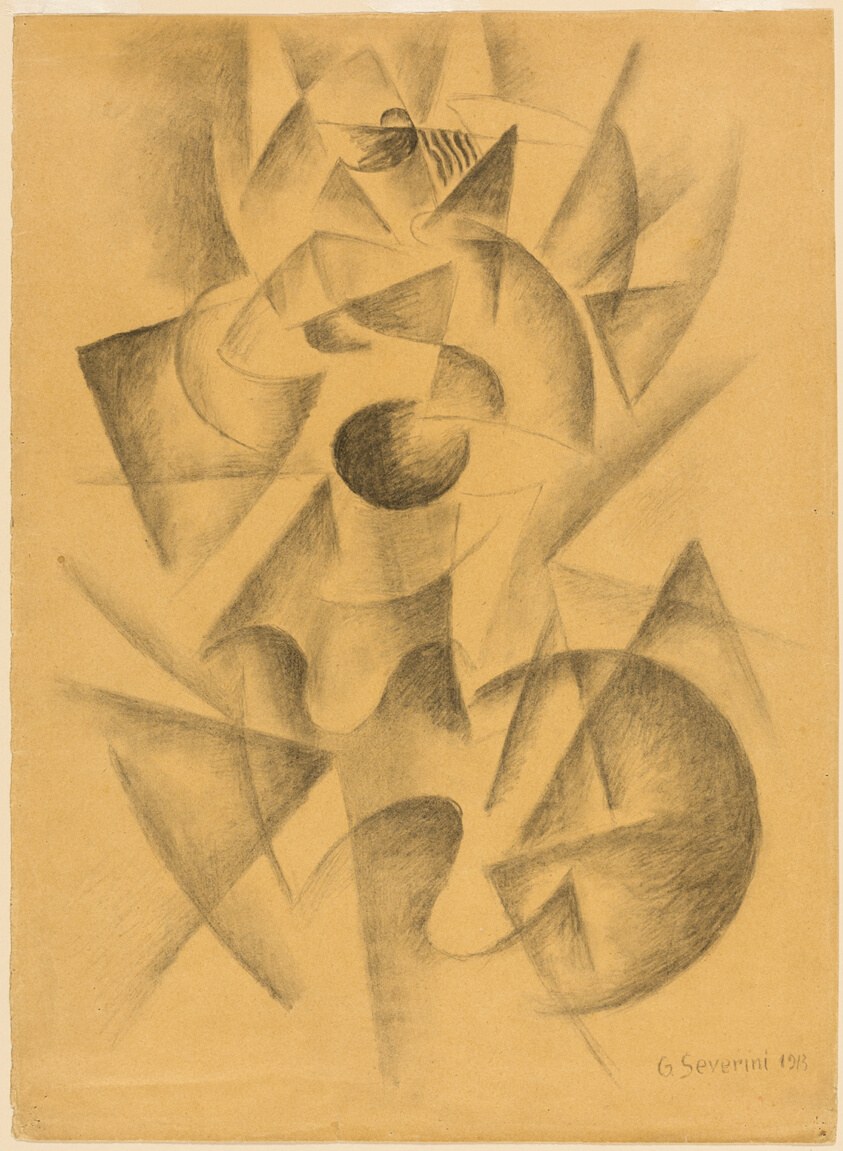
This drawing documents a crucial moment in early modernism when avant-garde artists—particularly Futurists—turned to dance and the human body as primary subjects for exploring how art could represent movement and time. Severini's geometric dissection of the dancer prefigures later 20th-century abstraction and testifies to the influence of both Cubism and Futurism on how the dancing figure was understood and visualized. For dancers and historians, it reveals how modernist artists saw the body not as a unified form but as a nexus of forces and planes.
What you are looking at
A single figure dominates this composition, rendered in charcoal with sophisticated stumping that creates soft, sculptural modeling. The dancer is shown in a dynamic, almost explosive pose: the body twists and fragments into angular, interpenetrating planes of light and shadow. The torso appears arched or contracting, with limbs articulated in sharp, geometric facets that suggest movement caught mid-gesture. The figure's musculature is indicated through bold, directional shading that emphasizes weight and momentum. A smaller insect—possibly a bee or fly—appears in the upper portion of the composition, drawn with delicate hatching, creating an unexplained scale relationship or symbolic presence. The background is a warm, uniform tan paper, unmarked and undifferentiated, throwing the modeled figure into relief. The signature "G Severini 1913" is visible in the lower right.
The dancing
A single dancer, their body twisted in a contortion or extreme flexion. The pose is architecturally fragmented into interlocking wedges and curved segments, with particular emphasis on the central torso and pelvis region, which dominates the composition. The limbs are somewhat ambiguous in the play of light—it is unclear whether both arms and legs are represented or if the overlapping planes suggest a single form viewed from multiple angles simultaneously. The weight appears suspended or centrifugal. The modeling suggests muscular tension and balletic extension, though the geometric abstraction obscures traditional dance terminology.
The dance depicted
This work depicts dance in abstract, modernist form rather than as literal representation. The fragmented, Cubist approach dismantles the dancer's body into intersecting planes and passages of light, common to Severini's Futurist investigations of movement and dynamism between 1912–1914. The pose itself suggests classical ballet training—the articulation of the torso, the implied extension—but it has been deconstructed into pure formal gesture. This is not documentation of a step or a recognizable position, but a meditation on how the body moves through space and how that movement might be represented through abstraction. The small insect introduces an element of scale ambiguity or symbolic intrusion that remains unresolved.
How it was made
Charcoal on tan wove paper with stumping—the blending of charcoal with a stump or cloth to achieve soft tonal transitions and volumetric modeling. This technique allows the artist to build form through gradation rather than line, and the warm paper serves as an active middle tone, allowing both dark accents and reserved highlights. The stumping creates a painterly, almost sculptural quality despite the drawing medium. This is a study or independent work of the kind that circulated in avant-garde circles and galleries, reproduced through photography or collected by museums of modern art seeking to document early 20th-century innovation.
About this work
This charcoal drawing by Gino Severini, dated 1913, abstracts the dancing body into Cubist and Futurist form. Rather than depicting a recognizable step or pose, it deconstructs the dancer's musculature and weight into interpenetrating geometric planes, rendering movement itself as a problem of form and space. Severini, an Italian Futurist, was deeply invested in capturing dynamism and the sensation of motion through fragmentation and multiple viewpoints—approaches he applied to many subjects between 1911 and 1915. This work belongs to the intersection of dance, modernism, and kinetic theory, where the body becomes an instrument for exploring how visual art might represent intangible, temporal experience.
How to look at it
Attend to the way the figure twists and fragments rather than flowing. The artist has chosen a moment of maximum torsion or contraction, rendered not as a silhouette but as intersecting planes of musculature and shadow. Notice how the darker zones suggest weight and mass, while the lighter areas read as extension or hollow space. The small insect in the upper portion should intrigue you—it creates an unexplained relationship of scale and seems to float outside the logic of the composition, possibly a symbol or a deliberate disruption. Step back and squint: the figure resolves into a sense of rotation and energy that is nearly abstract.
The artist
Gino Severini (1883–1966) was an Italian Futurist painter and sculptor central to early European modernism. Based in Paris from 1906, he was a signatory of the Futurist Manifesto (1909) and dedicated much of his early career to representing speed, dynamism, and the sensation of modern life. He was particularly drawn to dance as a subject—works like 'Dynamic Hieroglyph of the Bal Tabarin' and 'The Dance of the Pan-Pan at the Monico' explore how the fragmented, overlapping forms of Cubism could capture the energy of the human body in motion. His charcoal studies from 1912–1914 represent moments when Futurist theory met direct observation, attempting to visualize how the eye perceives movement as a sequence of overlapping states rather than a single frozen instant.
The period
In 1913, European modernism was at a turning point. Cubism had destabilized the unified perspective and the coherent body; Futurism was celebrating speed, violence, and dynamism as moral and aesthetic virtues. Dance itself was undergoing radical transformation: Diaghilev's Ballets Russes had premiered 'The Rite of Spring' the previous year, scandalizing Paris with its primitive choreography and dissonant score. Modernist artists saw in dance a perfect subject for exploring movement, energy, and the limits of representation. Severini's interest in dance was not incidental—it was a way of thinking about how to represent time, multiplicity, and sensation on a static surface. The charcoal medium, favored for rapid exploration, reflects the sketch-like, investigative character of avant-garde art practice at this moment.
Where it lives
This work belongs to the Prints and Drawings collection of the Art Institute of Chicago. The charcoal and stumping technique and its size suggest it circulated as an independent study or finished drawing suitable for exhibition in avant-garde galleries, rather than as a preparatory sketch for a larger painting.
Dance in this work
Questions about this work
Is this a study for a painting?
Unknown from the image alone. The finish and signature suggest it may be a completed independent work, but Severini often used charcoal studies as a stage in his creative process. The technique and tonality are sophisticated enough to stand as a finished drawing.
What is the insect doing in the composition?
Its purpose is unclear. It may be a symbol of nature intruding into the abstraction of the human form, a mark of scale, or an element of Surrealist or Dada-adjacent disruption. Severini's work does not typically explain such intrusions.
What dance is being depicted?
No specific dance. The abstraction is too advanced to identify a step or style. The work is concerned with representing the sensation of movement and muscular tension rather than documenting a particular technique or tradition.
Why use Cubist fragmentation for a dancer?
Cubism's overlapping planes and multiple viewpoints offered a visual language for representing movement through space and time. For Severini and other Futurists, fragmenting the body showed how motion dissolves unified form into a sequence of overlapping states.
More dance artwork





