49 works in this view — arrow keys or swipe to move between them.
Dance in Art
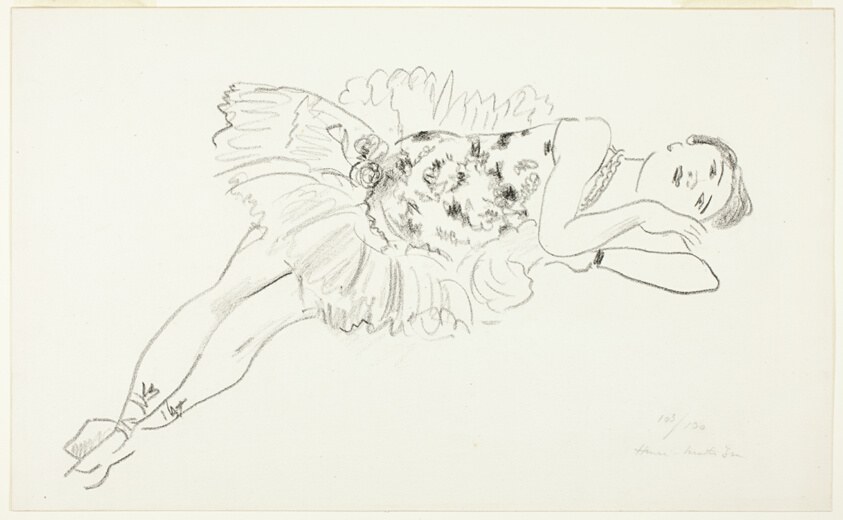
Dancer Reclining, from Ten Dancers
Henri Matisse French, 1869-1954
- Medium:
- Lithograph in black on ivory wove paper
- Collection:
- Prints and Drawings
- Source:
- Art Institute of Chicago
- Rights:
- Rights reserved by the holding institution — do not reuse without permission. Source record ↗
- Recorded as:
- AIC — rights reserved
This work captures a pivotal moment in the representation of dance: the shift from narrative or idealized scenes toward documentary observation of the performer as a working body. It shows Matisse's interest in dance not as a vehicle for abstract form, but as a window onto labor, fashion, and the modern theatrical world. For historians of 1920s Paris dance and for anyone tracking how artists have represented the female dancer's body off-stage, this portfolio remains essential.
What you are looking at
A single female dancer reclines across the composition in a relaxed, almost languid pose that reads as off-stage or intimate rather than performance. She wears a heavily ruffled or gathered costume with voluminous skirts that dominate the image, rendered in bold, scratchy pen lines that suggest movement and texture. Her upper body tilts back with her head resting to one side; one arm reaches across her body while her legs extend in a loose, unstructured position. The artist has emphasized the costume's elaborate decoration—likely feathers, beads, or ornamental trim clustered at the neckline and bodice—through concentrated hatching and shading. The setting is minimal and suggested only by line; the figure floats against a plain background, making the body and dress the sole subject. The drawing technique is sketch-like and economical, yet the composition has clear intention: the reclining pose and costume detail tell us this is a performer between moments, not caught mid-movement.
The dancing
A single dancer, viewed from a three-quarter angle, lies in a supported recline with her spine arched and weight distributed across one hip. Her torso is relaxed, her head dropped back, suggesting exhaustion or ease. The arms are loose and unstudied rather than held in a frame; the legs are splayed without tension or turned-out position. This is an unpracticed, natural body, not one held in the formal alignment of ballet or ballroom. The costume—heavy, gathered, possibly a tutu or skirt with extensive embellishment—reads as professional stage dress, but the body inside it moves or rests without classical discipline.
The dance depicted
The work belongs to the Matisse series *Ten Dancers* (1927), a portfolio of lithographs that documented the Paris theatrical dance world he observed. The costume and the reclining pose suggest this may represent a dancer from the Russian Imperial Ballet or from the fashionable theatrical revues (possibly Ballets Russes-affiliated work) that dominated Paris in the 1920s. However, the image captures not a dance step or position but a moment of rest or backstage fatigue, suggesting Matisse's interest in the dancer as body and labor rather than as performer in action. The abundant costume detail—the ruffles, the ornament—records the excess and spectacle of the era's dance fashion, while the loose body inside resists the usual idealization.
How it was made
This is a lithograph printed in black ink on cream wove paper. The technique permitted Matisse to work with a fluid, responsive line and bold tonal contrasts; the result reads as sketch-like and urgent despite being a finished, printed work. Lithography allowed such portfolios to circulate widely among collectors and museums in the interwar period, making Matisse's observations of Paris dance culture available beyond the theater. The scratchy, searching quality of the line suggests the artist drew directly on the stone, capturing immediate observation rather than a polished, distanced rendering—a key shift in how artists documented dance in the twentieth century.
About this work
This lithograph is one of ten studies Matisse made of Parisian dancers in 1927, a moment when the city's dance world was dominated by the Ballets Russes, revue shows, and the fashionable entertainments of the Jazz Age. Rather than stage the dancer in performance, Matisse chose instead to document her at rest, in the costume that defined her work. The reclining pose and the economy of line—achieved through the medium of lithography—emphasize the body's weight, the fabric's presence, and the labor beneath spectacle. The work belongs to a broader interwar conversation about modernism and the body, shared with photographers like Man Ray and dancers' own documentarians. It is also an example of the portfolio as an artist's statement: ten images, each distinct, addressing the same subject across variation.
How to look at it
The viewer should attend first to the costume and its rendering: the clustered, obsessive hatching at the bodice records the period's theatrical excess and the weight of ornament that a dancer carried. Then look at the body: note how Matisse has abandoned the upright, alert posture of academic figure drawing and allowed the body to go slack. The reclining pose itself is the subject—not a dance position, but a body at ease or exhausted. Finally, consider the medium: the scratchy, searching line is possible because of lithography, and it gives the image an immediacy and intimacy that a more finished technique would lose.
The artist
Henri Matisse (1869–1954) was one of the twentieth century's preeminent modernists, a founder of Fauvism and a master of color and composition. Throughout his career, he was drawn to the figure in motion; his dance paintings and sculptures engage the body as a site of expressive form. In the 1920s, Matisse was deeply immersed in the Paris cultural scene and had connections to the Ballets Russes through Serge Diaghilev. His *Ten Dancers* series reflects this context: it is neither pure portraiture nor abstract study, but a hybrid form of artistic observation. Lithography was central to Matisse's mature practice; it allowed him to work at scale and with spontaneity while achieving the finish of a completed work.
The period
The 1920s were a golden age for dance in Paris. The Ballets Russes, founded in 1909, continued to dominate artistic culture, while music halls and revue theaters offered popular entertainments with substantial corps de ballet and elaborate costumes. The medium of lithography was undergoing renewal: artists from Toulouse-Lautrec onward had used it to document performers, and by the 1920s, it was again central to avant-garde printmaking. Simultaneously, photography was beginning to document dance with new directness—Man Ray, for instance, photographed dancers in the same period. Matisse's *Ten Dancers* sits between these media: more spontaneous than academic painting, more composed and deliberate than snapshot photography.
Where it lives
The work is held in the Prints and Drawings collection of the Art Institute of Chicago. The *Ten Dancers* series was a professional publication, one of a number of print portfolios Matisse issued through his dealers and publishers, making it a work designed for circulation among collectors, museums, and art institutions from the date of its creation.
Dance in this work
Questions about this work
Is this a ballet dancer?
The costume suggests professional theatrical dance from the 1920s Paris scene, which included ballet companies (notably the Ballets Russes) as well as music hall and revue performers. The ruffled, ornate skirt is consistent with both contexts. However, the image does not show a recognizable ballet position or technique, so Matisse may have been documenting a performer from the broader dance world of the period rather than a classically trained ballerina.
Why is the dancer reclining?
The pose suggests rest, fatigue, or a moment away from the stage—backstage, in a dressing room, or between performances. Matisse's choice to document dancers at rest rather than in action reflects a modernist interest in the body as it is, without the glamour of stage lighting. It also records something true about a performer's labor: much of it is waiting, recovering, and sitting still.
What is lithography and why did Matisse choose it?
Lithography is a printmaking technique in which an image is drawn on a stone with a greasy crayon, then printed. It allows for bold lines and tonal effects, and importantly, it permits artists to work with a sketchlike, immediate quality while still achieving a finished, publishable work. Matisse used it to create portfolios that could circulate widely; the *Ten Dancers* series was a deliberate statement about both dance and about how modern artists could document their subjects.
What is the series 'Ten Dancers' and where can I see the others?
The *Ten Dancers* (1927) is a portfolio of ten lithographs by Matisse, each depicting a different dancer or aspect of the Paris dance world he observed. Individual prints are held in museums worldwide; the Art Institute of Chicago holds this one. Museum collection databases and monographs on Matisse's prints will show the full series.
More dance artwork





