49 works in this view — arrow keys or swipe to move between them.
Dance in Art
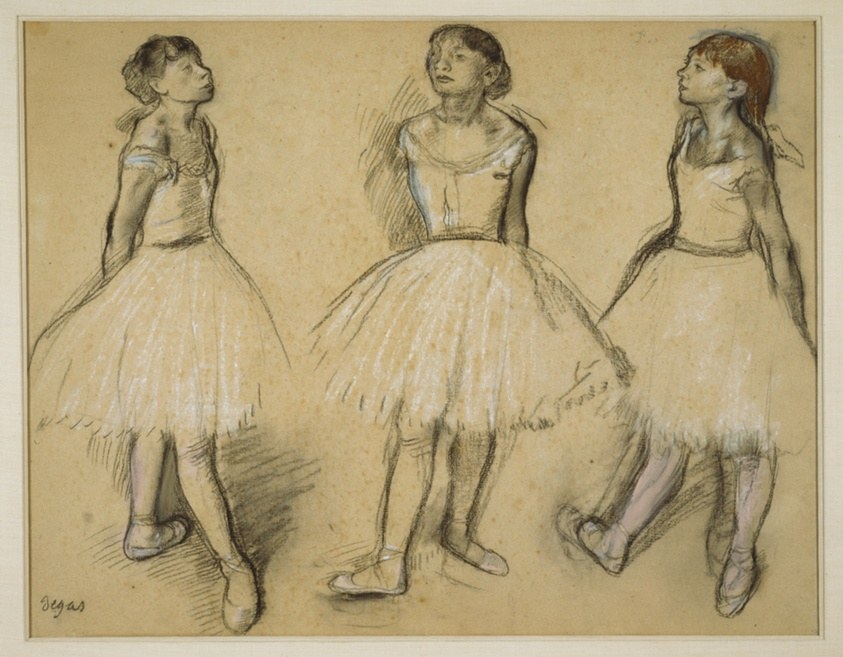
Three Studies of a Dancer in Fourth Position
Edgar Degas French, 1834-1917
- Medium:
- Charcoal and pastel with stumping, and touches of brush and black wash, on grayish-tan laid paper with blue fibers, laid down on gray wove paper
- Collection:
- Prints and Drawings
- Source:
- Art Institute of Chicago
- Rights:
- Public domain — free to use, share and adapt.
- Recorded as:
- CC0 (Public Domain)
This drawing demonstrates how closely Degas observed the physical reality of ballet training and performance, capturing not the spectacle but the labor and control required to sustain the classical line. It is one of hundreds of studies he made of dancers, and it shows his working method: the repetition of a pose to understand its anatomy and its variations. For anyone interested in how ballet looked in the nineteenth century—what the body did, how the training worked, what the dancer experienced—this is primary evidence.
What you are looking at
Three young female dancers are shown in a single compositional study, each rendered in a slightly different pose but all in the characteristic posture of ballet practice. The drawing is executed in charcoal and pastel on tan paper, with the figures occupying most of the frame and set against a neutral background. The leftmost dancer stands with her body angled away, head tilted back and arms positioned as if in movement. The central figure faces more toward the viewer, her upper body upright and arms held at her sides or slightly extended. The rightmost dancer echoes the pose of the left figure, also with her body in profile and head raised. All three wear the simple practice tutu of the Parisian ballet studio—a short, bell-shaped skirt rendered in pale wash that sits at mid-thigh, paired with fitted bodices that reveal the working anatomy of the torso. The artists has paid particular attention to the articulation of the legs and feet: each dancer wears ballet slippers, and the legs are rendered with anatomical precision, showing the turned-out position at the hip and the delicate pointing of the feet. The paper's grayish tone and the use of black wash for contour and shadow create a study of form rather than a finished work for exhibition.
The dancing
Each dancer stands with her weight held upright in a position characteristic of classical ballet vocabulary—externally rotated at the hip, with elongated legs and feet pointed or flexed. The three poses are variations on a held position: the outer dancers both turn their heads back while maintaining vertical spinal alignment, while the central figure looks forward. The arms are held in soft positions, neither dramatically extended nor hanging slack, and the torsos show the controlled engagement of the abdominal and back musculature required for sustained positions. The repetition of the pose across the three figures—what the title calls "fourth position"—suggests a study of a single movement or stance held at different moments or angles, a method of drawing from life or memory that was standard in academic ballet training.
The dance depicted
This is a study of ballet, the dominant theatrical dance form of the Paris Opera in the late nineteenth century. Fourth position in classical ballet is a fundamental stance in which one foot is placed directly in front of the other, both turned out from the hip, with the weight distributed between them. The drawing captures the moment of stillness or the held pose that precedes or follows movement—not the leap or the turn, but the quiet work of balance and control. The identical repetition of the pose across three figures suggests Degas was studying the position itself rather than a sequence of steps, perhaps as preparation for a larger composition or simply to understand how the body holds and sustains the external rotation and vertical alignment that ballet demands. The context is unmistakably the ballet studio or stage of the Opéra in Paris, where Degas was allowed access to watch rehearsals.
How it was made
This is a drawing in charcoal and pastel on paper, a medium that allowed Degas to work quickly from observation and to layer color and tone with great flexibility. The use of charcoal for the contour lines gives a searching, linear quality—the artist is looking hard at the structure of the body and the position of the limbs. The pastel washes, particularly the pale pink and buff tones used for the tutu and the flesh of the legs, build form through color rather than through line alone, a technique that gives the figures a soft, ephemeral quality even as the underlying anatomy is rendered with precision. The stumping technique—rubbing and blending the charcoal and pastel with a stump or the artist's fingers—creates areas of soft modeling, especially in the torso and upper legs. This was a working method suited to the studio and to rapid notation from life; it was also a method that could be transferred to canvas or used for study and reference. The work shows no signature and bears no indication of having been prepared for exhibition or sale.
About this work
This is a study of the classical ballet dancer in repose, rendered by Edgar Degas in charcoal and pastel around 1879. It captures three variations on a single pose—fourth position—as if the artist were turning the model or the drawing itself to examine the stance from slightly different angles. The work is part of Degas's sustained engagement with the Paris Opera ballet, a subject that occupied him for nearly four decades. The drawing records not a spectacular moment of performance but a moment of stillness and control: the unglamorous, demanding work of maintaining the classical line and the external rotation that ballet required. It is a document of how the body was trained and held in the nineteenth century, and of what the artist chose to look at: not the face or the costume, but the musculature and the stance.
The work sits between the studio and the academy. It is a working drawing, made from observation, with the character of a note or a study. But it is also a finished drawing, signed by the artist and carefully worked in a medium that was at the cutting edge of artistic practice in Paris. It shows Degas's commitment to drawing from life and from movement, and his refusal to settle for the conventional ballet pose. The three figures are not identical; they show the variety and effort involved in sustaining a single position, the small shifts of weight and head that make the pose a living thing rather than a statue.
How to look at it
Look at the pose itself: the external rotation at the hip, the vertical alignment of the spine, the pointed foot. These are not natural to the human body; they have been trained into it. Notice how the artist has rendered the effort involved: the tension in the thigh, the engagement of the abdominal muscles, the way the head is held. The three figures are not identical, even though they are meant to show the same position. The small variations—in the tilt of the head, the angle of the shoulders, the distribution of weight—show the artist attending to the living reality of the pose, not to an abstract ideal. Look at the way the pastel has been used to model the form of the leg and the tutu: the soft blending creates the sense of flesh and fabric, while the charcoal lines define the structure underneath.
The artist
Edgar Degas (1834–1917) was a French painter and draughtsman who made the ballet of the Paris Opera a central subject from the 1870s onward. He had access to rehearsals and backstage spaces, and he drew and painted dancers obsessively, producing hundreds of works in every medium: oil, pastel, charcoal, monotype, and lithography. He was not interested in the spectacle or the illusion of the stage; he was interested in the body, the light, the effort, and the unglamorous reality of training and performance. His drawings and paintings of dancers are among the most acute anatomical studies of the moving body in nineteenth-century art, and they show a profound engagement with the physical and emotional reality of the performers. He was associated with Impressionism but maintained his own commitment to drawing and to the figure.
The period
In the 1870s and 1880s, French ballet was undergoing a transformation. The era of Romantic ballet—the sylphs and maidens of the early nineteenth century—was giving way to a new vocabulary of spectacle and athleticism. The Paris Opera ballet was a major cultural institution, and the dancers were celebrities. At the same time, there was a growing interest in the scientific study of movement: photography of motion, anatomical drawing, the precise notation of gesture. Degas's studies of dancers coincide with this moment of transition, and they reflect a modern sensibility—an interest in the actual body and the actual effort, not the ideal or the romantic.
In art, the 1870s saw the emergence of Impressionism, with its commitment to observation from life and its interest in light and color. Degas was involved with the Impressionists but maintained his own distinct approach, rooted in drawing and in the figure. His studies of dancers, done in charcoal and pastel, show the influence of Impressionism—the soft tones, the interest in light, the immediacy of observation—but they are also deeply committed to structure and to the human body.
Where it lives
This drawing is held in the Prints and Drawings collection of the Art Institute of Chicago. It is part of the museum's extensive holdings of works on paper, a collection that reflects the historical importance of drawing as a major art form in nineteenth-century Paris.
Dance in this work
Questions about this work
What is fourth position in ballet?
In classical ballet, fourth position is one of the five basic positions of the feet. It is achieved by placing one foot directly in front of the other, both turned out from the hip, with a space of about the length of one foot between the heel of the front foot and the toes of the back foot. Both feet are turned outward at the hip. The position is fundamental to ballet technique and appears constantly in combinations and combinations of steps. It is a position of readiness and control, neither fully closed nor fully open.
Why did Degas draw dancers so much?
Degas had unique access to the Paris Opera ballet, including rehearsals and backstage spaces, which allowed him to observe dancers at work rather than only in performance. He was fascinated by the physical reality of the body in motion and in training—by anatomy, effort, and the unglamorous reality of dance. His repeated studies of single poses, like this one, show his commitment to understanding movement through drawing and observation. For Degas, dancers were not symbols or allegorical figures but working professionals, and their bodies were a subject worthy of the most intense artistic attention.
Is this a finished work or a study?
It is both. The drawing is carefully worked and fully realized, with sensitive modeling of form and a clear visual intention. But it is also a study, made from observation and showing the artist's process of understanding a pose. The fact that it shows three variations on a single position, rather than a single definitive image, suggests an exploratory method. In the nineteenth century, the distinction between study and finished work was less rigid than it had been earlier; Degas in particular valued the drawing and the study as complete artistic statements in their own right.
What does the paper and medium tell us?
The use of charcoal and pastel on paper, rather than oil on canvas, shows a working method suited to rapid observation and to the studio. These materials allow for speed, flexibility, and the layering of color and tone without the long drying times of oil paint. The paper itself—grayish-tan laid paper with blue fibers—is a quality material, not makeshift, suggesting that the artist regarded the drawing as a work of some importance even though it was not prepared for exhibition. The medium and material are typical of the most advanced artistic practice in Paris in the 1870s, when drawing was valued as a major art form.
More dance artwork





