49 works in this view — arrow keys or swipe to move between them.
Dance in Art
Dancers
Emil Nolde German, 1867-1956
- Medium:
- Woodcut on white wove paper
- Collection:
- Prints and Drawings
- Source:
- Art Institute of Chicago
- Rights:
- Rights reserved by the holding institution — do not reuse without permission. Source record ↗
- Recorded as:
- AIC — rights reserved
For dance historians, this work documents the visual language artists used to represent modernist dance—not as technical spectacle but as psychological and emotional release. It reveals how Expressionist printmakers understood dance as a form of liberation, an attitude that shaped early modern dance in Germany and beyond.
What you are looking at
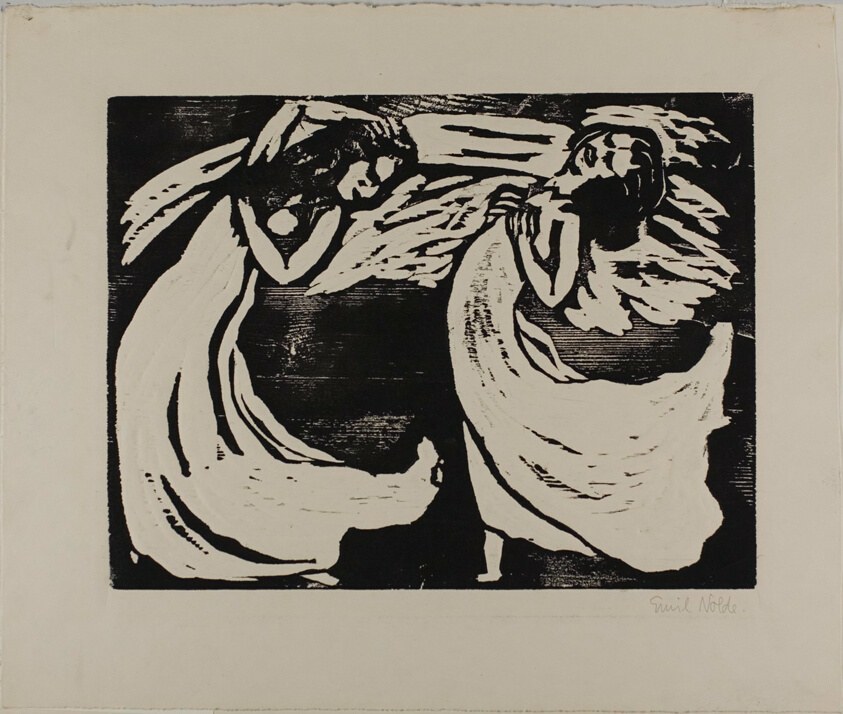
Two female figures dominate this stark woodcut, their bodies rendered in bold, high-contrast strokes against a deep black ground. Both wear flowing, translucent garments that billow and twist around them—the left figure's drapery swirls upward in spiraling folds, while the right figure's fabric cascades downward in sweeping arcs. Their poses suggest rapid movement or swaying motion; the left dancer leans back with arms raised, head tilted, while the right dancer bends forward with hand raised to her face in a gesture of abandon or ecstasy. The composition is compressed and intimate, the two bodies overlapping and intertwined in space, their garments merging into the turbulent background. The technique emphasizes gestural energy: sharp, expressive cuts of the woodblock blade create rhythmic lines that seem to pulse with movement. There is no setting—only the dancers and the void surrounding them.
The dancing
Both figures are caught mid-gesture with raised arms and tilted heads, suggesting a moment of release or trance-like movement. The bodies are elongated and sinuous, drawn with an expressionist disregard for anatomical precision; what matters is the impression of fluidity and emotional intensity rather than technical accuracy. Their weight appears suspended or shifting, and the overlapping composition creates a sense of two bodies moving in shared space. The drapery envelops them completely, obscuring the underlying form and making the cloth itself—billowing, spiraling, folding—as much a subject as the bodies within it.
The dance depicted
This work does not depict a recognizable dance genre or technique. Instead, it captures a mood of ecstatic or expressionist movement—the kind of free, emotion-driven physicality associated with Weimar-era modern dance, particularly the abstract and deliberately anti-classical movements of German Expressionist choreography. The figures suggest the uninhibited, trance-like dancing that emerged in avant-garde circles in the 1910s–1920s, movements intended to express inner states rather than follow codified steps. The work is more about the *idea* of dance as liberation than documentation of any specific style.
How it was made
This is a woodcut, a relief printing technique in which an image is carved into the surface of a wooden block, with raised areas then inked and printed. Woodcut creates bold, high-contrast effects ideal for expressionist work: the medium resists subtle gradation and rewards decisive, gestural marks. Nolde was a master of this technique, using it to create works of raw emotional power. The sharp, rhythmic lines visible here—particularly in the swirling drapery—are characteristic of the woodblock knife. This is a print, not a unique object, which means it circulated to a broader audience than a single painting; it belongs to the tradition of modern German printmaking that valued accessibility and reproducibility.
About this work
This woodcut presents two dancers caught in a moment of private, emotionally charged movement. Rather than depicting a ballroom, concert stage, or folk tradition, it captures the ethos of early-20th-century modern dance—specifically the German Expressionist vision of dance as a vehicle for inner feeling and spontaneous, non-classical physicality. The work is undated in the record but belongs to Nolde's intense period of printmaking and engagement with Expressionist aesthetics. It exemplifies how dance became, for avant-garde artists of this era, a metaphor for authenticity, freedom, and the rejection of bourgeois constraint.
How to look at it
Pay attention to the relationship between the two bodies: they are not in a conventional dance partnership or even clearly in conversation, but rather seem to exist in parallel states of abandon. Notice how Nolde uses the woodcut's capacity for bold contrast and expressive line-work—the gouged, rhythmic marks in the drapery suggest movement through the medium itself rather than through careful figure drawing. The composition is claustrophobic and intimate; there is no spatial recession, no stage, no audience implied. The work asks you to feel the movement as an emotional state, not to understand it as a choreographic form.
The artist
Emil Nolde (1867–1956) was a German-Danish Expressionist painter and printmaker, and one of the most prolific and powerful woodcut artists of the 20th century. He was associated with Die Brücke (The Bridge), a foundational Expressionist movement, and created thousands of works in oil, watercolor, and print media. His work is characterized by violent color, raw emotion, and distorted forms; he favored subjects—including dance—that allowed him to explore ecstasy, spirituality, and the primitive or instinctual aspects of human experience. Despite his artistic stature, Nolde's work was later condemned as "degenerate" by the Nazi regime, though he lived and continued to work in relative obscurity until his death.
The period
This work dates to 1917, during World War I and in the immediate prelude to the German Revolution of 1918–1919. The period saw an explosion of Expressionist activity in Germany, with dance playing a central role in avant-garde culture. Figures like Mary Wigman were pioneering new forms of modern dance rooted in German Expressionism—movement that rejected classical ballet's formal vocabulary in favor of angular, emotionally raw, often ecstatic physicality. Artists and dancers across media were united in a conviction that authentic human expression could be found only by breaking with tradition. Woodcuts and lithographs proliferated as printmakers, including Nolde, sought to capture and disseminate these new aesthetic values.
Where it lives
The work is held in the Prints and Drawings collection of the Art Institute of Chicago. It is part of the museum's holdings of modernist printmaking and represents the significant Expressionist material in the collection.
Dance in this work
Questions about this work
Is this depicting a real dance?
Not a specific, named dance style. Instead, it captures the expressive, emotion-driven movement associated with German Expressionist and modern dance of the 1910s–1920s. The artist was interested in the *idea* of dance as a vehicle for inner feeling rather than in documenting technique or form.
Why are the figures so distorted and hard to read?
Distortion was deliberate. Expressionists—both in visual art and dance—believed that precise, beautiful form served convention and restraint. By exaggerating and deforming bodies, Nolde suggests intensity, ecstasy, and authenticity. The swirling, broken lines in the woodcut also suit the medium's visual language.
What does the drapery represent?
The flowing garments are as much the subject as the bodies themselves. They suggest freedom of movement, weightlessness, and the dissolution of the body into pure gesture. In the context of modern dance, such loose, unrestricted clothing (unlike the corsetry of ballet) symbolized liberation.
More dance artwork





