49 works in this view — arrow keys or swipe to move between them.
Dance in Art
Female Dancer
Elie Nadelman American, born Poland, 1882–1946
- Medium:
- Bronze
- Collection:
- Arts of the Americas
- Source:
- Art Institute of Chicago
- Rights:
- Rights reserved by the holding institution — do not reuse without permission. Source record ↗
- Recorded as:
- AIC — rights reserved
For dancers and historians of early 20th-century art, this work documents how modernist sculptors understood and abstracted the moving body. Nadelman's reduction of the dancer to essential lines and masses influenced later dance-related sculpture and kinetic art. The piece also represents a rare moment when sculpture and dance vocabularies were in direct conversation—the arabesque and port de bras were not merely ballet steps but became materials for abstract formal invention.
What you are looking at
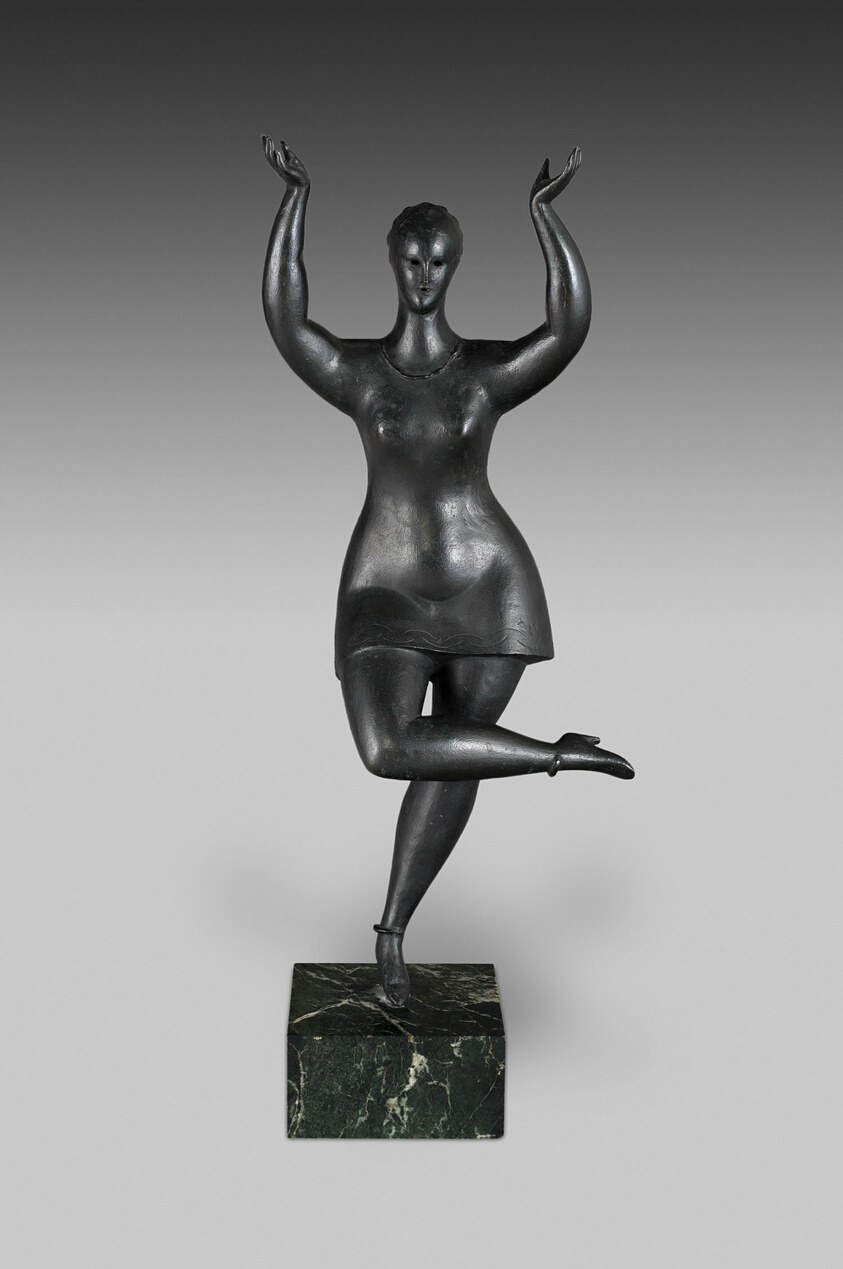
A bronze female figure stands alone on a dark green marble base, captured in a moment of exuberant celebration. She is shown in profile-front, her body angled slightly, with both arms raised high and bent at the elbows in a triumphant gesture. Her legs are in a dynamic pose: one leg straightened and extended behind or to the side, the other bent and supporting her weight, creating the sense of a suspended leap or arabesque. She wears a short, simple dress or tunic that falls to mid-thigh. The figure is rendered in polished dark bronze with careful attention to anatomical form—her musculature is defined, her posture exuberant and joyful. Her face is stylized and serene, turned slightly upward. The work is a sculpture in the round, designed to be viewed from multiple angles, though this photograph captures a view that emphasizes the raised arms and extended leg most dramatically.
The dancing
A single female figure with arms raised in a V-shape above her head, elbows bent at roughly 90 degrees, in a pose of triumph or celebration. One leg is extended (the supporting leg appears to be the bent one), while the other leg stretches behind or to the side, creating a balletic line that suggests elevation or a moment suspended in space. The raised arms and open chest create an expansive frame. The pose is confident and controlled, not chaotic—this is an athlete or trained dancer, not a casual gesture.
The dance depicted
The image most likely depicts a moment of classical or modern theatrical dance, possibly inspired by Romantic ballet vocabulary (the arabesque, the raised port de bras). The pose is celebratory rather than narrative—it suggests a moment of triumph, joy, or accomplishment within a dance. The artist has chosen to freeze a peak moment of elevation and extension, a vocabulary familiar to ballet audiences. The work may also reference more general notions of rhythmic movement and human celebration rather than a specific named dance; Nadelman's modernist abstraction of the human figure was often concerned with essential human gestures rather than technical specificity.
How it was made
This is a bronze sculpture, cast from a modeled form (likely clay or wax originally). The smooth, polished surface of the bronze allows light to play across the musculature and reveals the artist's attention to anatomical form and abstraction simultaneously. The figure is small enough to be held or displayed on a shelf, but the dynamic pose and careful finishing suggest it was intended for gallery or private collection display. Bronze allows for fine detail and a permanent record of the modeled gesture; the warm metallic surface contrasts with the cool marble base, a pairing common in early 20th-century modernist sculpture.
About this work
Elie Nadelman's 'Female Dancer' is a small bronze sculpture that captures the essence of human joy and physical celebration through the language of theatrical dance. Created in 1920, during a period when modernist sculptors were rethinking the representation of movement and the human body, the work distills a complex moment of elevation and triumph into a compact, abstracted form. The artist has removed narrative detail in favor of pure gesture—raised arms, extended limbs, and a composed face convey exuberance without telling a story. The sculpture sits at the intersection of dance, modernism, and the sculptural tradition of the figure in motion, asking what the essential form of human celebration looks like when stripped to its core geometry.
How to look at it
Look first at the pose: this is not a naturalistic or anatomically impossible position, but it feels effortless and joyful. The artist has chosen the peak moment of a leap or rise, not the preparation or recovery. Notice how the raised arms create a V-shape that reads clearly from many angles; this is design as much as representation. The smooth surface and dark patina of the bronze emphasize form over texture, and the simplified face—almost mask-like—keeps our attention on the body's gesture rather than psychological expression. The marble base anchors the figure but does not diminish the sense of elevation and lightness the pose conveys.
The artist
Elie Nadelman (1882–1946) was a Polish-born sculptor who worked primarily in the United States after immigrating in 1914. He was known for his modernist abstractions of the human figure, often drawing on folk art, caricature, and popular culture. His work in the 1920s frequently depicted dancers and theatrical figures, treating them as pure form rather than narrative subjects. Nadelman worked across scales from monumental public pieces to intimate gallery sculptures, always with a focus on simplified, elegant line and a subtle engagement with cubism and constructivism.
The period
In 1920, modernist sculpture was in active dialogue with theatrical dance. The Ballets Russes had revolutionized expectations about what dance could depict and how it could look; artists like Nadelman, who worked in New York, were influenced by this encounter. Simultaneously, sculpture was moving away from pure figural representation toward abstraction and formal investigation. The 1920s saw a flourishing of small bronze figures in private collections, especially among wealthy Americans collecting contemporary art. Nadelman's dancer sculptures belong to this moment of high modernism, when the human figure in motion remained a central subject even as abstraction and simplification became dominant formal strategies.
Where it lives
The work is held in the Arts of the Americas collection at the Art Institute of Chicago. It was cast in bronze and remains part of the museum's modernist sculpture holdings, available for public viewing and study.
Dance in this work
Questions about this work
Is this a real person or a generalized type?
Nadelman's sculpture abstracts and idealizes the human figure rather than depicting an individual dancer. The work is about the essential form of celebration and movement, not portraiture. The simplified facial features and geometric body planes indicate this is a type or idea—the joy of the dancing body—rather than a specific person's likeness.
What dance is this supposed to be?
No specific named dance is indicated. The raised arms and extended leg reference ballet vocabulary (arabesque, port de bras), but the sculpture is more about the general gesture of triumph and joy than about technique. Nadelman was interested in the sculptural essence of movement, not in documenting a particular choreography.
Why is a dancer cast in bronze?
Bronze allows the artist to freeze a moment of movement in a permanent, valued material. In the early 20th century, sculpture in bronze was a prestigious form associated with high art. By casting a dancer in bronze, Nadelman elevates the dancing body to the status of fine art sculpture, making a claim about dance's importance as a subject for serious artistic investigation.
Is this sculpture life-size?
No—the work is a small, gallery-scale bronze, designed to be seen close up and from multiple angles. The modest size invites intimate viewing and allows the work to be held in private collections. The compact scale does not diminish the sense of expansion and joy the pose conveys.
More dance artwork





