49 works in this view — arrow keys or swipe to move between them.
Dance in Art
Female Dancer
China
- Medium:
- Gray earthenware with slip coating and polychrome pigments
- Collection:
- Arts of Asia
- Source:
- Art Institute of Chicago
- Rights:
- Public domain — free to use, share and adapt.
- Recorded as:
- CC0 (Public Domain)
This figurine is one of the few surviving three-dimensional records of Han Dynasty dance practice, offering concrete evidence of pose, dress, and body presentation in the earliest phase of imperial Chinese court culture. For historians of East Asian dance, it documents the formal, gestural aesthetic that would shape classical Chinese dance for centuries, showing that early court dance prioritized ritual dignity and symmetry over the acrobatic virtuosity celebrated in later periods.
What you are looking at
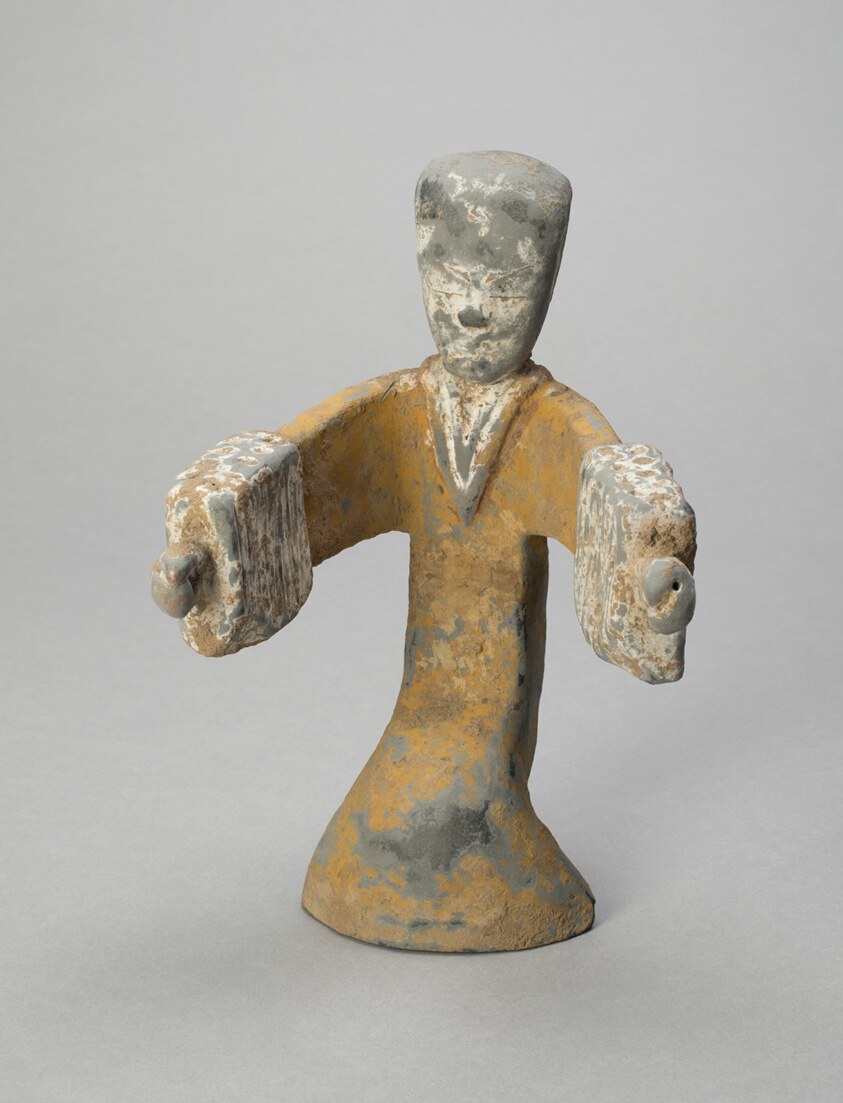
This is a ceramic figurine of a dancer modeled from gray earthenware and coated with pigments that have largely worn away, leaving the figure partially weathered but still legible. The figure stands on a conical base in a frontal pose with arms raised and bent at the elbows, hands extending outward to either side at roughly shoulder height. The dancer wears a long, loose-sleeved robe or tunic rendered in ochre-yellow pigment with a darker vertical stripe down the center front, suggesting a wrapped or overlap-front garment. The sleeves are voluminous and textured, possibly indicating pleated or gathered fabric typical of Han Dynasty dress. The head is rendered in a simplified, almost cylindrical form with minimal facial features, and sits directly atop the body without a distinct neck. The figure's posture—upright, symmetrical, with splayed arms—suggests either a moment of celebration, a ritual pose, or a formal greeting rather than energetic movement.
The dancing
This is a single standing figure in a frontal, symmetrical stance with arms raised and bent at the elbows, palms facing outward or slightly upward. The weight appears evenly distributed on both legs, with the body held erect and formal. The raised-arm position with open hands is characteristic of display postures or greeting gestures in early Chinese court and ceremonial contexts rather than the dynamic, rotational postures of virtuosic dance. The simplified, almost columnar rendering of the torso and the formal frontality suggest this is a representation of posed dignity rather than captured motion.
The dance depicted
This figure most likely represents a court dancer or ceremonial performer from the Han Dynasty (200 BCE onward). The pose suggests either a formal greeting, a moment of ritual significance, or the restrained, stately movement conventions of early Chinese court dance. Han Dynasty court dance, influenced by earlier ritual practices, emphasized symmetry, formal gesture, and dignified posture over the acrobatic or fluid movement that would dominate later theatrical traditions. The raised-arm pose is consistent with documented Han court dance gestures preserved in tomb reliefs and literary descriptions, where dancers performed in service to ritual and courtly ceremony rather than entertainment alone. The figure's gender designation as 'female' may reflect either the visible dress conventions of women performers or the context of women's roles in Han court music and dance.
How it was made
This is a hand-modeled ceramic figurine made from gray earthenware and enhanced with slip coating and polychrome pigments applied to the surface. The technique allows for three-dimensional representation and was standard for Han Dynasty tomb figurines—objects created to accompany the dead and ensure their afterlife comfort. The volumetric, sculptural quality of the form creates a presence that a flat image could not; the viewer must move around the figure to see it fully. The pigments have oxidized and faded significantly over two millennia, but traces of ochre and pale wash remain visible. This technique was not intended for permanence of color but rather for the ritual purpose of representation, and the aging only emphasizes the object's age and archaeological status.
About this work
This is a ceramic figurine of a dancer from Han Dynasty China, created around 200 BCE or later as a tomb object. The figure stands in a formal, frontal pose with raised arms and wears a sleeved robe typical of the period. The simplified modeling and symmetrical posture reflect the conventions of court and ceremonial dance in early imperial China—a context in which dancers were ritual specialists whose gestures carried formal, often symbolic meaning. The figure is important not as a record of virtuosic movement but as evidence of how Han dynasty society represented the dancer's body: formalized, dignified, and embedded in courtly ceremony. The weathered surface and the object's original funerary purpose mark it as an artifact of a particular historical moment in the evolution of East Asian dance.
How to look at it
Observe the symmetry and frontality of the pose—the figure is not caught mid-movement but held in a formal, presentational frame. The raised arms with open hands suggest a gesture of offering, greeting, or ritual significance rather than the twisted, off-balance positions of dynamic dance. Note the voluminous sleeves and the center-front stripe of the robe, which would have moved gracefully in performance but are here rendered in a static pose. The simplified facial features and the emphasis on the body as a unified, upright form reflect a different aesthetic from later Chinese dance representation, which would emphasize facial expression and sculptural detail. The weathering and loss of pigment also ask the viewer to imagine the original, more colorful appearance.
The period
The Han Dynasty (206 BCE–220 CE) was a period of consolidation and expansion in imperial China, during which court ceremony and ritual became increasingly formalized and elaborate. Music and dance were central to court life and served both ceremonial and entertainment functions. Han court dancers, often trained from childhood, performed at imperial banquets, funeral rites, and state occasions. The period saw the development of organized musical ensembles and the codification of gestures and poses. This figurine dates from early in this era and reflects the formal, restrained aesthetic of early Han court culture; later Han periods would see increasing influence from Central Asian dance traditions, introducing more acrobatic and energetic forms. Tomb figurines like this one became standard burial goods for officials and elites, suggesting that dancers and musicians held valued social positions worthy of representation in the afterlife.
Where it lives
This figurine is held in the Arts of Asia collection at the Art Institute of Chicago. It is catalogued as a Han Dynasty ceramic and is typical of the funerary figurines excavated from tomb contexts throughout Han-era burial sites in northern China. Such objects provide crucial archaeological evidence for understanding daily life, court practices, and artistic conventions of the period.
Dance in this work
Questions about this work
How do we know this represents a dancer?
The raised-arm pose, the formal gesture, and the context of Han Dynasty tomb figurines—which often included performers and musicians—all support a dancer identification. The pose matches documented Han court dance gestures in relief sculpture and textual descriptions. The female designation may reflect either gender-specific dress conventions or the documented role of women in Han court music and dance.
What kind of dance would this performer have done?
Han Dynasty court dancers performed restrained, formally gestured dances in service to ritual and ceremony. These were not improvisational or acrobatic but carefully codified movements performed in ensemble settings. The dancers often wore elaborate robes and headdresses and moved in symmetrical formations. The pose shown here—with raised arms and an upright, dignified bearing—is consistent with the formal aesthetic of this early imperial court tradition.
Why was this figurine buried with the dead?
Han Dynasty burial practices included figurines of all kinds—servants, musicians, dancers, animals, and household objects—to ensure the deceased had entertainment, service, and comfort in the afterlife. The presence of a dancer figurine in a tomb suggests that music and dance were valued aspects of elite life, worthy of representation in the world beyond death.
What happened to the color?
The pigments—applied as slip coating and paint—have oxidized and faded over approximately 2,200 years. The original figure would have been more vividly colored, likely with a brighter ochre robe and additional details in contrasting hues. The aging and loss of pigment are part of the object's archaeological history and do not diminish its significance as evidence of Han Dynasty art and practice.
More dance artwork





