49 works in this view — arrow keys or swipe to move between them.
Dance in Art
Girl Dancing
Bessie Potter Vonnoh (American, 1872–1955) Cast by Roman Bronze Works (American, founded 1897)
- Medium:
- Bronze
- Collection:
- Arts of the Americas
- Source:
- Art Institute of Chicago
- Rights:
- Rights reserved by the holding institution — do not reuse without permission. Source record ↗
- Recorded as:
- AIC — rights reserved
Vonnoh's work documents how women's social dance was perceived and valued in American fine art at the turn of the 20th century: as a subject of beauty and refinement rather than spectacle. The sculpture also represents the emergence of female sculptors in America during this period—Vonnoh was among the first to achieve recognition and major commissions—and her choice to depict social dance speaks to her interest in capturing the feminine body in its everyday grace.
What you are looking at
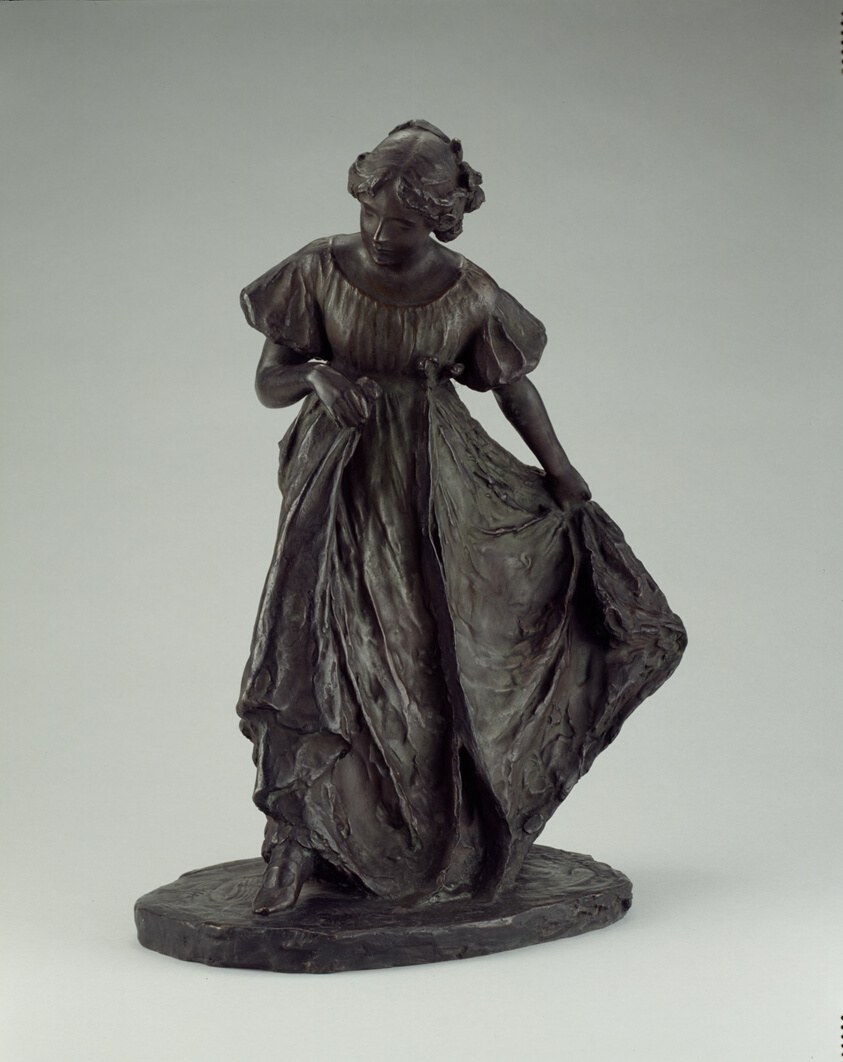
A bronze sculpture of a young woman in Regency or early 19th-century dress, captured in a moment of graceful movement. She wears a high-waisted gown with short puffed sleeves and a gathered skirt that swirls around her legs, suggesting motion. Her posture is elegant and composed, with her body angled slightly as if pausing mid-turn. The figure stands on an oval base, and the work demonstrates careful attention to the fall and flow of the fabric—the skirt is lifted and draped as though caught by her own movement or gesture. Her head is tilted downward in a contemplative or modest pose, her hair arranged in the ringlets characteristic of the period. The bronze has developed a rich, dark patina over time.
The dancing
A single female figure stands in contrapposto, with weight shifted subtly to one side and the opposite leg slightly forward—a classical pose adapted to suggest locomotion rather than a static stance. Her right arm hangs naturally at her side while her left hand gathers or lifts the skirt fabric, a gesture that communicates both elegance and the mechanics of moving in a heavy gown. Her shoulders are relaxed and open; her carriage is upright but not stiff. The sculptor has understood how fabric behaves in motion and how a dancer or woman trained in social movement would carry herself.
The dance depicted
The work depicts a woman in the idiom of early 19th-century social dance—most likely a ballroom context of the Regency or early Victorian era. The pose suggests a promenade or a moment between movements in a waltz, quadrille, or cotillion rather than a specific choreographed step. The emphasis is on grace, propriety, and the beauty of the feminine form in motion within the formal constraint of period dress. This is not theatrical dance but the refined social dancing of the leisure classes.
How it was made
This is a bronze sculpture, cast by the Roman Bronze Works, one of the most respected foundries in America from 1897 onward. The foundry's involvement indicates this was a work of significant artistic ambition intended for exhibition and collection. Bronze allows for fine detail in the rendering of fabric texture, facial features, and the subtle shifts in the figure's weight and posture. The patina suggests either age or intentional finishing to achieve a warm, classical appearance.
About this work
This sculpture by Bessie Potter Vonnoh captures a moment of refined social dancing in the early 19th century, freezing in bronze the grace and propriety demanded of women in ballroom settings. The work belongs to a tradition of American sculptural practice that took the human figure—particularly the female form in motion—as a subject worthy of serious artistic attention. It is not a narrative or historical work but a study in elegance, and it reveals how the sculptor understood both the physiology of movement and the aesthetic conventions of her time.
How to look at it
Attend to the fabric: how the sculptor has rendered the weight and volume of the gown, the way the skirt is lifted as if by the figure's own motion, and the care taken to show drapery as functional rather than merely decorative. Notice the figure's posture—not rigid but alert, with a subtle shift of weight that suggests she is mid-step rather than posed. The downward tilt of her head and the modest expression reinforce the period's ideals of feminine grace and restraint. The work asks us to find beauty in restraint and refinement.
The artist
Bessie Potter Vonnoh (1872–1955) was an American sculptor who studied at the Art Institute of Chicago and in Paris under Frederick MacMonnies. She was known for small-scale figurative works, often depicting women and children in moments of quiet activity or repose. She exhibited widely and achieved considerable success in her lifetime, winning medals and commissions. Her work is characterized by sensitivity to movement, drapery, and psychological nuance—qualities evident in this sculpture.
The period
At the turn of the 20th century, American sculptors were engaged with European traditions while developing a distinctly American idiom. The academic study of the figure remained central to artistic training. Social dance in the Regency and early Victorian periods had by then become a subject of nostalgic interest, associated with refinement and a pre-industrial world of leisure. In the visual arts, the female figure in graceful repose or gentle motion was a dominant subject, particularly in sculpture.
Where it lives
The work is held by the Art of the Americas collection at the Art Institute of Chicago. It was cast by the Roman Bronze Works, a major American foundry that produced works for many significant sculptors of the period. This casting and foundry mark indicate it was made for exhibition and permanent collection rather than as a unique work.
Dance in this work
Questions about this work
Is this a specific dance or a generic pose?
The pose is generic to early 19th-century social dance rather than a specific, choreographed step. It suggests the posture and movement quality of a woman in a ballroom setting—likely in a waltz, quadrille, or cotillion—but the sculptor's interest is in capturing grace and refinement rather than documenting a particular dance form. The emphasis is on the beauty of movement within social constraint.
Why did Vonnoh choose to sculpt a dancing figure?
Dance and movement were central to Vonnoh's artistic practice and aesthetic vision. She was drawn to the female figure in motion as a subject that allowed her to explore grace, femininity, and the interplay of fabric and form. By choosing a social rather than theatrical context, she elevated the everyday movement of women in her own era to the status of fine art.
What does the foundry mark tell us?
The Roman Bronze Works was one of the premier art foundries in America and produced works for major sculptors of the period. The foundry's involvement indicates this sculpture was professionally cast in editions for sale and exhibition, making it not a unique work but part of a controlled edition. This was standard practice for important sculptural works of the period.
More dance artwork





