49 works in this view — arrow keys or swipe to move between them.
Dance in Art
The Dancing Fox
Artist unknown Japanese, mid- to late 18th century
- Medium:
- Color woodblock print; chuban
- Collection:
- Arts of Asia
- Source:
- Art Institute of Chicago
- Rights:
- Public domain — free to use, share and adapt.
- Recorded as:
- CC0 (Public Domain)
For historians of East Asian theater, this print documents the performance vocabulary of kyōgen and early kabuki at a moment when these forms were still developing. For dancers and choreographers, it records how comedic physicality—the humor in an animal attempting human movement with conviction—was valued as a performance skill. The work also reveals the function of theatrical prints in Edo society: they were affordable documents of live performance, allowing viewers to relive moments they had seen onstage or to imagine performances they had not.
What you are looking at
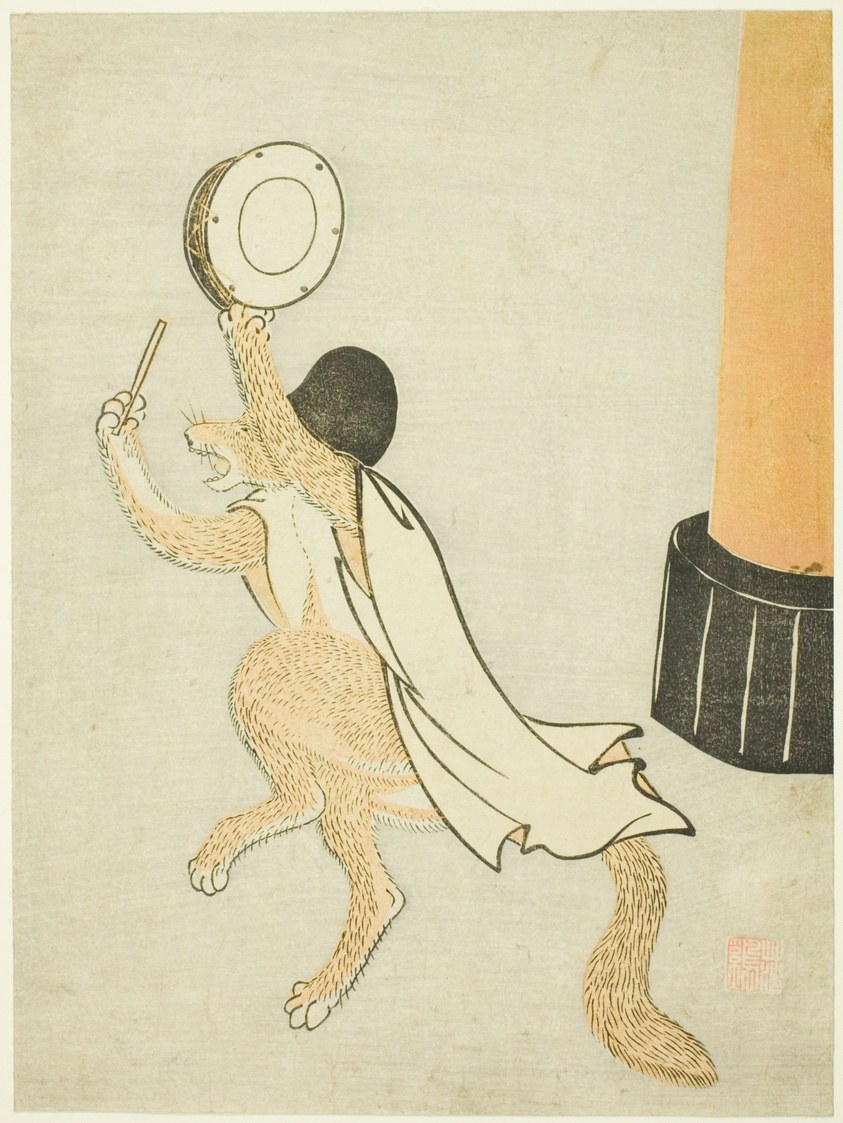
A figure in a tawny-colored robe with dark fabric at the neck and shoulders holds aloft a shallow circular drum or tambourine, caught mid-gesture in an upward reach. The figure's body is oriented in profile, turned sharply to the left, with the torso extended and weight shifted dynamically. The lower body shows animal characteristics—a furry tail and animal hindquarters—suggesting this is not a human dancer but a fox or similar creature depicted in human dress and posture. The face is rendered with a simple dark oval, almost mask-like. The background is plain cream paper with a golden-orange panel on the right edge, typical of the compositional framing in Japanese woodblock prints. The entire scene is executed with careful attention to texture: fine crosshatching renders the animal fur, while linear marks describe the fabric folds of the robe. The print bears a red seal in the lower right, characteristic of Japanese artist signatures or collection marks.
The dancing
The figure stands on two legs in a contrapposto-like stance, with one leg bearing weight while the other appears to push upward with the motion. The right arm extends overhead in a triumphant or celebratory pose, holding the drum aloft. The left arm, holding what appears to be a stick or beater, is angled across the body. The gesture reads as exuberant and playful rather than formally trained—the weight is loose, the shoulders are engaged, and the entire frame conveys joy and release rather than precision. The anthropomorphized animal body performs human movement, which was a recognized comedic and performative tradition in Japanese theater.
The dance depicted
This appears to depict a fox performing in the style of kyōgen or early kabuki theatrical tradition, where animal characters performed satirical or comedic dances. The raised drum and energetic posture suggest a celebratory or festive moment. The animal-human hybridity—a fox in human clothing, playing a human percussion instrument and adopting human movement vocabulary—was a stock device in Edo-period theatrical entertainment. The raised instrument and upward-reaching posture suggest a moment of triumph or revelry, consistent with kyōgen's comic mode. Without additional documentary evidence, the specific dance form cannot be definitively named, but the context points toward theatrical animal characters rather than a naturalistic representation of human dance.
How it was made
This is a color woodblock print in the chuban (medium sheet) format, as documented in the record. The technique involved carving separate woodblocks for each color layer and hand-pressing dampened paper against inked blocks in sequence. Woodblock printing allowed for affordable reproduction and wide circulation among urban merchant and artisan audiences in Edo-period Japan. The artist has used restrained color—warm ochre for the body, black for the robe and facial features, and white paper for highlights—which was both economical and effective. The fine linear hatching in the fur and careful registration of color suggest a skilled printmaker's workshop, though the artist remains unattributed in the record.
About this work
This print captures a moment of theatrical performance: a fox dancer or actor in the guise of a fox, mid-performance, holding a drum aloft in a gesture of exultation. It documents a specific strand of Edo-period Japanese entertainment—the use of animal characters in comedic theater—and shows how movement, costume, and percussion were combined for popular audiences. The work belongs to the visual record of kyōgen and early kabuki, art forms that relied on skilled performers mastering precise physical vocabularies that were then translated into prints for sale to theatergoers and collectors.
The image reveals the aesthetics of Japanese theatrical printing: economical use of color, dynamic composition that captures a single decisive moment, and attention to texture and fabric that grounds the fantastical subject (a fox in a robe) in tactile reality. The unknown artist has rendered the animal body with enough anatomical precision that the viewer never doubts it is a fox, while the human gesture—the raised arm, the forward-leaning posture—reads as recognizably dance-like. This simultaneity of animal and human, funny and skilled, popular and artisanal, defines the tradition.
How to look at it
Attend to the moment the artist chose: not a moment of stillness, but an instant of maximum energy and abandon, the drum held high as if the fox has just struck it or is about to. The upward tilt of the body, the forward momentum of the posture, and the diagonal composition all work together to convey motion that has not stopped but is merely frozen for the viewer's benefit. Notice how the artist rendered the animal anatomy—the hindquarters, the tail—with as much care as the human costume, insisting on the double nature of the figure. The simplicity of the background throws all attention onto the body and its gesture, a compositional choice typical of theatrical prints, which needed to broadcast the performer's movement clearly to buyers who had not necessarily seen the show.
The artist
The artist is unknown, which was common for woodblock prints of this period and format. Many chuban prints were produced collaboratively in workshop settings, with separate artisans responsible for design, carving, and printing. The quality of the line work and color registration suggests a competent professional hand, likely trained in the Utagawa school or a related Edo printmaking lineage. Without a signature or seals beyond the collection mark, attribution remains open.
The period
This print dates to the mid-to-late 18th century, a period when kabuki and kyōgen were fully established as popular entertainment in Edo (modern Tokyo) and other urban centers. Woodblock prints of theatrical subjects were a booming commercial category, sold in theater districts and appealing to both regular theatergoers and armchair fans. Animal characters had long appeared in Japanese performance traditions, but the mid-Edo period saw them become increasingly codified and celebrated. The use of anthropomorphized animals for comedy and social commentary was also a legacy of much older narrative traditions, including folklore and Noh theater. The chuban format (roughly 8 x 6 inches) was standard for affordable theatrical prints aimed at the urban middle classes.
Where it lives
The print is held in the Arts of Asia collection at the Art Institute of Chicago, catalogued from AIC's database. It is one of thousands of Japanese woodblock prints in the museum's collection, representing the democratic circulation of theatrical imagery in Edo society.
Dance in this work
Questions about this work
Is this a real dance or a made-up choreography?
The gesture and posture suggest a real performance tradition—likely kyōgen or kabuki—rather than the artist's invention. However, without documentation beyond the print itself, the specific name and rules of the dance cannot be recovered. What we can say is that this fox was performing in a style recognizable to contemporary audiences, and the print was valuable enough to be preserved because it captured a known performer or role.
Why is the fox wearing human clothes and playing an instrument?
This was a stock convention in Edo-period theater. Animal characters in human dress and performing human actions created comedy through incongruity, but also allowed performers to comment on human behavior at one remove. The fox as a trickster or clever figure had deep roots in Japanese folklore, and theater capitalized on audiences' familiarity with that tradition.
Who made this print?
The artist is unknown, as noted in the record. Many woodblock prints of this era were unsigned or bore only workshop seals, especially in the chuban format aimed at popular audiences. The red seal visible in the lower right may indicate a collection mark or publisher's mark rather than the artist's signature.
How much did a print like this cost?
Chuban prints were among the most affordable woodblock prints, costing roughly the price of a meal or a day's labor for a craftsperson. They were intended for the urban merchant and artisan classes, not the wealthy elite, which is why they were produced in large numbers and why many survive today.
More dance artwork





