49 works in this view — arrow keys or swipe to move between them.
Dance in Art
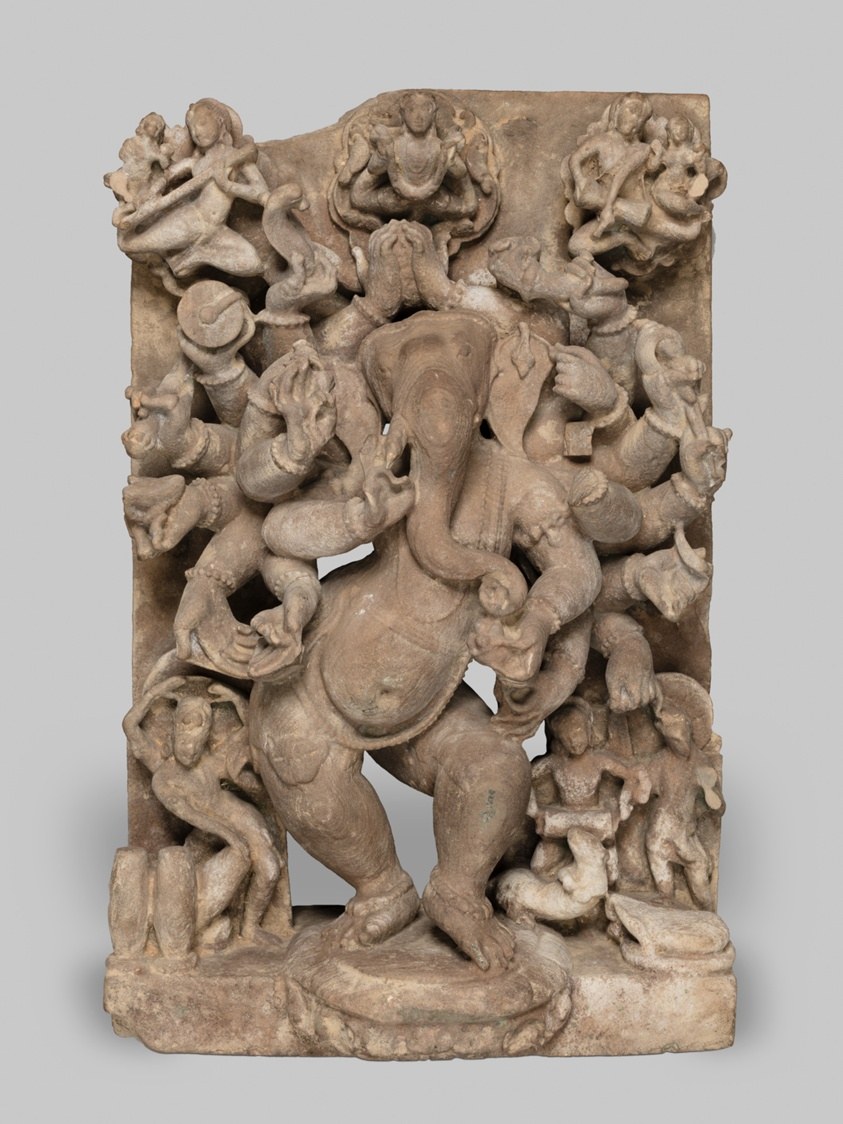
Twenty-Armed Dancing God Ganesha, Remover of Obstacles
India Madhya Pradesh
- Medium:
- Sandstone
- Collection:
- Arts of Asia
- Source:
- Art Institute of Chicago
- Rights:
- Public domain — free to use, share and adapt.
- Recorded as:
- CC0 (Public Domain)
This work shows dance functioning as a theological statement rather than a social practice: Ganesha's dance is not taught, learned, or performed by humans, but exists as an eternal cosmic principle carved in stone for perpetual contemplation. The multiple arms reveal how non-Western sculptural traditions solved the problem of depicting simultaneity and divine multiplication—a formal strategy utterly distinct from European Renaissance perspective or neoclassical idealization, yet equally committed to expressing abstract ideas through the moving body. For anyone studying sacred or devotional dance across cultures, this work exemplifies how movement can carry metaphysical weight.
What you are looking at
This sandstone relief depicts Ganesha, the elephant-headed Hindu deity, in a dynamic dancing pose at the center of a densely carved rectangular plaque. The god's multiple arms—the catalogue claims twenty, though the carving's erosion and the photograph's angle make a precise count difficult—extend outward in varied gestures of movement and blessing. Ganesha's massive elephant body is rendered in three-quarter view, his trunk curved gracefully, his weight shifted as if mid-step. He wears a decorated upper garment and stands on a rounded base. The surrounding space is filled with smaller figures: celestial attendants, musicians, and other deities arranged in tiers around the central god. Above, a band of figures gestures in apparent response or participation. The entire composition is crowded with detail, every surface activated with carving; the work shows the wear of centuries—some faces are abraded, and significant portions of limbs are missing or broken—yet the dynamism of the dance remains legible.
The dancing
Ganesha's torso twists in a contrapposto stance, his upper body angled while his elephant legs provide a stable base. The multiple arms radiate outward—some raised in what appears to be blessing or mudra (ritual hand gesture), others bent as if playing instruments or gesturing in dance. The smaller surrounding figures are carved in lower relief, their poses more confined; they lean inward toward the central deity, creating a compositional focus. The attendants show varied postures: some stand upright, others bend or sit, their bodies oriented toward Ganesha as an audience to or participants in the cosmic dance.
The dance depicted
This is Ganesha Tandava—the cosmic dance of Ganesha, the remover of obstacles in Hindu theology. Ganesha is traditionally depicted as a dancer in devotional and temple sculpture, and the multiple arms are a sculptural convention allowing the artist to show simultaneous gestures and the divine multiplication of cosmic power. The surrounding figures are likely celestial beings (devas, apsaras, or attendants) witnessing or participating in this sacred dance. The dance itself is not a social or martial form but a metaphysical act: Ganesha's movement embodies divine creative and destructive force. The work suggests a performance tradition in which the deity's dance was invoked through ritual and devotional practice, though this is a permanent stone record rather than a depiction of human dancers enacting the role.
How it was made
This is carved sandstone in high and medium relief, a technique that allows the sculptor to layer the figures spatially and create pronounced shadows that emphasize the movement. The relief carving permits the multiple overlapping arms and the surrounding attendant figures without the formal constraints of freestanding sculpture. Sandstone, widely available in medieval India, was the preferred material for temple architecture and sculpture; its relative softness allowed fine detail but also meant the work was vulnerable to erosion and damage, which is evident here. The depth of carving—particularly the undercutting of arms and the spatial separation of figures—suggests this was a significant commission, likely part of a temple wall or architectural program rather than a portable object.
About this work
This 10th-century sandstone relief from Madhya Pradesh presents Ganesha in cosmic dance, a subject central to Hindu devotional sculpture. The god's multiple arms, rendered through sculptural convention rather than naturalism, express divine simultaneity—blessing, playing, dancing, and creating all at once. The carving technique and the surrounding chorus of celestial figures place this work within a temple context, where the image functioned as a permanent invocation of divine presence and power. The work belongs to the mature phase of medieval Hindu temple sculpture in central India, when relief carving reached high technical sophistication. For dance historians, it documents how movement was understood in a non-Western sacred context: not as secular entertainment or even as a skill to master, but as a manifestation of cosmic principle, embodied through a deity whose very form—part human, part animal, part divine—transcends ordinary categories of being.
How to look at it
Observe how the sculptor has used the multiple arms to create a sense of perpetual motion—the eye moves around the figure, reading different gestures as if the dance is unfolding in all directions at once. Notice the contrast between Ganesha's weight-bearing elephant legs, which anchor him to the stone, and his upper arms and torso, which seem to float outward in gesture and dance. The surrounding figures, though smaller and flatter, are essential: they establish that this is a cosmic event, witnessed and celebrated by the celestial hierarchy. Look at the weathering and damage—the missing hands and abraded faces—not as loss but as evidence of centuries of ritual use; this was a living image in a temple, handled, touched, and invoked by worshippers.
The artist
The sculptor is unknown; this work is identified only by region and period. Medieval Hindu temple sculpture in Madhya Pradesh was produced by organized workshops of stoneworkers, often hereditary guilds, whose names were rarely recorded. The sophistication of the carving and the scale of the commission suggest an experienced hand or workshop with access to significant resources, likely employed by a royal patron or large temple institution. The style and technique are consistent with the Pratihara period (9th–12th centuries) in central India, a era of great temple construction and sculptural innovation.
The period
This sculpture dates to the early medieval period in India (circa 901), a time of extraordinary temple construction and sculptural production across central and northern India. The Pratihara dynasty was consolidating power and patronizing massive temple complexes, which served as centers of religious devotion and courtly display. In this period, Hindu temple sculpture developed the iconographic and formal vocabulary we recognize today: multiple-armed deities, elaborate celestial hierarchies, and the integration of dance and music into sacred narrative. Ganesha worship was becoming increasingly central to Hindu practice, and depictions of Ganesha Tandava—the cosmic dance—appear with frequency in temple sculpture from this era onward. In the broader history of sculpture, this work demonstrates the technical confidence and religious purpose of medieval Hindu carving at its peak, before the disruptions of the 12th and 13th centuries.
Where it lives
This work is held in the Arts of Asia collection at the Art Institute of Chicago. It is documented as a sandstone relief sculpture, likely originally part of a temple architectural program in Madhya Pradesh. The work entered a Western collection at an unknown date, and its specific temple of origin has not been definitively established.
Dance in this work
Questions about this work
Why does Ganesha have so many arms?
Multiple arms are a sculptural convention in Hindu art that allows the deity to perform several actions or mudras (ritual hand gestures) simultaneously, expressing divine omnipotence and the simultaneous nature of cosmic forces. In the case of Ganesha Tandava, the multiple arms show the god blessing, dancing, playing instruments, and manifesting creative power all at once—actions that would be impossible for a human body but are essential to expressing divinity.
Is this meant to show a human dancing the role of Ganesha?
No. This depicts the deity itself in divine dance, not a human performer. However, the existence of this image suggests that Ganesha's dance was invoked through ritual, temple ceremony, and possibly through performed enactments by priests or dedicated dancers. The stone sculpture is a permanent record of a sacred act understood to occur eternally in the spiritual realm.
What does 'Remover of Obstacles' mean?
Ganesha is the deity of beginnings and the remover of obstacles in Hindu theology. Worshippers invoke Ganesha at the start of any important undertaking—a journey, a ritual, a business venture—to clear the path and ensure success. The dance depicted here is understood as an act of cosmic clearing and blessing, not entertainment.
How was a relief like this used in a temple?
This relief would have been integrated into the wall or exterior surface of a temple structure, typically at a point where worshippers would encounter it during ritual circumambulation or approach. The image would be an object of devotion: worshippers would gaze upon it, touch it, make offerings before it, and invoke the deity's presence and blessing through prayer. The stone itself was understood as a vessel of divine presence, made animate through the sculptor's skill and the devotee's faith.
More dance artwork





