49 works in this view — arrow keys or swipe to move between them.
Dance in Art
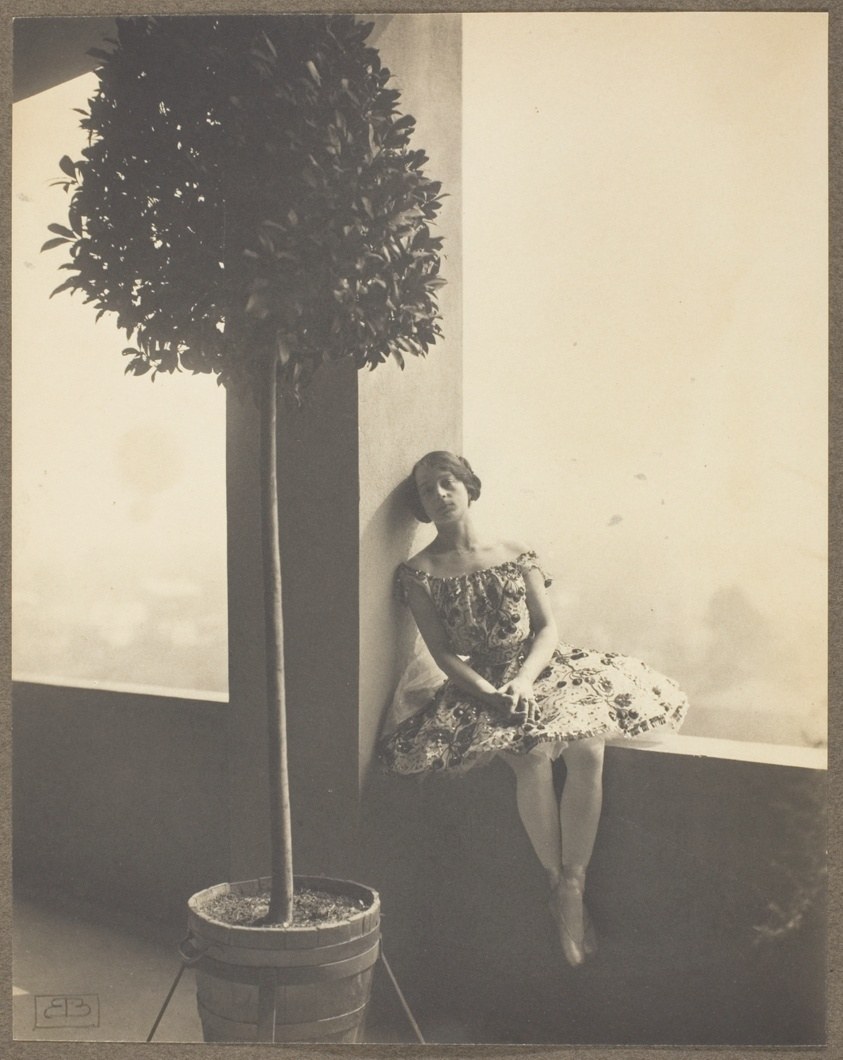
Mlle Julie Hudak Premier Ballerina of Chicago
Elizabeth Buehrmann American, 1886–1965
- Medium:
- Gelatin silver print
- Collection:
- Photography and Media
- Source:
- Art Institute of Chicago
- Rights:
- Rights reserved by the holding institution — do not reuse without permission. Source record ↗
- Recorded as:
- AIC — rights reserved
The image is historically significant as a record of how a professional female ballet dancer of this period was presented to the public—not as a body in motion performing difficult technique, but as a fashionable, tasteful person of leisure and cultivation. It reveals the gap between the professional demands of ballet training and performance and the social construction of the ballerina in early 20th-century American public culture. For historians of photography, Elizabeth Buehrmann's use of studio space, natural light, and compositional geometry exemplifies the artistic ambitions of art photography in this era.
What you are looking at
A young woman in an elaborately patterned light dress sits on the edge of a low bench or platform against a pale interior wall, positioned beside a large potted topiary tree. The tree, with its dense spherical crown of foliage and thick central stem, occupies the left side of the composition and rises well above her head. She sits in a relaxed, three-quarter pose with her weight settled to one side, her body angled toward the camera, her gaze directed downward and to the left. The photograph is lit from the right by strong natural light entering through a large window or opening behind her, which creates a luminous, almost ethereal quality and casts her silhouette softly against the wall. The setting appears to be an interior studio or conservatory space—spare, modernist, and deliberately composed. The interplay between the geometric precision of the potted tree and the organic grace of the seated figure creates a tension between formal arrangement and human ease.
The dancing
The woman's posture is one of stillness and introspection rather than active movement. She sits with her torso upright but her head tilted slightly forward and to the side, as if lost in thought. Her arms rest quietly in her lap; her legs are extended or crossed at the knee in a manner typical of seated portrait conventions. Her dress—a light, patterned fabric with what appears to be a short, full skirt—suggests youth and elegance but is not posed to display movement or technique. There is no evidence of turned-out legs, pointed feet, or the muscular engagement expected in a ballet pose. This is a portrait of a ballerina in repose, not a documentation of dance.
The dance depicted
The catalogue identifies Mlle Julie Hudak as 'Premier Ballerina of Chicago,' placing her within the professional ballet world of the early 20th century. The photograph does not depict her dancing; instead, it presents her as a public figure and a person of cultivation, posed in an artistic interior setting. The title asserts her status and professional rank, but the image itself is a society or studio portrait, not a dance documentation. The work belongs to a tradition of theatrical portraiture in which prominent performers were photographed in costume or semi-costume, often in carefully staged studio settings, for publication and circulation among patrons.
How it was made
This is a gelatin silver print, a photographic medium that emerged in the 1870s and became the standard for professional and art photography by the early 1900s. The technique allowed for rich tonal gradation and fine detail, as visible here in the subtle modulation of light across the wall and the fine rendering of foliage. The photograph exhibits careful compositional control—the framing, the use of natural light, and the placement of figure and object suggest the hand of a trained art photographer rather than straightforward documentation. The medium's capacity for reproducibility meant such images could be widely circulated in theatrical programs, newspapers, and society magazines.
About this work
This is a studio portrait of a Chicago-based professional ballet dancer, photographed by Elizabeth Buehrmann around 1910. It documents not the dancer's technical practice but her public identity as a cultivated artist and woman of the theatrical world. The photograph sits at the intersection of portraiture, fashion, and theatrical promotion—a genre of imagery that was central to the celebrity culture developing around theatrical performance in the early 20th century. The work shows the photographer's attention to composition and lighting, using architectural and botanical elements to create a setting that speaks to refinement and modernity rather than theatrical spectacle.
How to look at it
Attend to the composition first: notice how the photographer has balanced the vertical thrust of the tree against the horizontal line of the bench, and how the woman's tilted head and downward gaze create a diagonal that leads the eye through the frame. The light is key—it is not theatrical spotlighting but a softer, more naturalistic illumination that models form without drama. The woman is not 'performing' for the camera but appears absorbed in private thought, a mood the photographer has created through pose, lighting, and the meditative quality of the setting. This is an exercise in what photography of the era called 'artistic' portraiture—the use of fine technique and composed setting to elevate the subject into the realm of art.
The artist
Elizabeth Buehrmann (1886–1965) was an American photographer active in the early 20th century. Her career spanned the period when photography was establishing itself as an art form distinct from documentary or commercial work. She worked in portraiture and theatrical subjects, positioning her practice within both the commercial sphere of theatrical promotion and the artistic sphere of pictorialist or art photography. The careful composition and attention to light and form evident in this work are consistent with the artistic photography movement of the period, which valued aesthetic arrangement and subtle tonal control.
The period
In 1910, ballet in America was still largely imported from Europe; professional ballet companies and dancers were still a relatively rare and elite cultural presence outside major cities. Chicago had a growing theatrical culture and a wealthy patron class interested in European art forms. The photograph belongs to a moment when theatrical photography was becoming an important tool for publicity and the construction of celebrity. In photography more broadly, 1910 was a moment of transition: pictorialism—the art photography movement that valued hand-crafted, compositionally sophisticated images—was at its height, while commercial and documentary photography were becoming more direct and immediate. Buehrmann's work sits comfortably within the pictorialist aesthetic.
Where it lives
The work is held by the Art Institute of Chicago in its Photography and Media collection, catalogued as a gelatin silver print. As a photograph of a theatrical performer, it likely circulated originally in theatrical and society contexts—in programs, newspapers, or photographic publications—before entering a museum collection.
Dance in this work
Questions about this work
Why is this called a ballet photograph if the woman isn't dancing?
In the early 20th century, theatrical performers were regularly photographed in costume or elegant dress as part of their public promotion, whether or not the photograph showed them actually performing. This is a portrait of a professional ballet dancer—a record of her public identity and status—rather than a documentation of her dancing. Such images were essential to the celebrity culture of the theater.
Who was Julie Hudak?
The catalogue identifies her as 'Premier Ballerina of Chicago' around 1910, placing her among the professional ballet dancers working in American cities during the early 20th century. Beyond this title, little contextual information is recorded. The photograph itself is her primary historical trace.
What is the potted tree for?
It is a compositional element chosen by the photographer. Its geometric form and vertical thrust provide formal balance to the seated figure and contribute to the cultivated, artistic mood of the portrait. Potted plants were common elements in studio portraiture of the period, signaling both nature and cultivation—refinement.
More dance artwork





