49 works in this view — arrow keys or swipe to move between them.
Dance in Art
Margaret Severn
Arnold Genthe American, born Germany, 1869–1942
- Medium:
- Gelatin silver print
- Collection:
- Photography and Media
- Source:
- Art Institute of Chicago
- Rights:
- Rights reserved by the holding institution — do not reuse without permission. Source record ↗
- Recorded as:
- AIC — rights reserved
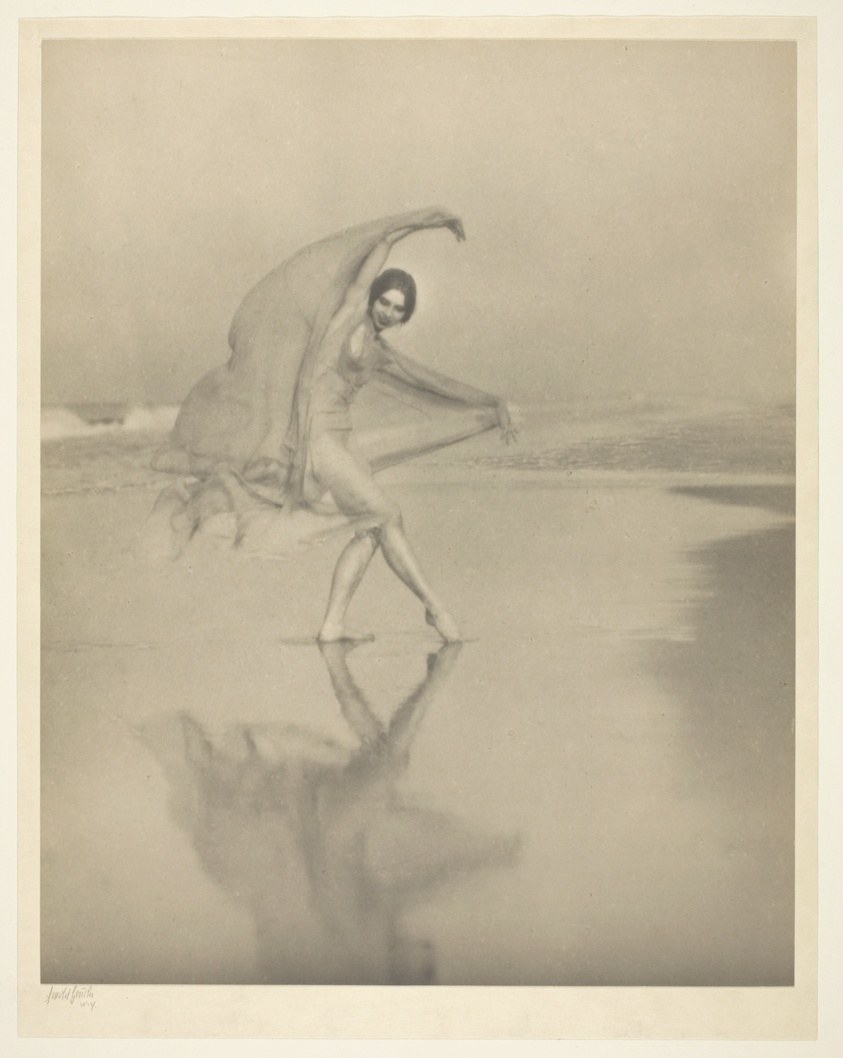
This photograph documents a crucial moment in the history of Western concert dance, when women dancers and choreographers were asserting the right to move in new ways and to claim artistic authority over their own bodies. The image shows the aesthetic that dominated early modern and interpretive dance: the body as a sculptural form, the embrace of flexibility and lateral movement (moves unknown in classical ballet), and the use of drapery and natural settings to create mood and meaning. For historians of dance photography, Genthe's work represents the pinnacle of pictorialist technique applied to the moving body.
What you are looking at
A single female dancer stands alone on a vast, reflective beach or shallow water, photographed in soft, diffused light that renders the scene almost ethereal. She wears a long, draped garment—possibly a shawl or wrap—that curves dramatically around her body, creating an arc that frames her pose. The fabric catches the light, appearing pale and luminous against the muted, overcast sky and flat horizon. The dancer's body is bent into a deep lateral curve, her torso folded sideways with one arm extended upward in a graceful line, the other arm lower, creating an elegant S-shape. Her head is tilted toward her raised shoulder. The setting is minimalist: water or wet sand stretches flat and empty behind her, with no other figures, structures, or objects visible. The image has the soft, slightly hazy quality of pictorialist photography, emphasizing mood and line over sharp detail.
The dancing
A single dancer in a pronounced lateral flexion, the body weight shifted to create an extended curve from foot to fingertips. The raised arm reaches upward and back in a soft, sustained extension; the lower arm is relaxed but still articulate. The pose suggests deep flexibility and control, with the torso fully engaged in a sustained side bend. The drapery appears to be part of the choreography rather than incidental costume, flowing with and emphasizing the direction of the movement. There is no visible footwork or weight transfer; the image freezes a single held position of balance and extension.
The dance depicted
This appears to be interpretive or art-dance from the early 20th century, the kind of expressive movement that emerged in reaction against academic ballet's rigid codes. The pose—a sustained lateral curve with extended arms and flowing drapery—is characteristic of the Denishawn school or similar modern/interpretive approaches of the 1920s, which emphasized sculptural body forms, the integration of drapery as both costume and movement device, and the exploration of flexibility and line over technical vocabulary. The absence of any rigid frame or turnout, and the emphasis on the body's three-dimensional shape rather than position, places this outside classical ballet. The solitary, contemplative mood and the integration with a natural landscape suggest a solo lyric or character piece rather than an ensemble or narrative dance.
How it was made
This is a gelatin silver print, a photographic medium that allows for precise tonal control and was the standard for art photography by the 1920s. Arnold Genthe, a renowned pictorialist photographer, used this medium to emphasize atmosphere and form over documentary detail, employing soft focus and careful lighting to create an effect close to painting. The print's luminosity and the softness of the background suggest deliberate exposure and development choices designed to produce a romantic, theatrical effect rather than a candid record. This technique places the image in the tradition of pictorialist dance photography, which sought to elevate dance to the status of high art.
About this work
This is a pictorialist photograph of a solitary dancer in a moment of sustained lateral flexion, dressed in flowing drapery and photographed on an empty beach. The image dates to 1923 and is the work of Arnold Genthe, one of the most important dance photographers of the early 20th century. The photograph belongs to the history of early modern and interpretive dance, which emerged in the 1910s and 1920s as a reaction against the formality of classical ballet, seeking instead to explore the body's expressive potential through flexibility, line, and integration with music and landscape. Genthe's pictorialist technique—soft focus, atmospheric lighting, emphasis on form over narrative—was itself an artistic statement about dance's claim to be a serious art form worthy of aesthetic consideration.
How to look at it
Notice how the photograph captures not a moment of action but a moment of stillness—a sustained shape held in space. The emphasis is on the curve of the body and the line created by the extended arm, not on the dynamics of weight or the sequence of movement. The drapery is not incidental; it follows the body's line and amplifies the visual impression of the curve. The empty landscape and soft light create a mood of solitude and contemplation, which was a new subject for dance photography: rather than documenting a theatrical event or a moment of virtuosity, the image offers the body as a subject for aesthetic appreciation in its own right. The soft focus and high key of the image push it toward the realm of painting and away from documentary photography.
The artist
Arnold Genthe (1869–1942) was born in Germany and emigrated to the United States, where he became one of the most celebrated photographers of the early 20th century. He was a pictorialist, a movement within photography that rejected the documentary impulse in favor of soft focus, atmospheric effects, and the deliberate control of tone and light to create images that resembled paintings or drawings. Genthe is particularly celebrated for his photographs of San Francisco's Chinatown and for his extensive documentation of American dance and theatre, including numerous photographs of Ruth St. Denis, Ted Shawn, and other major figures of the period. His dance photographs are characterized by their elegance, their emphasis on line and form, and their refusal to document the literal moment in favor of creating an idealized, artistic vision.
The period
In the early 1920s, modern dance and interpretive dance were rapidly gaining prestige and audiences in the United States and Europe. Ruth St. Denis and Ted Shawn had founded their Denishawn school in 1915 and were touring internationally; Martha Graham was beginning her career; the Russian Imperial Ballet had recently emigrated to the West following the Russian Revolution, and Ballets Russes was at its height under Sergei Diaghilev. At the same time, pictorialist photography was beginning to decline as a dominant aesthetic (modernism and straight photography were ascendant), but it remained the preferred mode for artists seeking to elevate dance to the status of fine art. Genthe's photographs of dancers were widely distributed and collected during this period, shaping how educated American audiences understood and valued dance.
Where it lives
This work is held in the Photography and Media collection at the Art Institute of Chicago and derives from that collection's records. It is catalogued as a gelatin silver print and is dated 1923. Genthe's photographs of dancers are scattered across major American museums and archives, reflecting the broad circulation and respect for his work during his lifetime.
Dance in this work
Questions about this work
Who was Margaret Severn?
Margaret Severn (1903–1996) was an American dancer and student of Ruth St. Denis. She was known for her lyrical, interpretive style and her work in the Denishawn aesthetic. Genthe photographed several of his subjects multiple times across their careers; this image likely documents a moment during her association with the Denishawn school or a related interpretive dance practice.
What is interpretive dance, and how does it differ from ballet?
Interpretive dance (also called art dance or early modern dance) rejected the technical codes and constraints of classical ballet in favor of exploring the body's natural expressiveness, flexibility, and capacity to embody emotion and meaning. Where ballet emphasized turned-out legs, precise positions, and a vertical line, interpretive dancers used the full range of the body's mobility, including lateral flexion, contractions, and floor work. The style was pioneered by Isadora Duncan and later developed by Ruth St. Denis, Ted Shawn, and Martha Graham.
What is pictorialist photography?
Pictorialism was a late 19th and early 20th-century movement within photography that sought to establish the medium as a fine art by imitating the aesthetic effects of painting and drawing. Pictorialist photographers used soft focus, careful control of light and tone, and hand-applied techniques to create romantic, atmospheric images that rejected the documentary clarity associated with commercial or scientific photography. The movement declined after World War I but remained influential in art and dance photography.
Why photograph dance on a beach?
The beach setting serves multiple artistic purposes in this image. It removes the dancer from the theatrical context, presenting her as a solitary figure in dialogue with nature rather than as part of an entertainment spectacle. The flat, reflective surface of the water and sand emphasizes line and form; the empty landscape heightens the mood of introspection and contemplation. This approach reflects the influence of Greek art and the classical ideal on interpretive dance aesthetics of the period.
More dance artwork





