49 works in this view — arrow keys or swipe to move between them.
Dance in Art
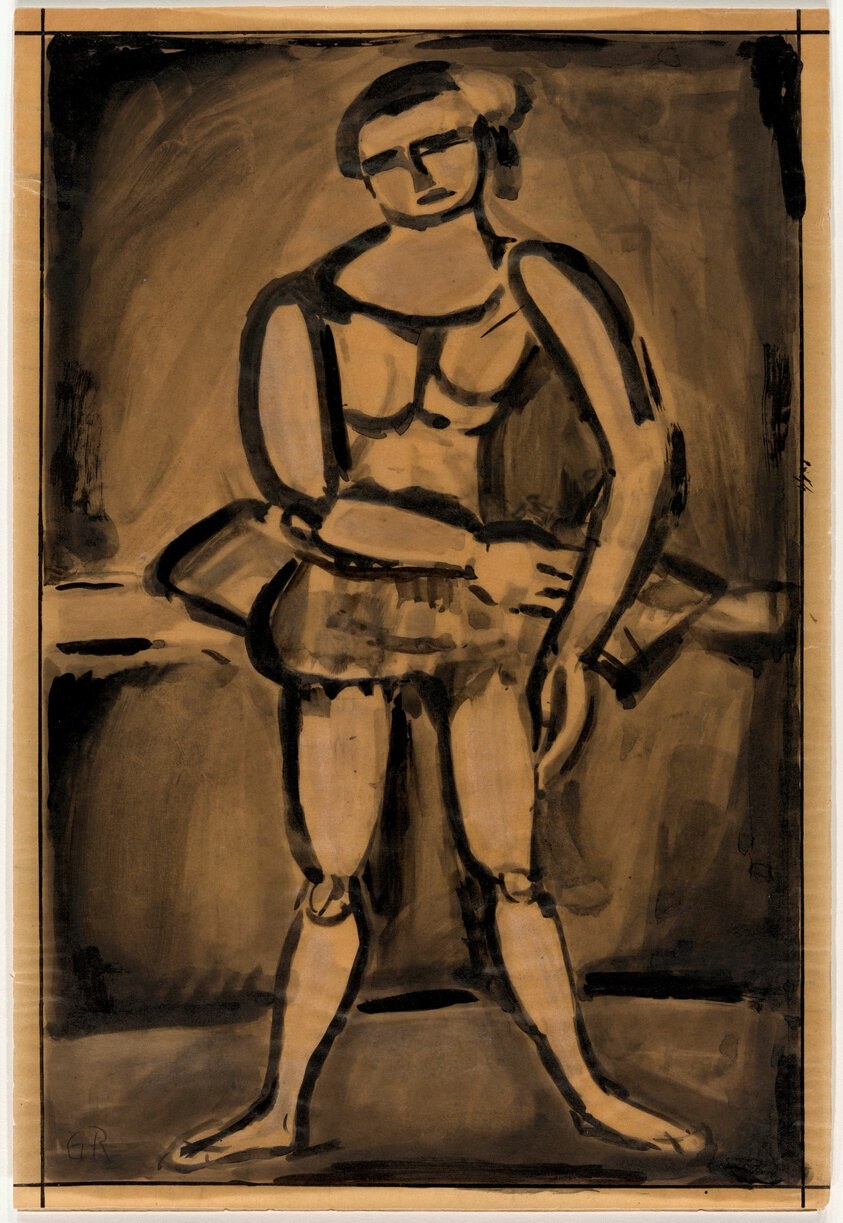
The Ballerina, drawing for plate eight from Cirque
Georges Rouault French, 1871–1958
- Medium:
- Brush and black ink and watercolor, over traces of graphite, with border in pen and black ink, on tan wove tracing paper
- Collection:
- Prints and Drawings
- Source:
- Art Institute of Chicago
- Rights:
- Rights reserved by the holding institution — do not reuse without permission. Source record ↗
- Recorded as:
- AIC — rights reserved
Rouault's Cirque series challenged the hierarchy that placed classical ballet above circus and working-class performance, presenting acrobats and performers with the formal rigor usually reserved for fine art subjects. The work demonstrates how modernist artists used the circus body—muscular, bound, displayed—to explore abstraction, monumentality, and the figure freed from classical idealization. For historians of dance and performance, this drawing documents the aesthetic fascination with circus acrobatics in early twentieth-century European art.
What you are looking at
A single figure dominates the composition, rendered in bold black contour lines against a warm tan ground with atmospheric brown washes. The dancer stands in a frontal, almost heraldic pose, weight settled on both legs, torso bared and muscular. The figure wears a short skirt or skirts cinched at the waist with a decorative belt, and the legs are bound or wrapped at the shins and ankles—a costume element that reads as deliberately archaic or exotic. The head is tilted slightly, the gaze direct, the expression severe. Rouault's technique here—sparse, gestural line work over wash—creates an effect of both monumentality and rawness, as if the figure has been distilled to its essential form. The setting is minimal: the figure inhabits a shallow picture plane defined only by the rectangular border and the background's warm, indeterminate space. This is a study for a plate in a larger work, and its isolation and formal frontality suggest it may represent a character or archetype rather than a narrative moment.
The dancing
The dancer is presented frontally with equal weight on both legs and the torso upright and exposed—a posture of display rather than motion. The arms hang at the sides or are held loosely; there is no complex arm vocabulary or classical port de bras. The wrapped legs and bound ankles suggest restricted or specialized footwork. The figure's solidity and symmetry, combined with the direct gaze and compact stance, convey a sense of archetype or symbol rather than a dancer caught mid-gesture. The body is neither elongated in the classical ballet manner nor twisted into a dynamic contraposto.
The dance depicted
This is a costume or character study for a circus figure, most likely a principal acrobat or strongman performer from the commedia dell'arte or circus tradition rather than classical ballet. The title 'The Ballerina' is misleading: the wrapped legs, the compact musculature, the bare torso, and the archaic or non-Western costume elements all point to circus performance or a theatrical grotesque rather than ballet proper. Rouault was fascinated by circus life and working-class performance; the work belongs to his larger investigations of circus subjects (Cirque, 1930). The binding at the ankles and shins suggests either acrobatic preparation or a stylized costume element meant to evoke an exotic or archaic tradition. Without the title, one might read this as a performer from commedia dell'arte, harlequinade, or non-European theatrical traditions.
How it was made
The work is executed in brush and black ink and watercolor over graphite on tan wove tracing paper, with pen and black ink used for the border. Tracing paper is a working material—light, absorbent, and semi-transparent—and suggests this is indeed a preparatory drawing for a printed plate, as the catalogue states. Rouault's technique here relies on bold, expressive line to construct the figure, with warm watercolor washes creating depth and atmosphere around the contours. The translucency of tracing paper and the fluidity of watercolor allow the warm tan ground to show through, unifying figure and space. This would later be transferred to a plate for the Cirque suite, making this both a finished work in its own right and a functional intermediate stage in a printmaking process.
About this work
This is a preparatory drawing for a plate in Rouault's Cirque suite (1930), a series devoted to circus performers and the theatrical grotesque. The work presents a single figure in frontal display, stripped of narrative context and rendered with bold, economical line work. The costume and bound legs suggest either acrobatic performance or a character from commedia dell'arte tradition, not classical ballet—despite the title. Rouault's interest was in the body as an object of labor, spectacle, and formal interest; the dancer (or acrobat, or performer) becomes a study in human geometry and monumental simplicity. The work belongs to early twentieth-century modernism's reappraisal of circus, cabaret, and vernacular performance as legitimate subjects for high art.
How to look at it
Look at the frontality and stillness of the pose: this is not a moment of action but of presentation, the performer at rest or on display. Notice how Rouault uses the rectangular border to frame the figure like a sculptural object; the horizontal and vertical lines of the frame echo the geometry of the body itself. Observe the economy of line—how much information is conveyed by black contours alone, and how the watercolor wash creates atmosphere without modeling or depth. The bare musculature is emphasized; this is a body presented as labor and material, not grace. The bound ankles and wrapped legs are the most specific costume detail and reward close attention: they mark this as a specialized performer, not a ballet dancer. Rouault's style here is close to both Expressionism (the bold line, the distortion) and to the decorative arts tradition (the emphasis on outline and flat form).
The artist
Georges Rouault (1871–1958) was a French Expressionist painter and printmaker who trained as a stained-glass artisan before turning to fine art. He was drawn to circus, music hall, and street performance throughout his career, finding in those subjects a raw, human truth he felt was absent from polite society. His Cirque suite (1930) represents the culmination of decades of sketching performers, acrobats, and clowns. Rouault's bold use of line, his emphasis on expressive distortion over anatomical accuracy, and his color palette of earth tones and blacks were partly inherited from his training in decorative arts but also reflected his fascination with Expressionism and Fauvism. He often worked across media—painting, drawing, printmaking—treating each as equal modes of expression.
The period
The 1920s and early 1930s saw a widespread European artistic interest in circus, cabaret, and vernacular entertainment as subjects worthy of modernist attention. The Surrealists, Expressionists, and Constructivists all turned to the circus body as a site of authentic human experience and formal experimentation. In France, the Cirque Medrano and other Parisian circus venues were frequented by artists, writers, and composers. This coincided with a broader de-centering of classical ballet as the sole legitimate dance form; the Ballets Russes, while maintaining classical technique, incorporated exotic and primitive elements, and artists increasingly looked to non-academic traditions. Rouault's Cirque suite appeared at a moment when the circus performer and acrobat had become emblems of modernist values: authenticity, physical discipline, and freedom from academic convention.
Where it lives
This drawing is held by the Art Institute of Chicago in its Prints and Drawings collection. It is catalogued as a preparatory study for plate eight of Rouault's Cirque suite, a major series of prints and drawings produced around 1930. The work's status as a drawing on tracing paper reflects its intermediate position between sketch and finished print.
Dance in this work
Questions about this work
Is this actually a ballet dancer?
Despite the title, probably not. The wrapped ankles, bound shins, muscular build, bare torso, and archaic costume all suggest a circus acrobat or commedia dell'arte character. Rouault titled many works in his Cirque series ironically or ambiguously. The binding at the ankles is the key detail: it points to acrobatic performance or an exotic theatrical tradition rather than classical ballet technique.
Why is this on tracing paper?
Tracing paper was a standard material for transferring designs to printing plates. Because it is semi-transparent and takes ink well, an artist could draw on tracing paper and then use it as an intermediary to transfer the image to a copperplate, stone, or block. This drawing was preparatory to a printed plate in Rouault's Cirque suite.
What is the Cirque series?
Rouault's Cirque is a suite of prints and drawings devoted to circus performers, produced around 1930. It represents the artist's long engagement with circus life and his belief that acrobats and performers embodied truths about human labor and physicality that fine art had neglected. The series marked a high point of European modernist interest in the circus as a subject.
Why would an artist care about how the ankles are wrapped?
Wrapped or bound ankles are a marker of specialized performance: they suggest either acrobatic training (where the ankles need support) or a costume element drawn from non-Western or archaic traditions. Rouault was interested in the material reality of the performer's body—what it had to do, how it was prepared, what it signified. The binding is not decorative but functional, and it tells us something essential about what kind of performer this is.
More dance artwork





