49 works in this view — arrow keys or swipe to move between them.
Dance in Art
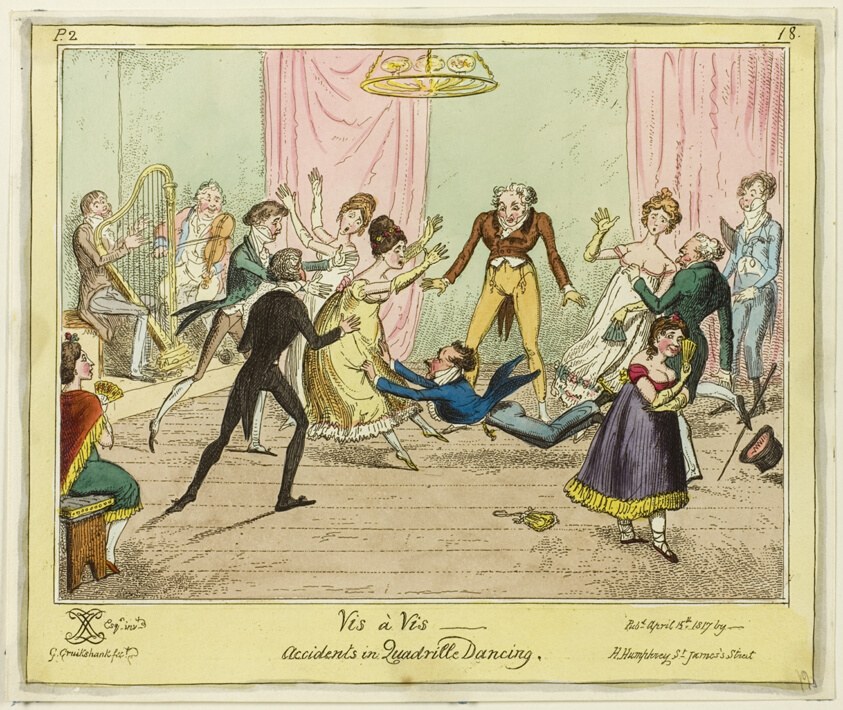
Vis a Vis - Accidents in Quadrille Dancing
George Cruikshank (English, 1792-1878) published by Hannah Humphrey (English, c. 1745-1818)
- Medium:
- Hand-colored etching on paper
- Collection:
- Prints and Drawings
- Source:
- Art Institute of Chicago
- Rights:
- Public domain — free to use, share and adapt.
- Recorded as:
- CC0 (Public Domain)
This etching is one of the few contemporary visual records of quadrille performance in an English ballroom, made by a major satirist with a gift for anatomical comedy. It documents not just the dance but the social context—the musicians, the spectators, the architecture, the dress codes—that surrounded it. For historians of dance, it reveals how quadrille accidents were understood as both comic and newsworthy enough to merit commercial publication.
What you are looking at
A hand-colored etching depicts a chaotic moment in a ballroom quadrille, with the dance formation collapsing into comedy. The setting is a grand interior with a chandelier overhead and pink silk curtains framing the scene. A musician plays harp at left; well-dressed spectators line the walls. At center, dancers have fallen or stumbled—a man in blue breeches lies on his back with legs splayed, a woman in yellow has lost her balance beside him, and another figure sprawls across the floor. The remaining dancers—in formal evening dress—gesture in alarm or amusement, their arms raised in shock. The composition captures the precise moment of social catastrophe: the dance line fractured, dignity abandoned, and onlookers caught between horror and hilarity. The title, printed beneath in French, announces this as "Vis à Vis: Accidents in Quadrille Dancing," locating the humor in the formality of the quadrille's strict geometric demands meeting human clumsiness.
The dancing
The fallen figures show exaggerated vulnerability against the stiffness of quadrille etiquette. The supine man's legs are thrust upward in an undignified sprawl; the woman beside him has twisted awkwardly, her arms outstretched. The still-upright dancers frame the disaster with raised hands, open mouths, and bodies turned toward the chaos—their postures reading as surprise rather than recovery. The composition emphasizes the contrast between the controlled geometric precision the quadrille demanded and the sudden loss of bodily control. No dancer here maintains the composed frame or alignment the dance required.
The dance depicted
This is unmistakably a quadrille, the dominant social dance of the Regency and early 19th-century ballroom. The title confirms it; the setting and dress match; and the formation—couples arranged in squares facing each other, now disrupted—is the signature structure. The quadrille was a French import prized for its geometric complexity and its requirement of precise timing and footwork across multiple dancers. Accidents during such dances were real hazards: slippery floors, tangled hems, and the cognitive load of remembering figures left dancers vulnerable to the very mishaps Cruikshank depicts. The work documents both the dance itself and the social anxiety beneath ballroom propriety.
How it was made
This is a hand-colored etching, a print medium that allowed rapid mass production and circulation. The etching technique—with its fine lines and capacity for detail—is ideal for satirical work: Cruikshank captures facial expressions, the precise folds of fabric, and the comic exaggeration of falling bodies with equal clarity. Hand coloring added vibrancy and allowed differentiation of dress. As a colored etching, this would have been affordable to middle-class households and circulated widely as satirical social commentary, making it both an artwork and a vehicle for public humor about ballroom culture.
About this work
This is a satirical etching by George Cruikshank documenting the quadrille, the most fashionable social dance of 1817 England, at the precise moment it catastrophically fails. The quadrille was a geometric, formal dance imported from France and prized for its complexity; it demanded precise footwork, alignment, and coordination across multiple couples. Cruikshank chose to freeze the moment when bodies betray expectation—when the carefully controlled ballroom dissolves into slapstick. The work sits at the intersection of dance history and social satire: it is a primary document of how the quadrille was danced, how ballrooms were organized, and how the Regency public perceived the gap between pretension and reality in fashionable leisure.
How to look at it
Notice the moment Cruikshank chose: not the beginning of the disaster but its full comedic bloom, with fallen bodies still in mid-air and the surrounding dancers frozen in shock. The composition uses the spectators—standing safely at the margins, hands raised—as a frame for the catastrophe at center. The precision of the etching line heightens the satire: every wrinkle of fabric, every expression of horror, every flailing limb is rendered with care, making the chaos almost balletic. The title promises "accidents," and Cruikshank delivers visual proof that even the most formal, controlled social ritual can dissolve into farce.
The artist
George Cruikshank (1792–1878) was England's leading satirical printmaker of the early 19th century, celebrated for his sharp political commentary, caricatures of public figures, and scenes of everyday social folly. His etched and engraved works circulated widely in print shops and were collected by middle-class audiences hungry for witty social observation. This work exemplifies his method: precise draftsmanship deployed for exaggeration and comedy, targeting the pretensions of fashionable society. He often depicted leisure, courtship, and ballroom culture as sites of human vulnerability and absurdity.
The period
The quadrille became the dominant ballroom dance in England in the 1810s–1820s, following its popularity in Napoleonic France. It was prized among the gentry and aspiring middle class as a mark of sophisticated taste and proper training. Dance manuals of the period emphasize the precision required: specific figures, exact timing, and the coordination of multiple couples. At the same time, the early 19th century saw a flourishing of satirical prints mocking ballroom culture—a sign that the formality and expense of such entertainments invited public scrutiny and humor. Cruikshank's "Accidents in Quadrille Dancing" sits within this tradition of ballroom satire, treating the quadrille as a site of social comedy.
Where it lives
This hand-colored etching is held in the Prints and Drawings collection of the Art Institute of Chicago. It was published by Hannah Humphrey, a London print seller and publisher active in the late 18th and early 19th centuries, who was instrumental in circulating satirical prints by major artists including Cruikshank and James Gillray.
Dance in this work
Questions about this work
Was the quadrille really that dangerous?
Yes, by modern standards. The quadrille required precise footwork, rapid changes of direction, and coordination across multiple couples—all on floors that could be slippery, in clothing that restricted movement, under the pressure of being watched. Missteps were common enough that Cruikshank's satire rings true. Dance manuals of the period often address the problem of accidents and offer remedies.
Why would someone publish a print making fun of the quadrille?
Satire was commercially successful. Cruikshank and his peers profited by mocking the pretensions of fashionable society—and fashionable people bought the prints. This work gently ridicules the gap between the ballroom's formal elegance and human clumsiness, a comedy that transcends class. It was entertainment, not endorsement.
Is this a real event or imaginary?
It is imaginary in the specific incident but documentary in its details. Cruikshank depicts the quadrille formation, ballroom architecture, and dress with accuracy. The "accident" is his satirical invention—a composite of common ballroom mishaps exaggerated for comic effect.
What is the harp player doing there?
Harps and other orchestral instruments provided music for ballroom dancing. The musician at left is the orchestra, shown continuing to play even as chaos unfolds, which heightens the satire: the music goes on, indifferent to the dancers' disaster.
More dance artwork





