49 works in this view — arrow keys or swipe to move between them.
Dance in Art
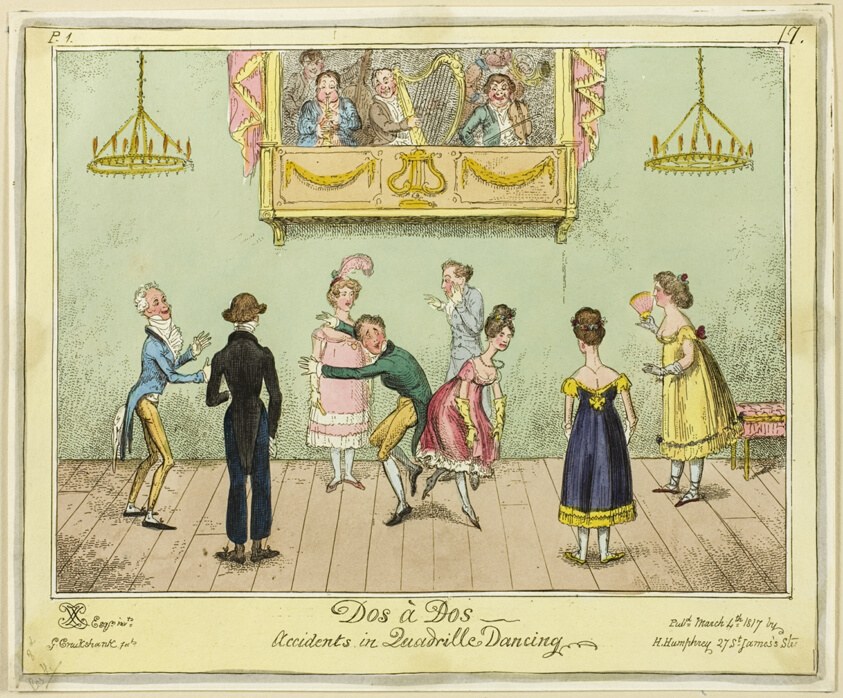
Dos-a-dos - Accidents in Quadrille Dancing
George Cruikshank (English, 1792-1878) published by Hannah Humphrey (English, c. 1745-1818)
- Medium:
- Hand-colored etching on paper
- Collection:
- Prints and Drawings
- Source:
- Art Institute of Chicago
- Rights:
- Public domain — free to use, share and adapt.
- Recorded as:
- CC0 (Public Domain)
For dance historians, this print is a rare visual record of how the quadrille was actually executed and experienced in Regency London—not idealized, but lived. For art historians of satire and caricature, it exemplifies how the human body in motion provided an irresistible target for comic exaggeration and social critique. The print proves that by 1817, the quadrille was so well-established and so central to fashionable life that its failures could be treated as comedy; it was a marker of social identity and aspiration, and thus fair game for ridicule.
What you are looking at
A hand-colored etching depicting a ballroom scene of comic chaos during a quadrille. The setting is an elegant interior with a pale green wall, two hanging chandeliers, and an ornate box or gallery above where three spectators look down on the action below. The floor is rendered in perspective planks. Six figures occupy the dance floor in various states of comedic disarray: a gentleman in dark coat and hat stands composed on the left; next to him, two figures in pink and yellow are entangled, the woman's skirt caught up; in the center, a couple in a closed dance hold are tumbling backward, the man's legs flying upward in an exaggerated loss of balance; a woman in a dark blue dress stands dismayed; and on the right, another couple appears to be recovering or repositioning. The title "Dos à Dos—Accidents in Quadrille Dancing" inscribed below identifies both the named figure (the dos-à-dos, a back-to-back passing movement) and the satirical intent. The hand-coloring is delicate: pink, yellow, blue, and flesh tones against the pale ground, with brown and gold accents in the furniture and metalwork.
The dancing
The bodies display exaggerated, knockabout postures that parody the formality of ballroom dancing. The falling couple at center shows the man nearly horizontal, legs and arms flung wide, while his partner maintains a seated balance—a theatrical impossibility rendered as slapstick. Other couples are off-balance, clutching at one another, skirts and coats in disarray. The standing figures show either alarm (the woman in blue) or composed bewilderment. The artist has rendered limbs at angles that violate ballroom decorum: knees bent awkwardly, arms akimbo, weight distributed without elegance. The scale is intimate—all six dancers occupy a shallow, crowded space, which heightens the sense of collision and social chaos.
The dance depicted
The work depicts a quadrille, the fashionable ballroom dance of the Regency and early 19th-century era, performed in this case as a comedy of errors. The title names the dos-à-dos, a figure in which partners pass back-to-back, but the print shows not the elegant execution of that move but its catastrophic failure: collisions, trips, and loss of balance. Quadrille was danced in sets of four couples and required precise coordination of figures (the dos-à-dos, the promenade, the chaîne, allemande turns). The artist has seized on the moment when coordination breaks down—the instant of social disaster that satire thrived on. This is not instruction in how to dance the quadrille but mockery of its pretension and the physical comedy lurking within its rigid formality.
How it was made
This is a hand-colored etching, a technique that allowed rapid production and distribution of satirical prints in the early 19th century. Cruikshank's etched line is fine and precise, defining figure and space with economy; the hand-coloring (applied after printing) is applied in flat, bright washes that emphasize the comic character. Etching was the medium of choice for caricaturists and satirists of this period because it could be reproduced in quantity and sold cheaply to a broad urban audience—prints were not luxury objects but disposable social commentary meant to circulate in print shops, homes, and clubs. The technique's combination of precise line and decorative color allowed both the legibility of the comedy and the visual appeal that made such prints collectible.
About this work
This is a Regency-era satirical print by the English caricaturist George Cruikshank, depicting a quadrille at the moment its choreography collapses into physical comedy. The quadrille was the dominant social dance of ballroom culture in the 1810s–1830s, demanding precision and decorum; Cruikshank's print captures the disaster that occurs when that decorum fails. The work belongs to a rich tradition of satirical dance imagery that mocked the pretensions of fashionable society by showing its formal rituals undone. It documents both the dance itself—what a quadrille looked like, how it was performed, and what its failures risked—and the anxieties of its era about physical grace, social standing, and the gap between aspiration and execution. Published by Hannah Humphrey, a prominent London printer of satirical prints, the work would have circulated among the urban middle and upper classes who both danced quadrilles and enjoyed laughing at their mishaps.
How to look at it
Look first at the moment frozen: not the elegant execution of a figure, but the instant of collapse. The artist has chosen the nadir—the moment of maximum social embarrassment and physical disorder. Observe how the tumbling couple at center dominates the composition; their imbalance radiates outward, destabilizing the other dancers and the entire social space. Notice the precision of the line work that defines each figure—Cruikshank draws with absolute control even as he depicts loss of control. The hand-coloring picks out pink and yellow fabrics that signal fashionability; that fashionable dress is now compromised, caught and disordered. Attend to the spectators in the box above, whose composed indifference or interest contrasts with the chaos below; they frame the disaster as spectacle. The title tells you the move (dos-à-dos) but the image shows you what happens when it goes wrong.
The artist
George Cruikshank (1792–1878) was the preeminent English caricaturist and satirical printmaker of the early 19th century, celebrated for his sharp observation of social life and his technical virtuosity in etching. He produced thousands of prints on political, moral, and social subjects, often in collaboration with writers and publishers. Hannah Humphrey, who published this print, was a renowned London printseller and publisher of satirical and caricature prints; her shop was a hub of radical and witty commentary on Regency society. Cruikshank's prints on dance, fashion, and ballroom life form a substantial body of work documenting the anxieties and absurdities of fashionable society.
The period
The quadrille rose to dominance in European ballroom culture in the 1810s, imported from France and rapidly adopted as the fashionable dance of Regency London. It replaced the minuet and cotillion as the dance of choice for formal balls and fashionable assemblies. The period saw a boom in satirical prints on ballroom life, as the ballroom became a site of social anxiety—a place where rank, wealth, and pretension were on display and vulnerable to ridicule. Cruikshank and his contemporaries produced dozens of prints on dancing disasters, unsuitable partners, and the physical comedy of the ballroom. In the visual arts more broadly, this era saw the rise of caricature as a dominant form of social commentary, alongside the emergence of Romanticism's fascination with the body in motion and feeling. Dance itself was becoming a subject of serious interest in art and literature; Cruikshank's comic treatment did not exclude dance from cultural significance but rather confirmed its centrality to social identity.
Where it lives
The print is held in the Prints and Drawings collection of the Art Institute of Chicago. Satirical prints such as this were produced in quantity for sale in print shops and to subscribers; it is thus a document of popular visual culture and social satire rather than a unique or precious artwork, though it has survived because it was valued and preserved.
Dance in this work
Questions about this work
What is a quadrille?
A quadrille is a set dance for four couples (eight dancers), performed in a square formation, consisting of five figures or sections, each made up of several movements. It became fashionable in France in the late 18th century and dominated European ballrooms, especially in London, from the 1810s onward. Dances included the promenade, the dos-à-dos (passing back-to-back), the chaîne (a chain of hands), and turns. Precision and coordination were essential; mistakes and collisions were both common and comic.
Who was George Cruikshank?
George Cruikshank (1792–1878) was an English caricaturist and printmaker, the most celebrated of his era. He produced thousands of satirical prints on politics, morality, fashion, and social life, working in etching and sometimes combining his images with text. He was admired for his technical skill, his sharp wit, and his ability to capture the absurdities of contemporary society. His prints circulated widely among the urban classes and are now invaluable documents of Regency and early Victorian life.
Why would people buy satirical prints about dancing?
Ballroom dancing was central to fashionable social life and identity in Regency London; it was also a site of anxiety, snobbery, and competition. Satirical prints mocked pretension and incompetence, allowing people to laugh at the vanities and blunders of fashionable society—including, often, themselves. The prints were cheap, witty, and widely circulated in print shops, homes, and clubs, making them a form of mass entertainment and social commentary.
Is this print based on a real event?
It is unlikely that this print documents a specific incident. Rather, it exaggerates and caricatures the kind of mishap that could happen during a quadrille—the sort of physical comedy that was a recognized risk of the dance. Cruikshank worked from observation and imagination, synthesizing his knowledge of ballroom life into a composite image of chaos that would be recognizable and funny to his viewers.
More dance artwork





