49 works in this view — arrow keys or swipe to move between them.
Dance in Art
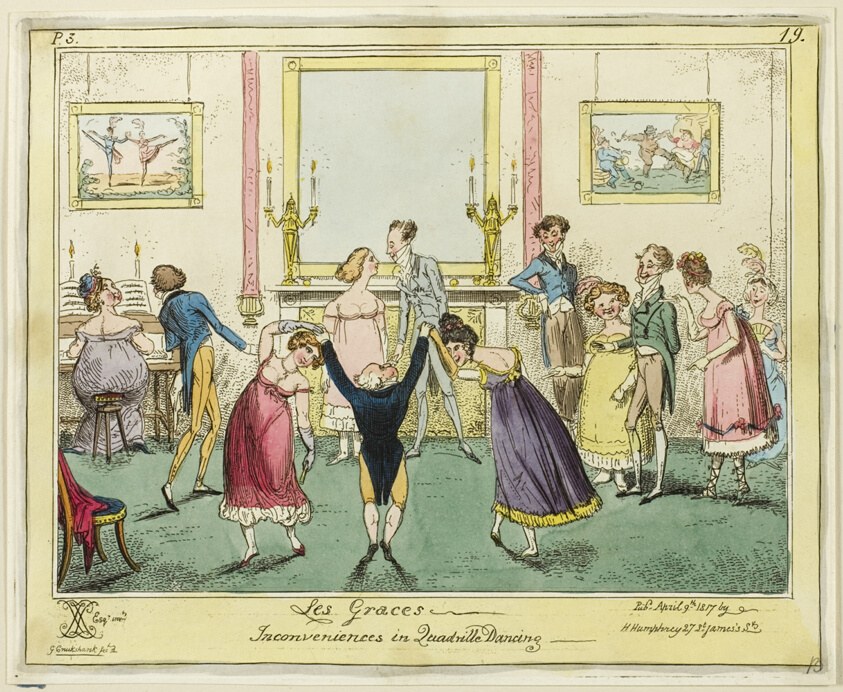
Les Graces - Inconveniences in Quadrille Dancing
George Cruikshank (English, 1792-1878) published by Hannah Humphrey (English, c. 1745-1818)
- Medium:
- Hand-colored etching and aquatint on paper
- Collection:
- Prints and Drawings
- Source:
- Art Institute of Chicago
- Rights:
- Public domain — free to use, share and adapt.
- Recorded as:
- CC0 (Public Domain)
For historians of dance, this print is primary evidence of how the quadrille was actually performed in the ballroom: the body angles, the size of the space, the ratio of dancers to musicians to spectators, and crucially, the real risk of physical exposure and embarrassment that attended even the most fashionable dancing. For students of visual culture, it shows how satirical prints used dance as a vehicle for social criticism, exposing the contradiction between Regency propriety and the body's unruly demands.
What you are looking at
A crowded drawing room scene depicts a quadrille in progress, with couples and onlookers arranged across a green floor beneath a grand mirror with ornate gilt frame. The room is decorated in Regency style with pink-striped wall panels, gilt candelabra, and small mythological paintings set into the walls above. In the center, a man in dark coat and breeches dances with a woman in a pink dress, while to his left another couple performs—the woman's skirt billowing outward. A second woman in dark dress with yellow-trimmed hem stands opposite the first couple. At the periphery, spectators in high-waisted gowns and formal dress watch the proceedings; one gentleman sits at the far left near a candelabra. The title below the print reads "Les Graces—Inconveniences in Quadrille Dancing," signaling that this is a satire on the mishaps and awkwardness that attended the fashionable dance.
The dancing
The dancers maintain the closed holds and upright carriage characteristic of Regency-era quadrille: the central male dancer's arm extends toward his partner's waist, while her arm raises toward his shoulder. The most prominent woman's skirt is caught mid-swing, ballooning outward—a visual joke about the physical comedy of the form. The dancers' legs and feet are barely articulated, typical of the period's satirical prints, but the body angles and turning positions match the demands of the quadrille's square figure. The composition shows at least four active dancers with several more waiting their turn or observing.
The dance depicted
This is a quadrille, the dominant fashionable ballroom dance of the Regency period (1811–1820), performed here by couples arranged in a square formation. The quadrille was a figure dance with set choreography, performed to music in 6/8 or 2/4 time, and required precise coordination between four couples. Cruikshank has chosen to illustrate the moment of maximum comic potential: a woman's skirt lifting during an energetic movement, exposing her legs—an embarrassing breach of decorum in an era of strict propriety. The dance was performed in formal drawing rooms like the one depicted, part of the social season's endless round of assemblies and balls.
How it was made
This is a hand-colored etching and aquatint, a printmaking technique that allowed for fine linear detail (the etched lines defining the figures and architecture) combined with tonal washes of color (the aquatint, creating the soft backgrounds and clothing). Hand coloring was applied afterward, visible in the careful separation of hues—the pink wall panels, flesh tones, and variety of dress colors. The technique made this work reproducible and affordable, allowing wide circulation as a satirical commentary on fashionable society; such prints were typically sold individually or as series in London print shops, reaching a broad middle-class audience interested in social observation and humor.
About this work
This 1817 satire by George Cruikshank captures a quadrille dancing scene in a Regency drawing room, freezing the moment of comedic mishap when a woman's skirt flies up, exposing the awkward physicality beneath polite ballroom dancing. Cruikshank was the preeminent social satirist of Regency England, and his work circulated widely through Hannah Humphrey's famous print shop on Bond Street, influencing public discourse on fashion, manners, and morality. The print documents both the steps and the social dynamics of quadrille dancing—a complex group dance that required not only physical skill but also emotional restraint, which Cruikshank's comedy reveals to be fragile.
How to look at it
Watch the woman's skirt in the center: it has lifted away from her legs in a full, almost horizontal plane, and that moment of uncontrolled physicality is the joke. The artist has caught the dance at the instant when motion overcomes propriety. Notice also the careful arrangement of spectators—some watching intently, others indifferent—which frames the dancing couples as simultaneously performers and subjects of scrutiny. The mirror above reflects the dancing figures, a convention of the period that allowed the artist to show both the action and the room's grandeur; it is a space designed for display.
The artist
George Cruikshank (1792–1878) was England's leading caricaturist and social satirist of the nineteenth century. He began his career in the 1810s producing prints for Hannah Humphrey's shop—the epicenter of London print culture—and became famous for his savage, anatomically exaggerated attacks on political figures, fashion, and social pretension. His style combined fine linear detail with grotesque distortion, allowing him to be both formally accomplished and wickedly funny. He went on to illustrate Dickens and produce thousands of social commentaries, but his early Regency prints, including scenes of dancing, established his reputation and influence.
The period
The quadrille emerged in Paris in the early 1800s and swept through European ballrooms in the 1810s and 1820s, becoming the dominant fashionable group dance. It required instruction, coordination, and a large enough space and party size to form squares of four couples—features that made it a marker of refined society and middle-class aspiration. In England, the quadrille was danced at Almack's Assembly Rooms and at private balls, and it generated intense social interest and anxiety. Simultaneously, Regency print culture—particularly the work of Cruikshank, Rowlandson, and others—made satire of fashionable dancing a popular genre, mocking dancers' pretensions, their physical exposure, and the absurdity of rigid social rules.
Where it lives
The work is held in the Prints and Drawings collection of the Art Institute of Chicago. It is one of thousands of satirical prints from the Regency and early Victorian periods that document fashionable life through humor and exaggeration; such prints were commercial objects, sold individually for a few shillings and often collected and bound into volumes.
Dance in this work
Questions about this work
Was the quadrille really this chaotic?
Not necessarily—this is satire, designed to find the worst moment. The quadrille was a set dance with repeating figures, and skilled dancers performed it with precision. But the physical comedy Cruikshank depicts was real: voluminous skirts, the risk of catching heels, and the difficulty of maintaining perfect timing across four couples all created potential for mishap. The satire exaggerates what was a genuine anxiety about bodily control in polite society.
What is the significance of the title 'Les Graces'?
"Les Graces" refers to the Three Graces of classical mythology—symbols of elegance, beauty, and harmony. By titling a comedy of mishaps 'Les Graces,' Cruikshank is making an ironic comment: the dancers aspire to grace and refinement, but the body betrays them. The quadrille itself was marketed as a graceful, continental (French) dance; Cruikshank's irony cuts against that pretension.
Who would have seen this print?
Cruikshank's prints were sold in print shops like Hannah Humphrey's and reached a broad London audience: middle-class people interested in fashion, servants and tradespeople who worked in fashionable houses, and aspiring dancers themselves. The satire appealed to those both inside and outside fashionable society—insiders enjoyed the knowing humor, and outsiders enjoyed the mockery of social pretension.
More dance artwork





