49 works in this view — arrow keys or swipe to move between them.
Dance in Art
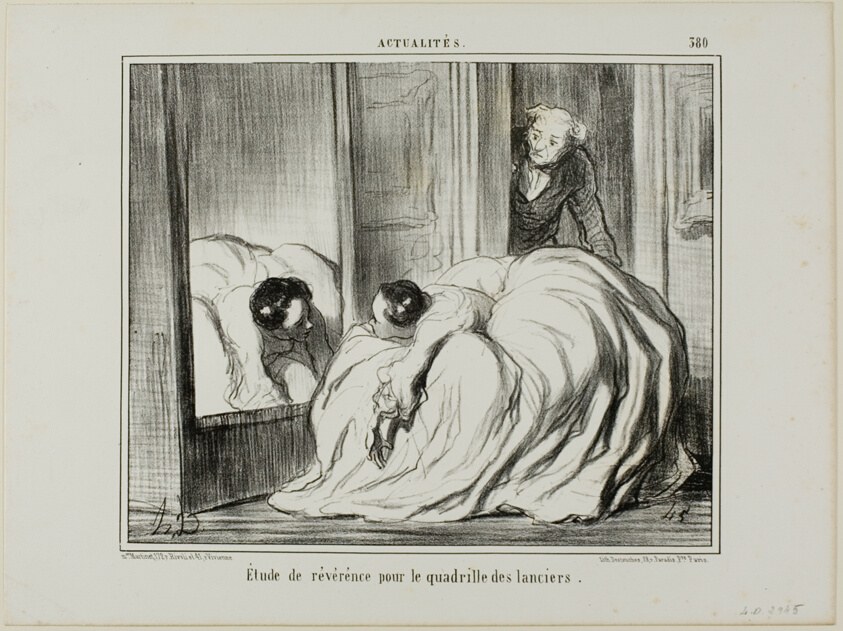
Study of Reverence for the Quadrille of the Lancers, plate 380 from Actualités
Honoré Victorin Daumier French, 1808-1879
- Medium:
- Lithograph in black on white wove paper
- Collection:
- Prints and Drawings
- Source:
- Art Institute of Chicago
- Rights:
- Public domain — free to use, share and adapt.
- Recorded as:
- CC0 (Public Domain)
This is one of the few images that directly depicts dance instruction in the 19th century, and it does so through a critical lens that reveals the gendered power dynamics at work. Daumier's satire exposes the Lancers not as an entertainment but as a site of social discipline, where deference and submission were literally choreographed into young women's bodies.
What you are looking at
A lithograph capturing a moment of instruction or correction in the Lancers quadrille. Two young women in full white ball gowns kneel or crouch low to the ground, their skirts billowing around them in voluminous folds. An older woman, dressed in dark clothing with white hair, stands watching from the right side of the composition, her posture and expression suggesting she is observing or critiquing the dancers' form. The interior setting is sparse, defined by vertical paneling or curtains in the background, which emphasizes the theatrical quality of the moment. The lithographic technique renders the white fabrics with careful gradation of tone, creating volume and movement, while the figures' faces are rendered with sharp focus. The composition has an intimate, almost rehearsal-like quality—this is dance instruction rather than performance.
The dancing
The two young dancers are positioned in a remarkably low, reverent posture—knees bent deeply, bodies folded forward from the hips, hands positioned demurely. This is not a typical quadrille step but rather an exaggerated courtesy or salutation. The older woman stands upright with arms at her sides, observing critically. The contrast between the dancers' deep submission and the instructor's authoritative stance is the image's central relationship. The dancers' postures suggest either an instruction in proper bowing or a satirical exaggeration of deference.
The dance depicted
This is a satirical study of the Lancers quadrille, a popular figure dance of the 1850s. The title 'Étude de révérence pour le quadrille des lanciers' (Study of Reverence for the Quadrille of the Lancers) signals that Daumier is examining—and likely mocking—the protocol of formal greeting within the dance. The Lancers was a regimented, geometric dance requiring precise figures and strict etiquette. The exaggerated depth of the dancers' curtsies suggests Daumier is satirizing either the excessive formality of the period's dance instruction or the absurd deference demanded of young women within these social rituals. The image reveals something of how the Lancers was actually taught: as a carefully supervised display of manners as much as movement.
How it was made
This is a lithograph, a print medium that allowed for wide distribution of topical commentary. Lithography's capacity for subtle tonal gradation is evident here in the rendering of the white fabrics, where the artist has built up careful layers of gray to suggest volume and light. The technique also permitted the sharp, expressive characterization of faces and the crisp definition of interior space. As a work published in the journal Actualités, this print was part of Daumier's regular output as a social satirist, designed for quick circulation and public consumption. The medium and context confirm this as journalism rather than fine art—a timely commentary on contemporary social manners.
About this work
This is a caustic observation of bourgeois dance culture in Second Empire France, captured in a medium—lithographic satire—that was Daumier's primary vehicle for social criticism. The image records not ballroom spectacle but ballroom instruction, and in particular the ritual of formal greeting that opened the Lancers quadrille. By isolating and exaggerating the moment of reverence, Daumier suggests that the dance was as much about performing submission as about executing figures. The work belongs in a dance gallery because it documents both the choreography of a specific historical dance and the social anxieties embedded in its practice—the pressure on young women to demonstrate absolute obedience through their bodies.
How to look at it
Attend first to the depth of the dancers' curtsey—the knees are bent to an extreme rarely seen in actual dance practice, suggesting that Daumier is isolating and intensifying a real gesture for satirical effect. Note the vertical emphasis in the composition: the standing instructor above, the kneeling dancers below, creating a hierarchy of power. The lithographic line is softest in the rendering of the women's faces and sharpest in the definition of the instructor's expression, guiding your eye to her as the authoritative voice. The white fabrics dominate the visual field, but they are weighted down by the dancers' postures; there is no lightness or grace, only submission.
The artist
Honoré Daumier (1808–1879) was a prolific lithographic satirist whose primary subjects were politics, social manners, and the follies of contemporary bourgeois life. Working for journals including La Caricature and Le Charivari, and later producing independent series like Actualités, he was relentless in his observation of Parisian society. His draftsmanship was bold and economical; he captured character and gesture with a few decisive lines while also exploiting lithography's tonal range. Though best known for political satire, Daumier frequently turned his attention to domestic and social rituals, rendering them with a mixture of humor and underlying critique. His dance scenes are rare but consistent in their satirical tone.
The period
The 1850s were the heyday of the Lancers quadrille, which had been introduced to Paris from Ireland and England in the 1830s and became a fixture of bourgeois ballrooms. Unlike earlier court dances, the Lancers was explicitly codified and taught according to strict rules; dancing masters published instruction manuals with numbered figures. This formalization was part of a broader Victorian-era anxiety about correct behavior and social distinction. At the same time, the 1850s saw increasing satire in French visual culture directed at bourgeois pretension and the rigidity of social ritual. Daumier's print sits at the intersection of these currents: the rising standardization of dance as a teaching discipline and the artistic critique of that standardization as fundamentally absurd.
Where it lives
This print is part of the Actualités series, Daumier's later independent publication of social and political observations issued in the 1850s–1860s. Held in the Prints and Drawings collection, it represents the kind of topical, journalistic satire that Daumier produced for a broad educated public rather than institutional patronage.
Dance in this work
Questions about this work
What is the Lancers quadrille and why would Daumier satirize it?
The Lancers was a highly formalized figure dance that became enormously popular in middle-class ballrooms across Europe in the mid-19th century. Unlike earlier dances that left room for improvisation, the Lancers came with strict choreography, published instruction manuals, and detailed protocols for comportment. Daumier saw in this rigidity a perfect subject for satire: the spectacle of young people forced to conform their bodies to arbitrary rules in the name of gentility. The dance became emblematic of Victorian social control.
Is Daumier making fun of the dancers or the dance?
Both, but primarily the system of instruction and social expectation that the dance represented. The dancers themselves are rendered sympathetically—they are young, obedient, doing what they have been taught. The older instructor, with her watchful expression and commanding posture, is the true target. Daumier's satire is directed at the power structure within ballroom culture: the way dance instruction was a form of discipline disguised as accomplishment.
Why does the title mention 'reverence'?
In the vocabulary of 18th- and 19th-century dance, a 'révérence' (or 'reverence') was a formal greeting or curtsey that opened and closed dances, particularly quadrilles. It was an essential part of ballroom etiquette, performed in pairs or groups. By isolating this moment and calling attention to it in his title, Daumier is suggesting that reverence—bowing, curtseying, submission—is the true content of the dance, not the figures or the music. The gesture has become grotesquely exaggerated, almost religious in its abasement.
More dance artwork





