49 works in this view — arrow keys or swipe to move between them.
Dance in Art
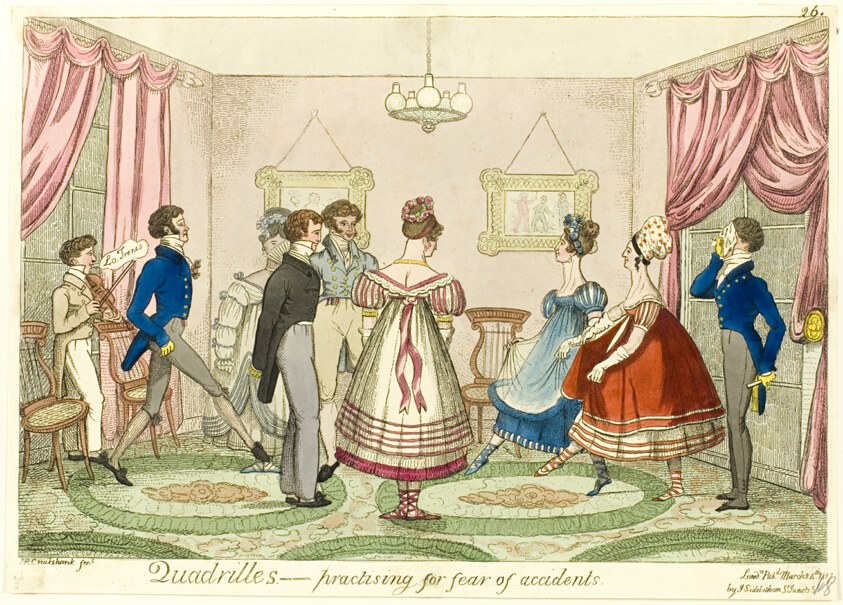
Quadrilles - Practising for Fear of Accidents
Isaac Robert Cruikshank (English, 1789-1856) published by J. Sidebotham (English, active 1802-1820)
- Medium:
- Hand-colored etching on paper
- Collection:
- Prints and Drawings
- Source:
- Art Institute of Chicago
- Rights:
- Public domain — free to use, share and adapt.
- Recorded as:
- CC0 (Public Domain)
This print is primary-source evidence for how the quadrille was actually danced and, more importantly, how it was perceived: not as art but as a social trial. The exaggerated anxiety captures the real stakes of ballroom dancing in the Regency era—a misstep was a public failure, watched and judged. For dance historians, it reveals the gap between the dance's formal elegance in instruction manuals and its lived experience as a source of social stress.
What you are looking at
A satirical drawing of a ballroom coterie practicing the quadrille, set in an elegantly appointed drawing room with pink silk curtains, a chandelier, and framed prints on the walls. Eight figures—a mix of men in tailcoats and women in high-waisted Empire-line gowns with deep hems—are arranged in the formal square formation required by the dance. The central female figure, shown from behind, wears a white gown with an elaborate ribbon sash; she is mid-turn, her skirts lifted to show the decorated hem. To her left, a woman in a blue-trimmed white dress reaches forward nervously. On the right, a portly gentleman in a red coat leans backward with an exaggerated expression of alarm. A military officer in a blue coat stands to the far left; an elderly woman in a rust-colored shawl sits apprehensively in the right foreground. The title's promise—'practising for fear of accidents'—is borne out in the anxious postures and theatrical expressions: this is not confident dancing but worried, accident-prone rehearsal, with bodies stiff and arms extended as if bracing for collision.
The dancing
The eight dancers occupy the four corners and sides of an imaginary square, holding the upright, formal postures required by quadrille: straight spines, raised chests, and extended arms. The nearest woman has her right arm reached forward and her left lifted, her torso twisted in a preparatory turn; her partner across from her leans backward with knees slightly bent, as if flinching. The two figures on the left maintain rigid, upright frames; on the right, a seated woman grips the arms of a chair, her body tense. The choreography is recognisably quadrille—the side-by-side and opposite-couple formations are in place—but the execution is portrayed as ungainly, with exaggerated caution and no fluidity.
The dance depicted
This is unmistakably a quadrille, the four-couple square dance that dominated European and American ballrooms from the 1820s through the 1880s. The quadrille was a prestige dance that required formal instruction and was danced in strict formations with named figures: the *chassé*, the *promenade*, the *balance*, and others. The print's humour lies in satirising the tension between the dance's formal beauty and the social anxiety it provoked—quadrille was demanding, and dancers feared collisions, missteps, and public embarrassment. The anxious gestures, backward leans, and braced postures show the dance as an ordeal rather than a pleasure, a common theme in caricatures of Regency-era social dancing.
How it was made
This is a hand-coloured etching, a technique that allowed the artist to achieve fine linear detail in the figures and setting, then apply colour by hand afterwards—visible here in the uneven application of the pink curtains and the selective brightening of the uniforms. Etching was significantly cheaper to produce and distribute than engraving, and the hand-colouring made each impression unique, which suited the market for topical satirical prints aimed at the educated middle class. The technique's strength lay in capturing expressive features and gestural nuance, which is why caricature and social satire found it ideal.
About this work
This 1817 satirical print depicts eight ballroom dancers in the formal, anxiety-ridden postures of a quadrille rehearsal. The artist has frozen a moment of comic disaster-avoidance: the dancers are rigid, their arms extended defensively, their faces registers of apprehension rather than pleasure. The quadrille was the dominant social dance of the Regency period, requiring formal training and elaborate coordination; this print exploits that very formality for comedy, portraying the dance not as an elegant accomplishment but as an accident waiting to happen. It sits squarely in the tradition of Regency-era social satire, where the pretensions and perils of fashionable society were fair game for mockery.
How to look at it
Attend first to the bodies: note how the artist has chosen the moment just before or during an active figure—a turn, a chassé—when collision is most likely. The rigid uprightness of the torsos and the exaggerated extension of the arms are the artist's way of showing panic. Look also at the faces: the nearest woman looks determined, the man on the right openly alarmed, the seated woman gripping the chair in terror. The elegant setting—the chandelier, the curtains, the prints on the walls—is rendered with precision to throw the dancers' ungainliness into relief. The print's joke is the contrast between the ballroom's refined décor and the chaos it contains.
The artist
Isaac Robert Cruikshank (1789–1856) was an English caricaturist and etcher active in the early 19th century. He worked in the tradition of satirical social commentary established by Gillray and Rowlandson, focusing on the foibles of fashionable society, domestic life, and sporting culture. His prints were distributed by publishers including J. Sidebotham, who issued this work, and his output was aimed at the urban middle-class market for topical, humorous prints.
The period
The quadrille arrived in England around 1815 from France and became the dominant ballroom dance of the Regency and early Victorian periods. It required considerable skill—dancers had to memorise sequences, maintain formation, and execute precise turns and figures. By 1817, when this print was made, the quadrille was already established as a marker of social respectability and a source of anxiety for those learning it. Regency-era prints frequently satirised social dancing as a site of pretension and peril, and the quadrille's formality and complexity made it an obvious target.
Where it lives
This print is held in the Prints and Drawings collection of the Art Institute of Chicago. It was published by J. Sidebotham, a London print publisher active in the early 19th century, suggesting it was a commercial object circulated to the London middle class market.
Dance in this work
Questions about this work
Was the quadrille really this awkward?
For many dancers, yes. While skilled dancers performed it elegantly, the quadrille demanded memorisation of multiple figures and strict timing to music. Contemporary accounts and prints frequently depict the anxiety it caused, especially among dancers of lower social status learning to dance 'correctly' for the first time.
Why does this print exaggerate the poses so much?
Caricature is the form. Cruikshank is using visual distortion—backward leans, rigid arms, terrified expressions—to amplify the comic potential of the quadrille as a source of social embarrassment. The exaggeration is the point: it makes visible an emotion that polite society tried to hide.
Who would have bought this print?
Urban middle-class Londoners with disposable income and an appetite for topical humour about fashionable life. Prints like this were affordable (a few shillings), portable, and perfect for display in the home or sharing with friends. They formed part of the period's visual culture of social satire.
How does the quadrille compare to modern ballroom dances?
The quadrille is the ancestor of modern ballroom formations; it requires similar precision and partnering. However, modern ballroom dances (waltz, foxtrot, quickstep) emphasize continuous flowing movement, whereas the quadrille relied on discrete figures and changes of direction, making it more cognitively demanding for dancers learning the sequence.
More dance artwork





