49 works in this view — arrow keys or swipe to move between them.
Dance in Art
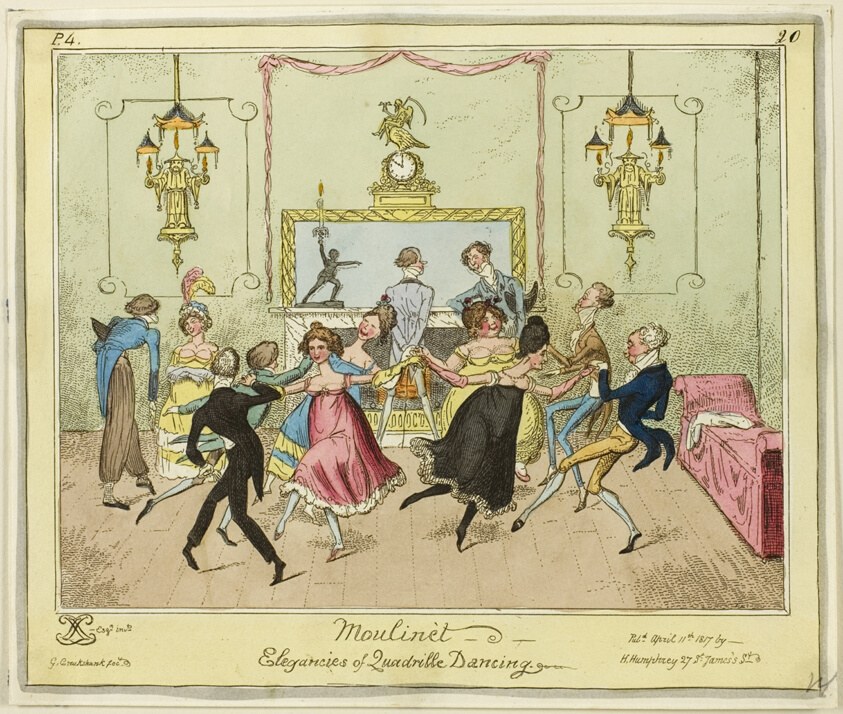
Moulinet-Elegances of Quadrille Dancing
George Cruikshank (English, 1792-1878) published by Hannah Humphrey (English, c. 1745-1818)
- Medium:
- Hand-colored etching on paper
- Collection:
- Prints and Drawings
- Source:
- Art Institute of Chicago
- Rights:
- Public domain — free to use, share and adapt.
- Recorded as:
- CC0 (Public Domain)
This image is one of the few surviving visual records of how the quadrille was danced in the Regency period, capturing not a technical manual but a social reality: the mixture of precision and exaggeration, control and spectacle, that characterized ballroom performance. The exaggeration is itself historically significant—it tells us what contemporary viewers found laughable, what counts as excessive, and how the dance was understood not as technical perfection but as social theater.
What you are looking at
A hand-colored etching depicting an elegant ballroom scene in full social animation. The interior is defined by classical architectural details: fluted pilasters frame the composition, and ornate gilt chandeliers hang from the ceiling, their light warming the cream-colored walls. At the back of the room, a raised platform or stage holds musicians and a clock surmounted by a gilt eagle, establishing this as a place of fashionable assembly. In the foreground, a large group of fashionably dressed figures in Regency-era clothing occupies the floor in a state of choreographed frivolity. The women wear high-waisted muslin gowns in pale yellows and pinks with short sleeves; the men are in dark formal coats with light breeches. The dancers' postures are exaggerated and comical—bodies tilted at acute angles, some in near-horizontal positions as they spin, leap, and cavort. The movement is deliberately absurd: two men in black coats execute extreme turns with one leg extended and body arched back; women with their arms raised or flung wide seem to defy balance. The overall impression is one of choreographed satire, a depiction of fashionable dancing rendered ridiculous through extreme physical distortion.
The dancing
The dancers occupy a crowded floor, arranged in small groups performing synchronized figures. The bodies are captured mid-rotation and mid-leap, with exaggerated deportment: spines arched, limbs fully extended, heads tilted back. Two principal male figures execute dramatic turns with one leg raised high and torsos bent backward at improbable angles—a visual exaggeration of the turning figures in the moulinet step. The women maintain upright posture but with arms raised or extended, their high-waisted gowns falling away from the body in motion. The hold between partners is inconsistent; some couples maintain contact while others are captured at the moment of separation, mid-turn. The density of the composition—at least a dozen dancers visible—suggests a formation dance rather than a simple couple dance.
The dance depicted
The title explicitly identifies this as the moulinet, a signature figure of the quadrille. The moulinet is a turning movement in which pairs or groups rotate around a central axis, and this image captures the moment of extreme rotation—hence the distorted, tilted postures and extended limbs. The quadrille was the dominant ballroom dance of the Regency period (1811–1820) and remained fashionable throughout the nineteenth century. This was a French import that became the height of fashion in English ballrooms, danced in sets of four couples in prescribed figures. The satire here seems directed at the exaggerated execution of fashionable steps—the artist exaggerates the moulinet's rotational violence to comic effect, suggesting either that contemporary dancers performed with absurd vigor or that fashionable pretension in dance was itself the target of mockery.
How it was made
This is a hand-colored etching on paper, a medium perfectly suited to satirical social commentary. Etching allowed fine linear detail and easy reproduction and distribution; hand-coloring gave it the finish and immediacy of a finished drawing while remaining cheap enough to circulate widely. The technique required the artist to bite lines into a wax-covered copper plate with acid, then print from the plate, making each print an impression rather than an original. This reproducibility made etching the ideal medium for topical prints, social satire, and commentary on contemporary life. The coloring here—the warm yellows and pinks of the gowns, the gilt of the furnishings, the careful shading of the men's dark coats—adds a sense of fashionable elegance even as the exaggerated poses undermine it.
About this work
This is a satirical representation of the quadrille, the most fashionable ballroom dance of early nineteenth-century England, capturing the moment of the moulinet—a spinning figure executed by all four couples of a set. The work is not a literal document of how the dance was performed, but rather a comic exaggeration of the extremity of contemporary ballroom movement. As a hand-colored etching, it belongs to a long tradition of English satirical prints commenting on fashion, social pretension, and the follies of polite society. The artist has rendered the dance both recognizable and absurd, suggesting that the very elegance fashionable dancers sought to display had become physically ridiculous.
How to look at it
Attend first to the architectural setting—it establishes this as a fashionable, formal space, not a rustic or casual venue. Then look at the postures: the extreme backward arches of the men's bodies and the raised legs are not errors or crude drawing, but intentional exaggeration of the rotational motion of the moulinet. The artist has frozen the moment of maximum distortion, the moment when control and elegance dissolve into physical extremity. Notice how the women's gowns catch the light and billow away from their bodies, emphasizing the centrifugal force of the spin. The crowded composition and the density of figures reinforce the sense of a fashionable ballroom at full gaiety—this is not a technical demonstration but a scene of social spectacle.
The artist
George Cruikshank (1792–1878) was one of the most prolific English satirical engravers and etchers of the early nineteenth century, celebrated for biting social commentary rendered in precise and expressive line work. He worked frequently in collaboration with the printmaker and publisher Hannah Humphrey, whose name appears on this print. Cruikshank's work ranged across political satire, social observation, and literary illustration; he was equally comfortable depicting Parliament or a ballroom, always with a sharp eye for human folly and physical grotesquerie. His style combined precise architectural and costume detail with wildly exaggerated figures, allowing him to make formal and social critique simultaneously.
The period
The quadrille emerged in Paris in the 1760s and reached England during the Napoleonic Wars, becoming the dominant ballroom dance by the Regency period (1811–1820). It represented a revolution in social dancing: it was complex enough to require instruction, fashionable enough to confer status, and orderly enough to be danced in large public ballrooms by many couples at once. The early nineteenth century saw an explosion of dance manuals, instructors, and commercial dance halls catering to the expanding middle class and gentry. Ballroom dancing had become not merely a social skill but a marker of gentility and fashion consciousness. English satirical prints of the period frequently targeted the pretensions of fashionable society, and dance was a favorite subject—it was visual, it was accessible to viewers of all classes, and it embodied the mixture of precision and vanity that satire thrived on.
Where it lives
The work is held in the Prints and Drawings collection of the Art Institute of Chicago. It is catalogued as a hand-colored etching by George Cruikshank, published by Hannah Humphrey in 1817. Such prints were commercially produced for public sale and would have circulated among middle- and upper-class households as both satirical commentary and fashionable decoration.
Dance in this work
Questions about this work
Is this a real dance or pure invention?
The moulinet is a real figure from the quadrille—a turning movement in which couples or groups rotate around a center point. However, this image is satire, not documentation. The artist has exaggerated the physical extremity of the movement to comic effect, suggesting that contemporary dancers executed it with absurd vigor or that the pretension of fashionable dancing itself was the target of mockery.
What is the quadrille?
The quadrille was a French ballroom dance that became the height of fashion in England and across Europe during the nineteenth century. It was danced by four couples arranged in a square formation, executing a series of prescribed figures in a specific order. It required instruction and was complex enough to confer social status, making it the dominant form of public ballroom dancing during this period.
Why does everyone look so contorted?
The extreme postures—arched spines, extended limbs, tilted heads—are deliberate exaggeration by the artist. The moulinet is a spinning movement, and by pushing the rotation to an absurd extreme, the artist creates comedy while also capturing the essential motion of the dance. The exaggeration is also social commentary: fashionable dancers may have danced with real vigor, and contemporary viewers may have found such extremity ridiculous or admirable, depending on their view of fashionable pretension.
Who was George Cruikshank?
Cruikshank (1792–1878) was one of the most celebrated English satirical engravers of the early nineteenth century, known for precise, witty social and political commentary rendered in fine line work. He worked frequently with publisher Hannah Humphrey and was celebrated for his ability to combine formal architectural and costume detail with grotesquely exaggerated figures, allowing him to critique both form and content simultaneously.
More dance artwork





