49 works in this view — arrow keys or swipe to move between them.
Dance in Art
Le Menuet de la mariée (The Minuet of the married)
Philibert Louis Debucourt French, 1755-1832
- Medium:
- Color aquatint with etching and engraving in black ink on cream laid paper
- Collection:
- Prints and Drawings
- Source:
- Art Institute of Chicago
- Rights:
- Public domain — free to use, share and adapt.
- Recorded as:
- CC0 (Public Domain)
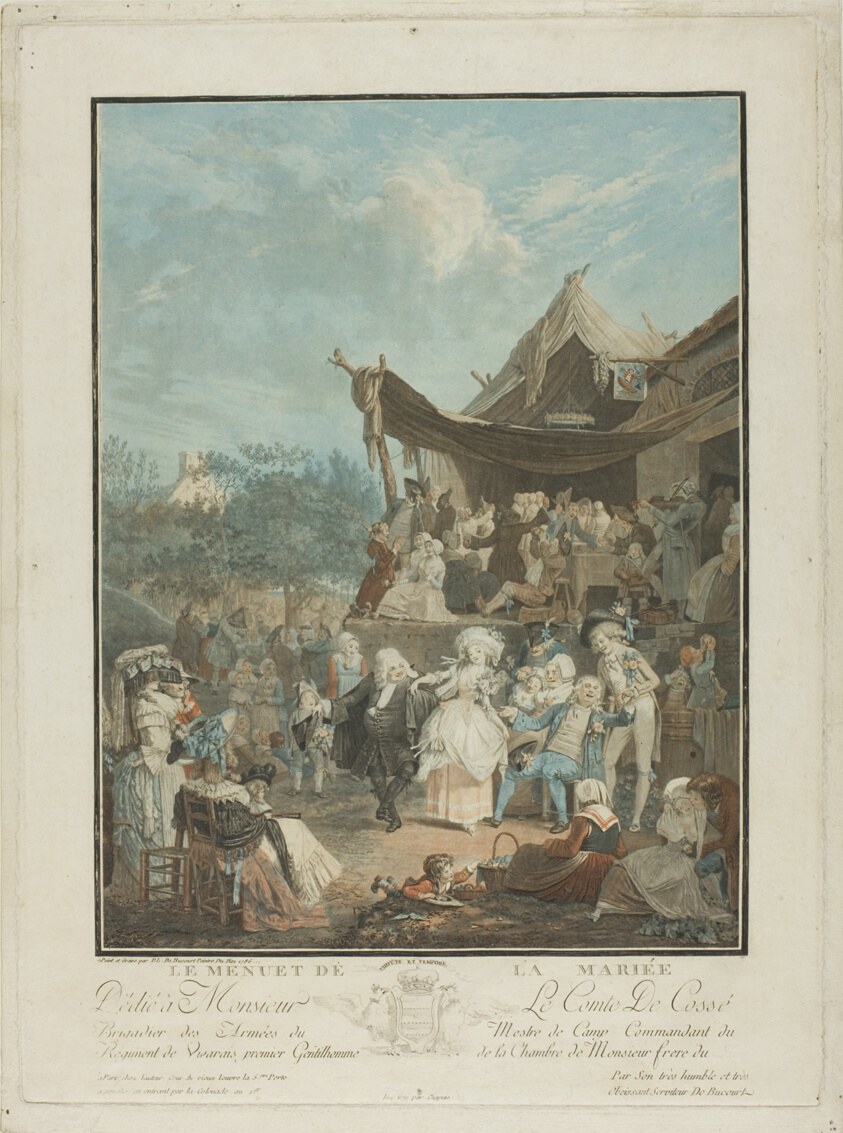
This print preserves visual evidence of minuet technique in its authentic social context—not as performed in a theater, but as danced in the actual celebrations of the French elite. The precision of the dancers' carriage and the careful composition of the scene around them reveals the minuet not as casual recreation but as a highly codified performance that could communicate status, education, and social worth to an assembled audience. For historians of dance and social custom, the work documents the minuet at the moment of its greatest cultural dominance, just before the upheavals of the French Revolution would transform European court life.
What you are looking at
A large outdoor wedding celebration unfolds beneath a striped canvas pavilion in the center of the composition. The bride, in an elaborate white gown with a long train, stands at the heart of the scene with her new husband in formal dress beside her. They are surrounded by dozens of wedding guests in 18th-century finery—women in pale silks and decorated bonnets, men in coats with colored trim and buckled shoes. In the immediate foreground, a couple performs a formal dance: the woman in a pale dress with her partner in dark coat and breeches, executing an upright, composed minuet. Behind them, under the tent's draped fabric, other couples stand and watch, some conversing, others preparing to dance. To the left, a fortified tower rises in distant landscape; to the right, servants attend to food and refreshment. The composition is crowded but hierarchical, with the dancing couple in sharp focus and the wedding principals creating the social center around which all other activity orbits. Light falls from the upper left, catching the whites of the dresses and the sky above.
The dancing
The dancing couple in the foreground displays the characteristic closed hold and upright carriage of the minuet: the man's arm raised to support the woman's hand, both bodies held at a courtly distance with elegant posture. Their feet are in a controlled small step pattern, weight held over the balls of the feet, the woman's skirt spreading slightly with the movement. The bride nearby stands still in her formal pose, receiving congratulations; the watching guests maintain the decorum of formal social display, with hands gesturing in conversation and bodies angled toward the action. The dancers are isolated from the crowd by their position and movement—they occupy a different register of action from those merely attending.
The dance depicted
This is a minuet, the paramount social dance of the 18th-century European aristocracy. The minuet appears here as the ceremonial opening dance of a wedding celebration, a ritual moment in which the newlyweds or prominent guests would dance to establish the formal tone of the event and signal the occasion's importance. The couple's vertical alignment, the precise foot placement, the woman's extended skirt, and the composed arm carriage all conform to the minuet technique documented in dancing masters' manuals of the period. The setting—an outdoor fête with music presumably provided by players outside the frame—was a typical venue for such celebrations among the nobility and gentry.
How it was made
This is a color aquatint with etching and engraving in black ink, a sophisticated printmaking technique that allowed for the reproduction of detailed narrative scenes in color for a cultivated audience. Aquatint creates the soft color washes visible in the sky and fabrics; the black etching and engraving lines provide precise definition of figures, drapery, and architectural detail. This technique was expensive and labor-intensive, indicating the work was produced for collectors of refined taste—likely the urban nobility and merchant class of late 18th-century France. The result circulated as a hand-colored or partially colored print, making it both a document of social custom and an art object of considerable refinement.
About this work
Le Menuet de la mariée documents the minuet as the ceremonial centerpiece of an 18th-century wedding celebration. The print captures a formal moment of social ritual: the bride and groom surrounded by assembled guests, with a couple performing the minuet as the primary entertainment and status marker. Philibert Louis Debucourt was known for such scenes of aristocratic and upper-bourgeois social life, depicting the manners, dress, and pastimes of his contemporary world. The work belongs in a gallery of dance in art because it records not merely the appearance of a historical dance form but its precise social function: the minuet as the opening gesture of a significant life event, the expression of rank and refinement through bodily control and courtly decorum.
How to look at it
Attend first to the minuet couple in the foreground: the artist has frozen the moment of engagement, the man's arm supporting the woman's hand in the characteristic raised position, both bodies upright and composed. The precise spacing between them—maintaining the proper distance—reflects the minuet's emphasis on form over intimacy. Then trace outward to the bride and groom, who are positioned as the true center of ceremony despite being still and silent, while the dancing couple enacts the ritual that honors them. The crowd's attention is divided between the dancers and the principals, and the composition manages both simultaneously, showing how the minuet functioned as a social gesture directed toward the assembled company rather than as entertainment for them alone.
The artist
Philibert Louis Debucourt (1755–1832) was a celebrated printmaker and painter specializing in scenes of fashionable Parisian and provincial life. He worked in aquatint and color engraving, techniques suited to the sophisticated taste of late 18th-century collectors. His genre scenes—balls, garden parties, weddings, promenades—document the manners and appearance of the French aristocracy and upper bourgeoisie with remarkable precision and humor. Debucourt's work occupied the intersection of fine art and social documentation: his prints were both aesthetically refined and narratively rich, making them valuable for their beauty and their historical record.
The period
The 1770s marked the height of minuet culture in France. The dance had evolved from a baroque court spectacle into the essential social dance of the aristocracy, dominating balls and celebrations. At the same time, the rococo visual culture that framed such events—with its emphasis on lightness, pastel color, elaborate dress, and intimate social scenes—was at its peak. Debucourt's work was produced on the eve of the French Revolution, during what would prove to be the final years of the ancien régime's unchallenged cultural authority. Prints like this one recorded a social world that was about to transform utterly.
Where it lives
The work is housed in the Prints and Drawings collection of the Art Institute of Chicago. As a hand-colored or color-printed aquatint of the late 18th century, it represents the type of luxury print that circulated among French collectors and was often bound into albums of social scenes and fashionable life.
Dance in this work
Questions about this work
Was the minuet always danced at weddings?
The minuet was the standard opening dance at formal celebrations throughout the 18th century, including weddings, balls, and court events. It served as a ritual gesture that established the formal tone of the occasion and displayed the refinement of the assembled company. By the 1770s, when this print was made, the minuet had become almost obligatory at any significant social gathering of the nobility or upper bourgeoisie.
What do the dancers' clothes tell us?
The man's dark coat, breeches, and buckled shoes and the woman's pale silk gown with its full skirt were standard formal dress for the period. The precision and lightness of their garments—designed for display—made them ideal for the minuet, which required upright posture and visible leg movement. The woman's skirt would catch the light and flow with her steps, making her movement visible even from a distance.
Why is this image so crowded?
The density of the crowd is intentional: Debucourt shows the wedding as a major social event involving the entire community or at least a significant portion of it. The crowd also emphasizes the importance of the bride and groom by surrounding them, and it demonstrates the minuet's role in public social display rather than private entertainment.
How would this print have been used?
Color aquatints like this one were expensive luxury goods, often purchased by wealthy collectors and bound into albums of contemporary fashionable life. They served as both art objects and historical documents, preserving the appearance and manners of aristocratic society for the cultivated viewer. Such prints could also function as guides to fashion and social etiquette.
More dance artwork





