49 works in this view — arrow keys or swipe to move between them.
Dance in Art
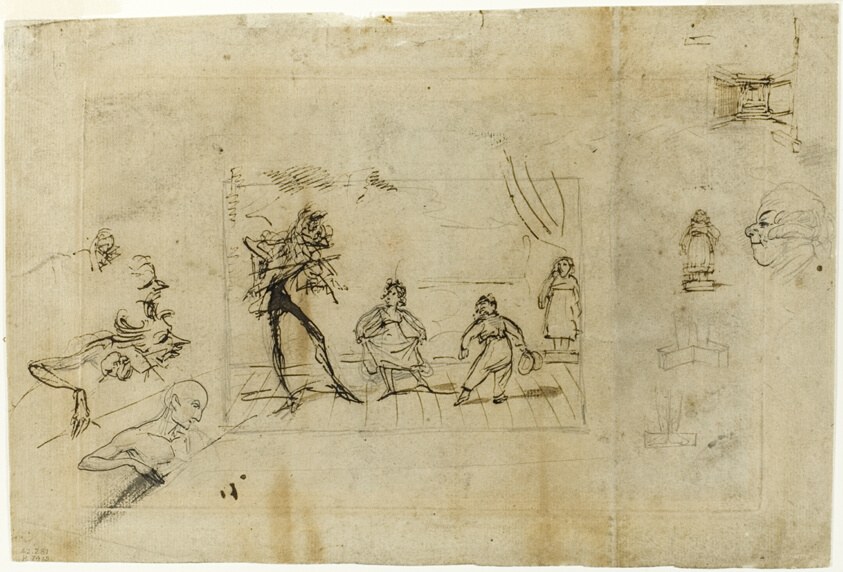
Study for the The Dancing Lesson, part 2: The Minuet
George Cruikshank English, 1792-1878
- Medium:
- Pen and brown ink over graphite, on tan laid paper
- Collection:
- Prints and Drawings
- Source:
- Art Institute of Chicago
- Rights:
- Public domain — free to use, share and adapt.
- Recorded as:
- CC0 (Public Domain)
For dance historians, this sketch documents the pedagogical method used to teach the minuet in the early nineteenth century: the breaking of complex formal steps into sequential positions, and the role of the dancing master as demonstrator. For art historians and viewers of Cruikshank, it shows his gift for capturing bodily movement and his use of exaggeration to comment on social convention and class.
What you are looking at
This is a compositional study for a formal dance instruction scene, executed in pen and brown ink with graphite underdrawing. The central action shows five figures arranged in a loose line or formation across the middle of the sheet, apparently demonstrating or learning a dance step. The figures are rendered in Cruikshank's characteristic caricatural style—elongated limbs, exaggerated postures, and expressive gestures. The nearest figure at left appears to be in a lunging or bent-knee position; the next figure stands more upright with arms extended; the three figures to the right progress from a dancer in profile with raised arms, through two more compact figures, to a standing observer at far right. The setting is minimally indicated—a few architectural lines suggesting an interior space, possibly a dance hall or drawing room. In the margin and upper corners are additional sketch studies: a small head study, a crouching or fallen figure at lower left, some architectural notations, and a mechanical device (possibly a pulley or theatrical apparatus) at upper right. The paper shows age and wear, with foxing and creasing consistent with an eighteenth-century working drawing.
The dancing
The dancers display the characteristic postures of early-nineteenth-century minuet instruction: forward bend from the hips, one knee bent in a deep plié or lunge, arms positioned at varying heights and angles suggesting the moment-by-moment teaching of arm carriage. The figure second from left extends both arms outward in a teaching or demonstrative gesture. The weight appears to shift between legs rather than being held evenly, indicating the step-by-step breaking-down of movement that a dancing master would perform. The variation in body angle and arm position from figure to figure suggests this is not a synchronized ensemble but a sequence of positions from a single step, or a series of students at different stages of learning.
The dance depicted
The title identifies this as part 2 of a 'Dancing Lesson' and specifically names the minuet. The minuet (MIN, historic-baroque / Minuet) was the dominant social and courtly dance of the eighteenth century and remained a prescribed element of dance instruction well into the nineteenth. Cruikshank's study appears to illustrate the method of teaching: breaking the minuet step into its component parts and demonstrating each position to students. The elongated, exaggerated limbs and the somewhat satirical tone typical of Cruikshank suggest this may be part of a comic or instructional series aimed at exposing the absurdities of fashionable dance convention or the pretensions of dance masters. The formal line and bilateral symmetry of the figures align with the minuet's structured, processional character.
How it was made
This is a working study in pen and brown ink over graphite, on laid paper. The combination of graphite underdrawing and ink line indicates this is a preliminary study, not a finished work for publication or display. The ink line is fluid and confident in the main figures but becomes lighter and more exploratory in the marginal studies, suggesting rapid annotation of ideas. The technique allowed Cruikshank to work out the composition, proportions, and gesture quickly before committing to a more elaborate finished drawing or engraving. The laid paper itself is consistent with early-nineteenth-century English practice.
About this work
This is a compositional sketch for a satirical or instructional scene depicting the formal teaching of the minuet, one of the most codified social dances of the eighteenth and early nineteenth centuries. It demonstrates both Cruikshank's keen eye for bodily movement and his satirical sensibility: the exaggerated postures and the sequence of figures breaking down a single step into teachable positions parody both the pretension of dance masters and the rigidity of fashionable dance convention. As part of a titled series on 'The Dancing Lesson,' it belongs to a tradition of comic or critical social observation that extends back to Hogarth and forward through the nineteenth century. The work records not just a dance form but a moment in its teaching, catching the peculiar position of the dance master—half servant, half arbiter of taste—in Regency social life.
How to look at it
Attend to the sequence of body positions from left to right: each figure represents a different moment or instruction in the minuet step, as if the dancing master is saying 'first bend, then step, then extend the arm.' The caricature exaggerates the posture required—the forward bend from the hips, the high knee action—which both aids readability and registers social critique: the minuet demands an absurdly rigid, artificial carriage. Notice also the variety of figure types in the background and margins: Cruikshank is working out not just the main instruction but the context, the onlookers, the social setting. The marginal studies are as important as the central scene—they show the artist's process.
The artist
George Cruikshank (1792–1878) was one of the foremost English caricaturists and social satirists of the nineteenth century. He was trained as an engraver and printmaker but worked across drawings, engravings, etchings, and illustrations. His work combined technical mastery with sharp social observation, often targeting fashion, pretension, and moral hypocrisy. He was known for his ability to distil character and movement into a few economical lines, and for his prolific output—he produced thousands of designs over six decades. His depictions of social life, dance, and spectacle are often coded with satire or critique.
The period
The minuet was in decline as a fashionable dance by the 1820s, having been displaced by more energetic forms like the quadrille and the waltz. However, it remained part of formal instruction and aristocratic ceremony, and Cruikshank's focus on a 'dancing lesson' rather than a fashionable ballroom scene suggests he is documenting a pedagogical or institutional context rather than living practice. The Regency era (roughly 1811–1820) was a period of intense social satire in English art and literature, with Cruikshank as one of its leading visual commentators. His treatment of dance reflects a broader interest in the gap between prescribed social behavior and lived experience.
Where it lives
The drawing is held in the Prints and Drawings collection of the Art Institute of Chicago. It is a working study, not a finished print or exhibited piece, and belongs to the category of studio material: preliminary work that may have led to an engraving, published illustration, or finished drawing, or may have remained as a study in the artist's collection. The title and numbering ('part 2') suggest it was part of a broader series or project, possibly intended for publication.
Dance in this work
Questions about this work
What is a minuet and why was Cruikshank drawing dancing lessons about it?
The minuet was the dominant formal social dance of the eighteenth century, characterized by small steps, forward bends, and strict etiquette. By the 1820s it was old-fashioned, but it remained part of upper-class instruction. Cruikshank often satirized fashionable life and social pretension; a 'dancing lesson' in the minuet offered rich material—the gap between the elaborate formal rules and the actual bodies trying to follow them, the authority of the dancing master, the absurdity of fashion. The exaggerated postures are both accurate record and comic commentary.
Is this a finished work or a sketch?
It is a working study: graphite underdrawing with pen and ink line added over. The technique and the presence of exploratory marginal studies indicate this is preliminary work, likely created as a step toward a finished drawing, engraving, or print. The laying-out of composition, figural arrangement, and gesture suggests Cruikshank was testing ideas before committing to a more elaborate version.
What do the extra sketches in the margins tell us?
They show Cruikshank's working method: he uses margins to note down poses, expressions, and ideas that might feed into the main composition or related works. The crouching figure, the head studies, and the mechanical apparatus are all variations or possibilities—the artist thinking on paper, trying out alternatives and recording observations for future use.
How does Cruikshank's style comment on dance?
The exaggeration—elongated limbs, bent knees, forward-leaning torsos—is both mimetic and satirical. Cruikshank faithfully captures the peculiar bodily posture the minuet requires, but amplifies it to absurd extremes, inviting the viewer to laugh at the artificiality of fashionable dance and the gap between the ideal form and the actual body. This is typical of Cruikshank's broader practice: accurate social observation delivered with satirical edge.
More dance artwork





