49 works in this view — arrow keys or swipe to move between them.
Dance in Art
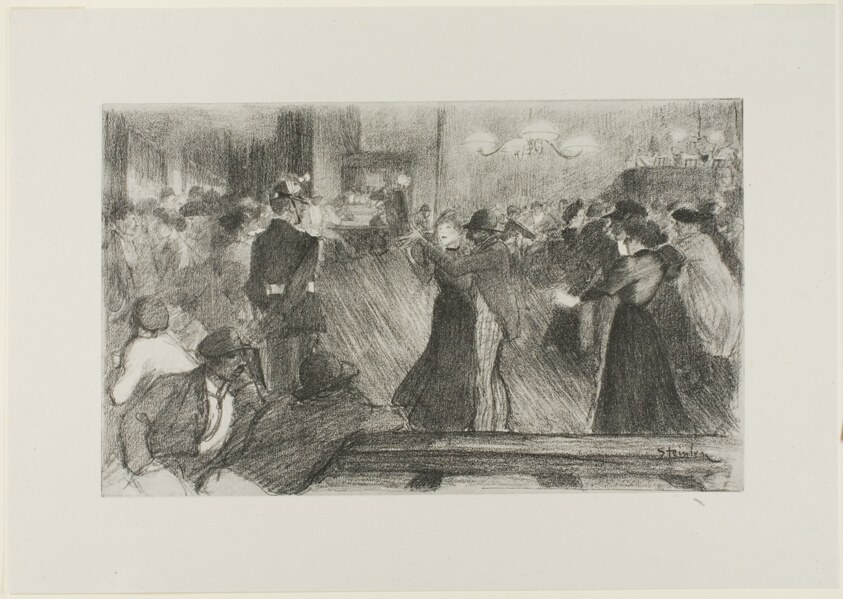
Dance Hall
Théophile-Alexandre Steinlen French, born Switzerland, 1859-1923
- Medium:
- Photo lithograph (from a drawing) in black on gray wove chine
- Collection:
- Prints and Drawings
- Source:
- Art Institute of Chicago
- Rights:
- Public domain — free to use, share and adapt.
- Recorded as:
- CC0 (Public Domain)
This image is crucial evidence for understanding how ballroom dance was practised in the late 19th century—not as performance or competition, but as everyday social practice in commercial venues. Steinlen's social authority as a chronicler of modern life gives the work documentary weight: he observed and recorded what he saw, without sentimentality or stylization. For dancers and historians, it answers the question 'What did people actually do?' rather than 'What were they supposed to do?'
What you are looking at
A crowded indoor dance hall filled with elegantly dressed figures in late 19th-century attire. The scene is rendered in soft graphite tones with atmospheric depth created by loose, sketchy handling of the background. In the foreground, couples occupy the dance floor in various stages of movement—some actively dancing, others conversing or observing. The women wear high-necked dresses with full skirts; the men are in dark suits. A chandelier hangs above, and architectural elements suggest a grand ballroom or public dance venue. The composition is dense and animated, with figures overlapping and receding into shadow, capturing the sociable chaos of a fashionable evening rather than a formally staged performance.
The dancing
The dancers move in closed ballroom hold with partners facing each other, their bodies leaning slightly forward into the dance. Several couples are caught mid-waltz, their frames upright and their steps fluid. The women's heavy skirts are in motion, caught at various points in their swing and rotation. Men's posture is formal, with arms extended at a social distance. In the foreground, seated figures and standing observers create a social rather than performance space. The gestures throughout are naturalistic—this is social ballroom dancing, not theatrical display.
The dance depicted
This depicts ballroom dancing in the Gilded Age, most likely the waltz, which dominated European and American social dancing in the 1890s. The closed position, the upright carriage, and the gentle turning motion visible in the women's skirts are consistent with the Viennese waltz as danced in public venues. The scene records how this dance functioned: as a central social practice in a commercial or semi-public dance hall where mixed company gathered for an evening. The artist has chosen to emphasize the social atmosphere—the mingling, the music, the pleasure of movement in a crowd—rather than technical precision.
How it was made
This is a photolithograph drawn from a graphite drawing, a reproductive process that allows for fine tonal gradation and the capture of loose, sketchy mark-making. Photolithography made the work reproducible and distributable to a mass audience, likely through periodicals or portfolios. The technique's softness suits the atmospheric, informal subject—the grainy tone and fluid lines evoke the lived experience of the crowded hall better than a sharp engraving would. This was a commercially viable medium for social and cultural commentary in the 1890s.
About this work
This is a snapshot of Parisian or European ballroom culture at the height of the Belle Époque, capturing the waltz as it was danced in public dance halls by the respectable middle and upper-middle classes. Steinlen was a master of social observation, and here he records not the dance in isolation but the entire social practice—the clothing, the architecture, the density of bodies, the mix of dancers and onlookers. The work belongs in a dance gallery because it documents what the waltz actually looked like in lived practice, removed from the stage and from instruction manuals. It shows how dance functioned as a vector of sociability and pleasure in modern urban life.
How to look at it
Watch the women's skirts: they show the moment of rotation and swing. The artist has caught the dancers not in a static position but in the traveling motion that defines the waltz—moving around the floor rather than in place. Note how the background figures blur and merge, emphasizing the sensory experience of the crowded hall over individual bodies. Observe the mix of activity and stillness: some couples dance while others stand, talk, or rest, which is how a real evening functioned. The loose handling of the graphite and the soft tones convey the mood and atmosphere rather than documentary precision—what mattered was the feeling of the event, not its anatomy.
The artist
Théophile-Alexandre Steinlen (1859–1923) was a Swiss-born French graphic artist, illustrator, and social commentator who made his reputation in Paris as a keen observer of urban and working-class life. He worked extensively in lithography, creating posters, periodical illustrations, and fine prints. He was associated with the anarchist and socialist movements and used his art to document social conditions, street life, and modern leisure. His subject matter ranged from street urchins to cabaret scenes to social gatherings, always with a direct, unsentimental eye. Steinlen's work in the 1890s-1900s is a primary visual record of Parisian life.
The period
The 1890s were the height of the waltz's dominance in European ballroom culture. The dance had been firmly established since the early 19th century but achieved maximum social penetration and commercialization in the Belle Époque. Public dance halls had become fashionable and profitable; the waltz was danced by the respectable classes and was a marker of social aspiration and modern urban identity. In art, fin-de-siècle printmakers and illustrators documented this new leisure culture extensively. The waltz was also at the centre of contemporaneous moral debates about propriety, close contact between men and women, and the pace of modern life—all of which Steinlen's image implicitly engages with through its crowded, energetic composition.
Where it lives
The work is held in the Prints and Drawings collection at the Art Institute of Chicago. As a photolithograph, it is a reproducible work, likely part of a published series or portfolio, though the specific publication context is not recorded here.
Dance in this work
Questions about this work
Is this a waltz?
Yes, almost certainly. The closed position, upright carriage, and the turning motion visible in the women's skirts are all consistent with the waltz as danced in the 1890s. The formal dress and ballroom setting confirm this as social ballroom dancing of the highest register.
What is a photolithograph?
A photolithograph is a print made by transferring a photographic image onto a lithographic stone, which is then printed. It allowed artists and publishers to reproduce drawings and paintings at scale, with softer tones and more subtle gradation than older engraving techniques. It was the dominant reproductive technique for periodicals, portfolios, and fine prints in the 1890s–1920s.
Why does this look so loose and sketchy?
Steinlen drew in a loose, gestural style that captures movement and atmosphere rather than anatomical precision. This was deliberate: the sketchy handling conveys the energy and flow of the event. The photolithographic process translated his drawing faithfully, preserving the soft graphite marks and tonal gradations that give the scene its immediacy and mood.
Are these professional dancers?
No. These are social dancers—members of the public paying to dance in a public or semi-public hall. The informality of the scene, the mix of dancing and socializing, and the everyday dress (fashionable but not performance costumes) all indicate that this is amateur ballroom dancing, not theatrical performance or professional instruction.
More dance artwork





