49 works in this view — arrow keys or swipe to move between them.
Dance in Art
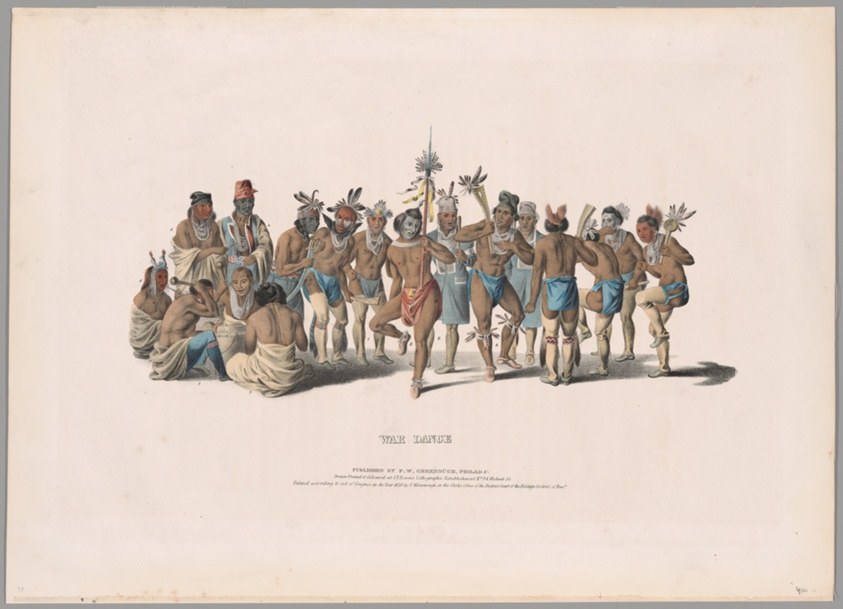
War Dance, from McKenney and Hall's Indian Tribes of North America
John T. Bowen American, born England, c. 1801-c. 1856
- Medium:
- Hand-colored lithograph in black on ivory wove paper
- Collection:
- Prints and Drawings
- Source:
- Art Institute of Chicago
- Rights:
- Rights reserved by the holding institution — do not reuse without permission. Source record ↗
- Recorded as:
- AIC — rights reserved
This work stands at the intersection of art history, ethnography, and dance documentation. It captures a moment when indigenous dance was being simultaneously suppressed in practice and intensely documented—often by outsiders—in visual form, making it essential to understanding how American movement culture was recorded and what was lost in translation. For dance historians, it offers rare visual evidence of war dance convention and posture from a period before film, even though the image is mediated through a European-American aesthetic sensibility.
What you are looking at
A hand-colored lithograph depicting a gathering of Native American figures arranged in a loose semicircle against a blank background. The composition centers on approximately fifteen to twenty individuals in various states of movement and stillness. At the center and slightly elevated, several figures leap or stride with raised arms and legs, their bodies extended in dynamic poses. Some hold what appear to be weapons or ceremonial objects—clubs, spears, or war implements—thrust upward. Others crouch or kneel in the foreground on the left, wrapped in blankets or hides. The figures wear minimal clothing typical of 19th-century ethnographic depiction: breechcloths, leggings, and ornamental elements including feathers, headdresses with tall plumes, and body paint or tattooing rendered in brown and blue washes. The color palette is muted—flesh tones in ochre and tan, blue accents for paint and clothing, browns for the ground line that anchors the composition.
The dancing
The bodies display highly varied postures within a single frame: some are mid-leap with both feet off the ground and arms raised or extended; others stand with legs wide and knees bent in a lunging or braced stance; a few sit or kneel. The raised arms suggest both exertion and weapon-handling. Legs are often bent at the knee with weight shifted forward or to one side, suggesting dynamic balance and readiness. The spacing is not uniform—some figures overlap or stand very close, creating depth, while others are isolated. The overall impression is of simultaneous rather than synchronized movement.
The dance depicted
This is represented as a war dance—a ceremonial or martial practice dance widespread among Native American nations, performed both before combat and in celebration or mourning. The title itself is explicit. The image captures the kind of vigorous, individualized movement and weapon display characteristic of ethnographic accounts of such dances from the Great Plains and Eastern Woodlands. The scattered arrangement and varied postures suggest the dance was not strictly coordinated or line-based, but rather a context for individual expression of strength, skill, and warrior status. The presence of multiple figures in different poses may indicate either sequential movement frozen in one image, or a convention of showing the typical vocabulary of the dance rather than a single moment.
How it was made
A hand-colored lithograph, a mass-producible process that allowed original hand-coloring to be applied after printing. This was the standard illustrative medium for the 1830s–1840s and implies circulation through bound volumes or loose-leaf portfolios rather than exhibition. Lithography's capacity for fine detail in the printed line combines here with watercolor or gouache applied by hand, allowing for rich local color and variation across copies. The technique was both economical and prestigious—suitable for scientific or ethnographic documentation aimed at a educated middle-class audience.
About this work
This hand-colored lithograph from McKenney and Hall's *Indian Tribes of North America*—a landmark 1838–1844 portfolio—represents a war dance as performed by Native American peoples, likely from the Great Plains or Eastern Woodlands. It belongs to a body of early American ethnographic art that attempted to document indigenous cultures through figure studies and genre scenes, often at a moment of rapid displacement and cultural erasure. The image is both a historical document and an artifact of the aesthetic conventions by which American artists of the period understood and represented indigenous movement and ritual.
For dance history, it represents one of the earliest attempts to capture—however imperfectly—the structure and character of a non-Western ceremonial dance in a medium designed for wide circulation. The poses and composition tell us something about how a 19th-century American lithographer understood the dancers' movement vocabulary: explosive, weaponed, individuated rather than synchronized, grounded in a wide stance.
How to look at it
Attend to the variety of body positions within a single frame: the artist has chosen not to show a synchronized line or formation, but rather a montage of poses that together suggest the energy and vocabulary of the dance. Notice the raised arms, the wide stances, and the elevated legs—these convey explosive, athletic movement. The scattered composition mimics the described practice of individual warriors dancing separately rather than in unison. The weapons and feathered headdresses anchor the dance to ritual warfare, distinguishing it from other ceremonial or social dances. The hand-coloring, visible as areas of wash and local pigment, was applied after printing and varies slightly across copies—a reminder that this is a mass medium with handmade variation.
The artist
John T. Bowen (c. 1801–c. 1856), born in England and active in Philadelphia, was a prolific lithographic illustrator and colorist. He is best known for his work on the McKenney and Hall project, one of the most ambitious and widely circulated ethnographic portfolios of the era. Bowen both drew original designs and colored prints, working in the conventions of 1830s natural history and ethnographic art—a mode that combined scientific observation with romantic idealization.
The period
This work was created during the Indian Removal era, when the U.S. government was actively displacing Eastern tribes westward and the frontier was rapidly shifting. Ethnographic art and writing flourished in the 1830s–1840s as a nostalgic response to indigenous displacement—documenting what was seen as a vanishing culture. Simultaneously, indigenous dances were being actively suppressed on reservations and in boarding schools, making visual documentation paradoxically more valuable as evidence even as the dances themselves faced erasure. In the art world, lithography had recently become the dominant medium for reproductive illustration, making images like this accessible to thousands rather than dozens.
Where it lives
This lithograph is part of the McKenney and Hall portfolio, *History of the Indian Tribes of North America*, published serially 1838–1844 and widely distributed to institutions and subscribers. It belongs to a bound or portfolio collection of ethnographic illustrations and was produced by the Philadelphia lithographic firm that specialized in this work.
Dance in this work
Questions about this work
Is this an accurate depiction of a war dance?
It is a 19th-century artist's interpretation, filtered through European artistic convention and ethnographic observation. The emphasis on individual posture, weapons, and dynamic energy aligns with written accounts of the period, but we cannot assume the composition represents a moment the artist witnessed or that the poses are faithful to actual movement. Hand-colored lithographs of this era often combined observation with romantic idealization.
Why are the figures shown in so many different positions at once?
The artist may have been showing the typical vocabulary or repertoire of poses used in the dance, rather than a single frozen moment—a common practice in ethnographic illustration. Alternatively, the dance itself may have involved non-synchronized individual movement, which the scattered composition would faithfully represent.
Who were these dances performed by?
War dances were performed by many Native American nations, particularly on the Great Plains and in the Eastern Woodlands, before and after combat and in ceremonies honoring warriors or mourning the dead. The McKenney and Hall portfolio included portraits and scenes from many nations, so without additional documentation this image cannot be attributed to a specific nation.
Why does this look like a formal art print rather than ethnographic documentation?
It is both. Lithography was the cutting-edge technology for mass reproduction, and McKenney and Hall's portfolio was designed as a prestigious publication for educated audiences. The fine draftsmanship and careful composition reflect the artistic standards of the time, while the subject matter—carefully annotated figures in ethnographic dress—served documentary aims.
More dance artwork





