49 works in this view — arrow keys or swipe to move between them.
Dance in Art
Palace Ball
Jules Pascin American, born Bulgaria, 1885-1930
- Medium:
- Soft ground color etching and aquatint on ivory wove paper
- Collection:
- Prints and Drawings
- Source:
- Art Institute of Chicago
- Rights:
- Rights reserved by the holding institution — do not reuse without permission. Source record ↗
- Recorded as:
- AIC — rights reserved
This print documents how ballroom dancing was represented to and understood by urban audiences in the late 1920s—as an elegant, informal social practice tied to fashion and leisure rather than as a performance or athletic achievement. For historians of social dance, fashion, and modern graphic art, it is a primary source for how the ballroom appeared to a sophisticated, observant contemporary eye.
What you are looking at
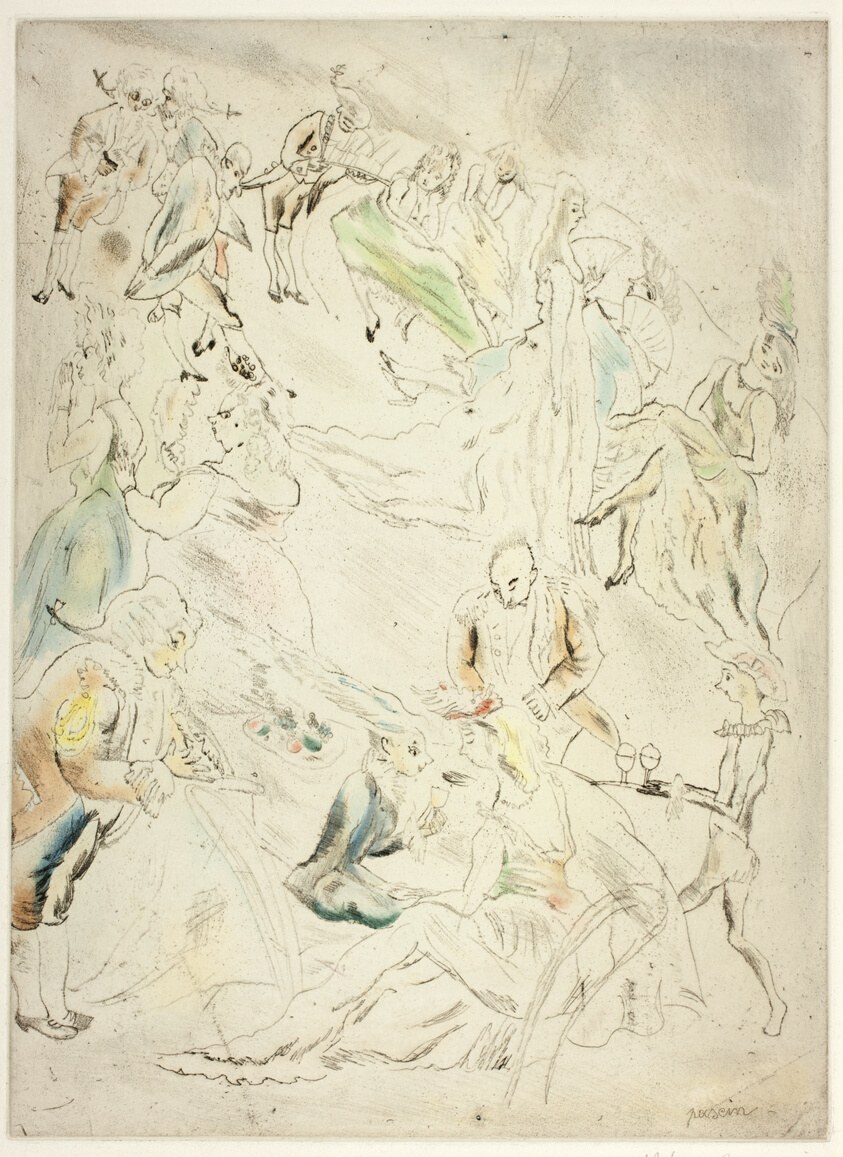
A crowded ballroom scene rendered in soft ground etching with selective aquatint color. Multiple figures in early 20th-century evening dress populate the composition—men in tailcoats and women in long gowns with dropped waists characteristic of the late 1920s. The figures are distributed across the sheet in overlapping groups, some dancing in the center and foreground, others standing or conversing at the periphery. The artist has used delicate line work to suggest movement and social interaction, with particular attention to the flutter and drape of women's skirts. Pale washes of green, blue, and ochre enliven the composition without overwhelming the linear structure. The paper itself, left largely untouched, creates luminosity and an sense of informality—this is a sketch-like record of a moment rather than a finished narrative scene.
The dancing
The figures are rendered in abbreviated, gestural line—elongated bodies with minimal modeling, capturing attitude and bearing rather than anatomical detail. Several couples appear in dance position, though the artist emphasizes the social and sartorial aspects more than technical footwork. Women's bodies are sinuous and S-curved, their weight often back on one hip, their postures suggesting fashionable languor. Men stand straighter, their frames geometric. The overall impression is of bodies moving through space with ease and social confidence, rather than bodies executing specific choreographic vocabulary.
The dance depicted
The work depicts social ballroom dancing of the late 1920s—specifically the kind of fashionable salon dancing that took place at formal evening events and palace balls of the period. This is not theatrical ballet or any codified social dance form with strict rules, but rather the improvisational, partner-based social dancing of the urban elite. The image captures the informality and fluidity of the ballroom as a social space, where dancing was one among several modes of interaction. The precise dances (waltz, foxtrot, tango) cannot be identified from the gestures alone, which is entirely consistent with how such an artist would work—interested in the social scene rather than choreographic specificity.
How it was made
This is a soft ground etching with aquatint and hand-applied color—a technique that allowed Pascin to combine the linear precision of line-based printmaking with the atmospheric effects of paint. Soft ground etching permits a drawing-like quality; the artist's actual pencil marks transfer to the plate, creating an intimate, sketch-like finish even in a printed work. The selective use of aquatint and watercolor wash suggests an experimental, non-traditional approach: the artist has not colored the entire composition systematically but has instead animated particular passages—a woman's skirt, an arm, a face—leaving much of the paper bare. This technique was labor-intensive and limited in edition, placing the work among Pascin's fine art prints rather than mass-circulation illustrations.
About this work
This work is a record of fashionable ballroom society in the late 1920s, captured through the eyes of an artist fascinated by human bodies in motion and social interaction. Jules Pascin, working in exile from Bulgaria via France and New York, was known for his drawings of leisure, eroticism, and social observation—nightclubs, cabarets, studio models, and society scenes. 'Palace Ball' belongs to the tradition of the ballroom as a subject for modern art: a space where bodies, fashion, and social hierarchy intersect. The print medium allowed the work to circulate among collectors and galleries, positioning it within the fine art market rather than as a documentary record.
The work captures a specific moment in dance history—the era when the waltz, foxtrot, and tango had become the dominant social dances of the urban bourgeoisie, and when dancing was understood as a pleasurable, fashionable activity rather than a spectacle or ritual. The artist's interest lies not in depicting a particular dance correctly but in capturing the atmosphere of the ballroom: the mingling of bodies, the play of fabric and light, the social codes expressed through posture and dress.
How to look at it
The viewer should attend to the way Pascin uses line to suggest movement without depicting it literally. Notice how the women's skirts are rendered with flowing, abbreviated marks that suggest fabric in motion rather than showing the skirt itself. Observe the distribution of color: the pale washes are not applied uniformly but instead accent particular figures or passages, creating rhythm and emphasis without narrative hierarchy. The composition is deliberately informal—figures overlap, some are only sketched in, others are more fully realized—mimicking the actual experience of being present at a crowded ball where one's attention moves from group to group. The untouched paper is as important as the inked or colored areas; this is a print that embraces its own incompleteness as part of its charm and modernity.
The artist
Jules Pascin (1885–1930), born Julius Mordechai Pincas in Bulgaria, spent his early career in Vienna and Berlin before establishing himself in Paris and New York. He was a printmaker, painter, and draftsman known for witty, sexually charged, and socially observant works depicting modern urban life—cabarets, brothels, artists' studios, society gatherings. He worked prolifically in etching, drypoint, aquatint, and lithography, often combining line with selective color. His subjects were usually women, dancers, performers, and the demimonde; his technique was rapid, gestural, and intimate. He died by suicide in 1930, at 45, leaving behind a substantial body of work that bridges fine art printmaking and popular social observation.
The period
In 1929, ballroom dancing was at the height of its social prestige and popularity among the international urban elite. The foxtrot, waltz, tango, and Charleston had democratized and modernized dance in the previous two decades; the 1920s was the era of the dancehall, the nightclub, and the fashionable ball as sites of modern leisure. Artistically, printmaking was experiencing a renaissance in the 1920s and 1930s, with etching and lithography seen as vehicles for experimental, modernist aesthetics. Pascin's work sits at the intersection of Expressionism and social realism—his fragmented, gestural line and his focus on contemporary urban subjects align him with German Expressionist printmakers and the Neue Sachlichkeit (New Objectivity) movement, though his focus on beauty, sensuality, and social pleasure distinguishes him from the more critical or satirical approaches of his contemporaries.
Where it lives
The work is held in the Prints and Drawings collection of the Art Institute of Chicago. As a soft ground etching with hand-applied color, it represents the artist's practice of creating unique or semi-unique impressions, with variations in coloring from one print to another. The work documents the kind of fine art print that circulated among collectors, galleries, and museums in the early 20th century.
Dance in this work
Questions about this work
What dance is being shown?
The specific dances cannot be identified from the gestures—this is a social ballroom scene of the late 1920s, likely including waltzes, foxtrots, and tangos, but the artist was not concerned with depicting any one dance precisely. The emphasis is on the social atmosphere and the fashionable bodies moving through the space.
Why does the print look unfinished?
This is intentional. The technique of soft ground etching with selective aquatint allowed Pascin to create a sketch-like quality even in a printed work. The bare areas of paper and the abbreviated line work are aesthetic choices that convey immediacy and spontaneity—the feel of a scene quickly observed rather than laboriously composed.
Who was Pascin and why did he paint dance?
Jules Pascin was a Bulgarian-born, Paris-based printmaker and painter fascinated by modern urban leisure, sexuality, and social observation. Dance—particularly the ballroom, the cabaret, and the studio—was a subject through which he could explore bodies, fashion, social interaction, and the pleasures and anxieties of modernity.
What is a 'palace ball' and who attended?
In the 1920s, a palace ball (or formal ball) was an exclusive social event held in grand venues, typically attended by the urban wealthy, nobility, and fashionable society. These were occasions for display, courtship, and the performance of social status through dress and dance.
More dance artwork





