49 works in this view — arrow keys or swipe to move between them.
Dance in Art
The Ball
Master M.Z. German, active 1500-1550
- Medium:
- Engraving on ivory laid paper
- Collection:
- Prints and Drawings
- Source:
- Art Institute of Chicago
- Rights:
- Public domain — free to use, share and adapt.
- Recorded as:
- CC0 (Public Domain)
This engraving is one of the earliest surviving visual documents of northern European Renaissance court dance in its lived context. It shows that by 1500, German court dancing was codified enough to be worth printing and circulating—evidence of a sophisticated choreographic culture—yet familiar enough that an artist could assume viewers would recognize the gestures and understand the social meaning of proximity and posture. For historians of dance, the work provides precise evidence of body positioning, relative distances between partners, and the integration of dance within a larger social occasion in a culture for which few other visual sources survive.
What you are looking at
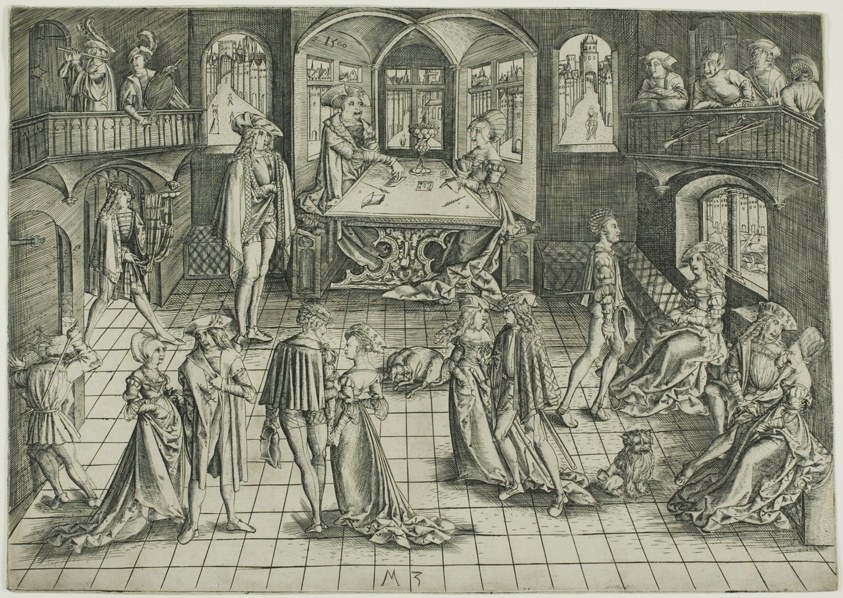
A formal indoor ball or court dance, depicted in an early sixteenth-century German engraving. The scene unfolds across a large vaulted interior with tiled floor and arched windows that open onto distant landscapes. Multiple figures in Renaissance dress fill the space: men in hose and tunics, women in long gowns with headdresses typical of the period. At the composition's center, a substantial table laden with food and vessels marks the social occasion. The dancers and attendants are distributed throughout the room in various groupings—some actively dancing, others watching, conversing, or attending to refreshment. The foreground shows at least two couples engaged with each other, while the middle distance and background contain further figures at rest and in motion. The overall impression is of a complex social occasion captured at multiple moments simultaneously, with the artist layering observation of courtship, display, and the formal protocols of Renaissance elite gathering.
The dancing
The dancers nearest the viewer are in close physical proximity, suggesting paired dancing. Their postures are upright and formal, arms positioned at waist and shoulder levels in a manner consistent with fifteenth- and sixteenth-century court choreography. One couple in the foreground left shows a woman in an elaborate long gown and a man in tunic and hose facing each other or holding hands at chest height—a positioning compatible with basse danse or almain figures. Throughout the scene, the weight distribution is vertical and controlled rather than dynamic; bodies are still or moving with deliberation rather than swiftness. The groupings suggest both danced pairs and observers arranged in the social hierarchy of the court.
The dance depicted
This depicts a Renaissance court dance, most likely a bal or court gathering where multiple forms would have been performed in sequence. The formal dress, vaulted interior, table service, and mixed social engagement (some dancing, some attending to other business) align precisely with accounts of Renaissance court balls in German-speaking territories. The postures and distances between figures are most consistent with basse danse, almain, or branle—stately processional or circular forms requiring little dramatic vertical movement. The presence of both couples dancing and a significant portion of the company at rest or in conversation suggests the occasion captured is an entire ball rather than a single choreographed spectacle, with guests proceeding through established dance forms over the course of an evening. The image provides visual evidence that court dancing was integrated into a larger social ritual of eating, drinking, observation, and courtship rather than a separate performance.
How it was made
This is an engraving on paper, a medium that required the artist to work in reverse on a metal plate (copper or iron) and achieve all tonal and textural effects through linear hatching and parallel lines. Engravings of this period circulated widely through print networks, making them far more numerous and accessible than paintings; this work was therefore designed for a broad educated audience across German territories rather than for a single patron. The technique's linearity and precision allowed the artist to render architectural detail, costume complexity, and spatial recession with clarity, but required advance planning and skilled execution—there is no spontaneity or revision. The work's survival suggests it was valued enough to be kept and reprinted, marking it as a significant document of Renaissance social practice.
About this work
A German Renaissance engraving documenting the social and choreographic protocols of a formal court ball, circa 1500. The work captures not a single moment of dance but an entire occasion—with couples engaged in stately paired forms while others attend to food, drink, conversation, and observation. Master M.Z. has structured the composition to show both the architecture of sociability (the vaulted hall, the service table, the distribution of figures) and the choreography itself, rendering the body positions and proximities of dancers with the precision expected in a legal or didactic document. This is not idealized or theatrical representation but empirical observation, documenting how Renaissance elites actually danced and how dance functioned as a core mechanism of courtship and social bonding.
How to look at it
Attend first to the architectural framing: the artist has chosen a vaulted interior with deep recession, positioning the viewer as if standing in the hall itself. This establishes the social space as formal and controlled—not a street or festival ground. Then trace the distribution of figures: note which pairs are actively dancing (close, facing, hands or arms engaged) and which are stationary or at some remove. The woman in the left foreground in a white gown and her partner are among the clearest instances of dance positioning; compare their distance and orientation to pairs elsewhere. Finally, observe how the artist has rendered fabric and movement: the long gowns fall vertically, the men's hose cling to the leg, suggesting controlled, upright carriage rather than active footwork—the visual signature of stately Renaissance court dance.
The artist
Master M.Z. was an active engraver working in German-speaking territories in the early sixteenth century, a period when printmaking was establishing itself as a primary medium for the circulation of both artistic and documentary imagery. The monogram M.Z. appears on several engravings of social and courtly subjects from this period, but the artist remains otherwise unidentified in historical records. The choice to engrave scenes of court life suggests both the artist's access to elite circles and the market demand among merchants, clergy, and minor nobility for images of courtly practice—as models, as records of fashion, or as assertions of cultural sophistication.
The period
The early sixteenth century saw the consolidation and standardization of Renaissance court dance in Germany and northern Europe, following models imported from Italy and the Burgundian court. Dance manuals and theoretical texts on choreography were beginning to circulate in print, reflecting increased interest in codifying and teaching formal dance. Simultaneously, engraving was establishing itself as a medium for documentary imagery, allowing artists to record social practices—costume, architecture, gesture—with greater precision and wider distribution than manuscript illumination permitted. The dancing depicted here belongs to the tradition of processional and circle dances (basse danse, almain, branle) that dominated European court choreography before the emergence of the couple-based waltz and quadrille.
Where it lives
The work is held in the Prints and Drawings collection of the Art Institute of Chicago, where it is recorded as part of a broader assemblage of Renaissance prints documenting social and courtly life. As an engraving, it entered the collection as part of a larger purchasing tradition that valued prints both as artworks and as historical documents of period dress, gesture, and social custom.
Dance in this work
Questions about this work
Is this a real event or an idealized fantasy?
The level of architectural and costume detail, along with the mixed activity (some dancing, some eating, some conversing), suggests the artist was documenting actual court practice rather than inventing an imaginary scene. However, the engraving is a composed image, not a snapshot; the artist has arranged figures and viewpoint to convey the formal character of the occasion rather than capturing random movement. It is therefore both observational and rhetorical—true to what happened, but shaped to make a point about Renaissance courtly refinement.
What dances were these people doing?
Based on the date, dress, and body positioning, the dances are most likely basse danse, almain, branle, or some combination of these. These were stately, processional forms performed in couples or circles, with steps that emphasized gravity and control rather than leaping or rapid footwork. The engraving shows the formal paired arrangements these dances required but does not give us clear evidence of specific footwork, so we cannot say which form is being danced at any given moment.
Why are some people not dancing?
Court balls were social events lasting hours, not choreographed performances. Musicians would play a series of dances in sequence, and different guests would participate in different dances depending on rank, age, health, and preference. The seated and standing figures in the background represent the actual social rhythm of a ball—some resting, some eating, some watching, some dancing. This mixed engagement was normal and expected.
Can we identify the artist?
Only by the monogram M.Z., which appears on several northern European engravings from the early sixteenth century. Despite archival research, the artist's full identity remains unknown. This is common for printmakers of the period, particularly those working in secondary artistic centers outside the major courts and cities.
More dance artwork





