49 works in this view — arrow keys or swipe to move between them.
Dance in Art
The Supper after the Masked Ball
Thomas Couture (French, 1815-1879) printed and manufactured by Jules Desfossé (French, 1816-1889)
- Medium:
- Woodcut with painted and stenciled additions on tan wove paper, laid down on fabric, and stretched on a wooden stretcher
- Collection:
- Prints and Drawings
- Source:
- Art Institute of Chicago
- Rights:
- Public domain — free to use, share and adapt.
- Recorded as:
- CC0 (Public Domain)
This work offers rare visual evidence that nineteenth-century observers were aware of the physical labor underlying ballroom dance, which histories often treat as purely decorative or courtly. It documents the social geography of the masked ball—a form of dance entertainment that played a significant role in urban leisure but is now largely invisible. The work suggests that the nineteenth century had already begun to see ballroom culture with irony, treating the formality of social dance as something to be abandoned rather than sustained.
What you are looking at
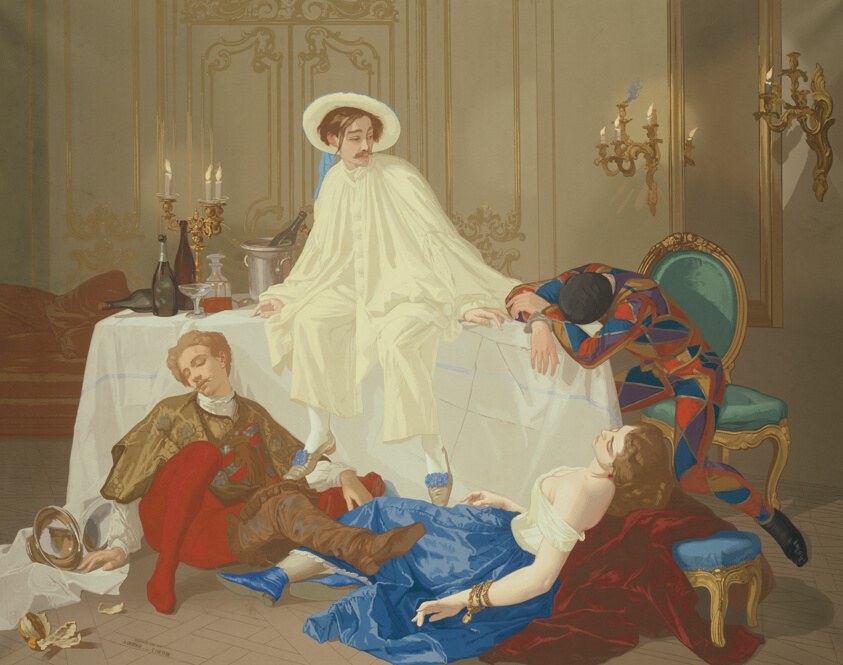
A fashionable interior of the mid-nineteenth century, decorated in the Louis XV style with gilt paneling and wall sconces, hosts the aftermath of a masked ball. Three figures occupy the space in various states of dishevelment and exhaustion. A woman in an elaborate white domino cloak and wide-brimmed hat reclines across a chair in the center, her costume still in place but her posture utterly collapsed. To her left, a man in a richly patterned coat of red and gold sits slumped in a chair, his head thrown back. A woman in a blue silk dress lies prostrate on the floor in the foreground, her red velvet wrap draped across furniture, having apparently abandoned the pretense of dignity altogether. A small table nearby holds champagne bottles, glasses, and the detritus of celebration. The composition captures not the dance itself but its exhausted aftermath—a moment of social performance abandoned.
The dancing
The figures are entirely static, their bodies marked by fatigue rather than movement. The recumbent woman in white spreads across her chair with her arms dangling, her weight fully given to furniture. The man beside her sits with spine curved and head tilted back in apparent stupor. The woman on the floor is fully horizontal, one arm trailing, her body slack. None of the three figures maintains an upright frame or engages with the others; instead, each is isolated in private exhaustion. The artist has deliberately rejected dynamic poses in favor of weighted, sagging bodies that convey the physical toll of hours of continuous motion.
The dance depicted
This is not a dance scene but a commentary on the social dance of the ballroom—specifically the masked ball, a feature of aristocratic and wealthy bourgeois entertainment in the nineteenth century. The dancers have departed the floor and now face the aftermath of the formal minuet, cotillion, and quadrille that would have constituted the evening's choreography. The image records not the performance of dance but its cost, suggesting the era's awareness that ballroom dance, for all its elegance and control, was fundamentally exhausting physical labor. The title specifies this is 'after' the ball, marking the temporal boundary between the disciplined body in motion and the body in collapse.
How it was made
This is a hand-colored woodcut—a relief print that combines the bold linear clarity of wood engraving with painted and stenciled color additions applied after printing. Woodcut allowed rapid reproduction, making this work available to a broad middle-class audience as a print rather than a unique artwork. The technique's reliance on strong line and simplified form works against the softness of the figures' collapse; there is an inherent tension between the medium's clarity and the subject's languid disorder. The hand coloring gives the print richness and particularity—the precise shades of the woman's white cloak, the red velvet, the gold leaf—that a woodcut alone could not achieve.
About this work
This is a satirical or observational print from the mid-nineteenth century that captures the social world of the ballroom by refusing to depict dancing at all. Instead, it shows the moment after the orchestra has stopped, when the bodies that have been performing grace and lightness for hours are revealed to be merely bodies—tired, sprawled, indifferent to the décor that framed their performance. The work sits at the intersection of social commentary and dance documentation, recording not technique but exhaustion, not elegance but collapse. It is a print made for circulation among a literate, urbane audience familiar enough with ballroom life to recognize both the luxury of the setting and the comedy of the abandonment of posture that follows the final cotillion.
How to look at it
Attend to the contrast between setting and body: the refined, expensive interior with its gilt and candles frames bodies that have abandoned all pretense of refinement. Notice the different varieties of collapse—the woman upright but sprawled, the man whose head hangs back, the woman fully horizontal. Each position suggests a different threshold of endurance, but all arrive at the same conclusion: the body, when released from the obligation to perform, seeks only rest. The print's humor and its pathos both lie in this moment of transition from the ballroom's disciplined elegance to the private disorder that follows.
The artist
Thomas Couture (1815–1879) was a French academic painter celebrated for historical and allegorical subjects, though also known for genre scenes and social observation. He was a teacher of considerable influence and authority within the French academic tradition. This print was manufactured by Jules Desfossé (1816–1889), a skilled craftsman in the production of hand-colored prints, suggesting that Couture designed the composition and Desfossé executed and colored the blocks. The collaboration was typical of nineteenth-century print production, where design and manufacture were often separated.
The period
The masked ball was a central institution of European social life in the mid-nineteenth century, particularly in Paris and other major cities. It represented a space of licensed transgression—a moment when rank, gender, and identity could be performed differently under the cover of costume. By the 1850s, when this print was made, the masked ball was already becoming a subject of satire and commentary, as writers and artists began to treat it as an emblem of bourgeois pretension and exhaustion. The print's attention to aftermath rather than spectacle reflects a broader nineteenth-century interest in the 'real' behind social performance—a concern shared with realist painting and the novel.
Where it lives
This work is held in the Prints and Drawings collection of the Art Institute of Chicago. It is a hand-colored woodcut on tan wove paper, laid down on fabric and stretched on a wooden stretcher, suggesting it was prepared for display or exhibition rather than kept as a loose print.
Dance in this work
Questions about this work
Why is this called a dance image if nobody is dancing?
This print documents the social world of ballroom dancing by capturing the moment when that world collapses. It records what happens when the orchestra stops and the obligation to perform grace and lightness ends. For historians and dancers, understanding how a dance was experienced—including its aftermath—is as important as seeing the steps. This image tells us that masked balls were physically exhausting events that required recovery.
What dances would have been performed before this moment?
The masked ball of the 1850s typically featured the quadrille, the cotillion, and the minuet, along with waltzes and galops. These were formal social dances performed in strict sequence. The composition, dress, and setting all point to Paris or another major European city where such balls were regular events among the wealthy and upper middle class. The print's title specifies 'supper,' suggesting this moment occurs during one of the breaks in dancing.
Is this a political or moral commentary?
The print is observational rather than explicitly moralistic, though it does invite the viewer to notice the distance between the ballroom's pretense and the body's honest collapse. It may be read as gently satirical—poking fun at the world's vanity and the futility of its formalities—or as simply documentary, recording how the body responds to sustained performance. The tone is closer to wit than to condemnation.
Who would have bought this print?
Hand-colored woodcuts of this kind were produced for the urban middle class—people familiar with ballroom society and capable of finding humor in its representation. The work was likely sold through print shops, magazines, or exhibitions. It was affordable enough to circulate widely but skillfully executed enough to appeal to people with some aesthetic education.
More dance artwork





