49 works in this view — arrow keys or swipe to move between them.
Dance in Art
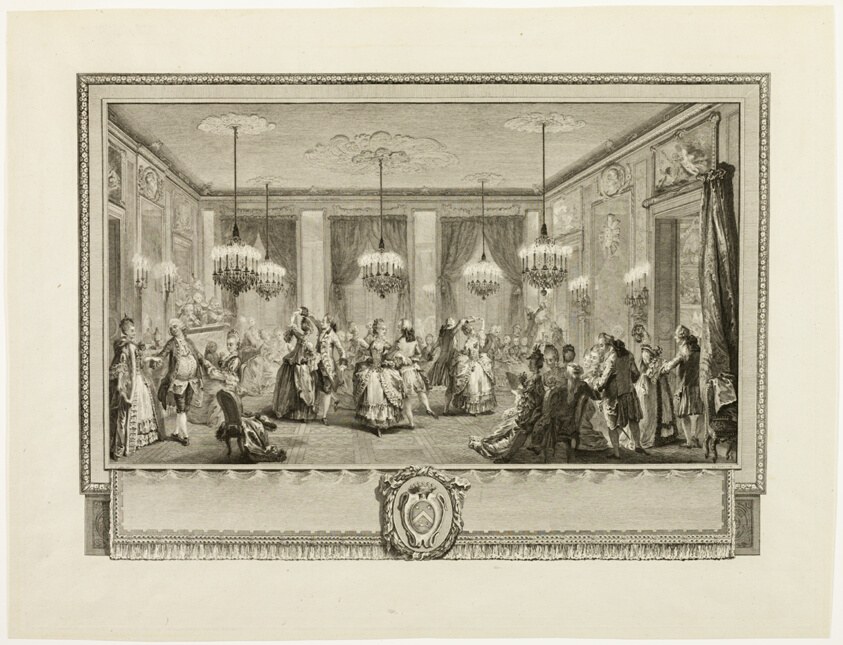
Bal Paré (The Jewel Ball)
Antoine-Jean Duclos (French, 1742-1795) after Augustin de Saint-Aubin (French, 1736-1807)
- Medium:
- Etching and engraving on ivory laid paper
- Collection:
- Prints and Drawings
- Source:
- Art Institute of Chicago
- Rights:
- Public domain — free to use, share and adapt.
- Recorded as:
- CC0 (Public Domain)
For historians of dance technique, this engraving is a rare contemporary record of how minuets and French Baroque social dances were actually held and performed in the ballroom, not on the theatrical stage. For art historians, it exemplifies the genre of fashionable society engraving that recorded the manners and material culture of the French aristocracy in the decades before the Revolution.
What you are looking at
A grand ball in an eighteenth-century French salon, captured in the moment of revelry. The room is illuminated by five crystal chandeliers hanging from an ornate ceiling decorated with clouds. The walls are paneled and enriched with relief ornaments and gilt details. The floor is a polished parquet on which dozens of elegantly dressed figures stand and move. In the center, a couple performs a formal dance while others cluster in conversational groups, stand in observation, or prepare to dance. The women wear elaborate gowns with panniers, their skirts spread wide and heavily decorated; the men are in knee breeches, coats, and heeled shoes. Some women wear feathered headdresses and jewelry. The gathering is orderly yet animated, with clear sightlines that suggest this is a choreographed social occasion rather than a crowded melee. A heavy damask curtain visible on the right side frames the scene. The engraving's fine cross-hatching creates subtle gradations of light and shadow that emphasize the luxury of the interior and the formality of the occasion.
The dancing
The central dancing couple holds the ballroom frame typical of eighteenth-century court dance: the man's right hand on the woman's left waist, their free hands raised and aligned. Both bodies are upright with a slight forward inclination from the hip, a posture characteristic of the period. Other figures stand in poses of attentive repose, their arms held gracefully at their sides or with hands engaged in conversation. The dancers' feet are not sharply defined in the engraving but the overall silhouette suggests the turned-out legs and small-stepped gait of Baroque dance. Several women display the sideways, gliding carriage of the waltz or similar paired dances gaining popularity by 1774, while others stand in the sideways presentation posture of court assemblies.
The dance depicted
This is a ballroom ball scene that documents the "bal paré"—a grand ball at court or in aristocratic society. The dances visible are consistent with late Baroque and early Rococo social dance: the formal opening pair appears to be performing a minuet or a gavotte, the most prestigious dances of the period, while the gathered observers suggest the structured rotation in which partners took turns dancing before the assembled company. The engraving captures the ritual of eighteenth-century court dance—not spontaneous movement, but choreographed, rule-governed display. The dancers' postures and holds are recognizable as the vocabulary of French Baroque technique, with its emphasis on épaulement, refined port de bras, and turned-out positions. This is amateur court dance, not theatrical ballet, performed in full formal dress as part of social hierarchy and courtship display.
How it was made
This is an etching and engraving on laid paper, as stated in the record. The combination of both techniques allowed the artist to achieve both the linear precision of engraving (for the architectural and decorative detail of the walls, ceiling, and furniture) and the tonal subtlety of etching (for the figures' clothing, skin, and the play of candlelight). The layering of fine lines creates areas of tone without solid fills, essential to the eighteenth-century print medium. This was an expensive and labor-intensive technique, implying circulation among wealthy collectors and patrons. The print's format and presentation suggest it was issued as a separate engraving or as part of a sequence documenting fashionable Parisian or Versailles society, making it both a record of how the elite danced and a desirable art object in its own right.
About this work
This engraving records a "bal paré"—a formal ball in late-eighteenth-century French aristocratic society—in the moment of performance. Based on the composition and the figures' dress and posture, the work dates to around 1774 and documents the minuet and related court dances that constituted polite social dancing at the apex of the ancien régime. The precision and luxury of the engraving indicates its intended audience: the same social class who attended such balls and wanted a record of their refinement. This is one of the few images that captures the actual lived experience of Baroque social dance, not its theatrical idealization—the dancers are in full regalia, the setting is architectural and grand, and the social function is explicit. It belongs in a gallery of dance in art because it records not a choreographed performance but the everyday (or rather, formal-everyday) movement practice of a vanished world.
How to look at it
Attend first to the central couple and the precise geometry of their frame: the alignment of their bodies, the angle of the man's hand on the woman's waist, and the formal distance between them. This is the minuet frame, one of the most codified bodily positions in dance history. Then trace the eye outward to the standing figures: notice how many are in conversation sideways, their shoulders turned away from the center of the room in the characteristic posture of the period. Finally, observe the architecture and light: the chandeliers are not merely decorative but functional, and their placement suggests where the dancing took place and how the space was organized for both performance and observation. The engraver has frozen the ball at a moment of maximum formality—a dance in progress, with the company assembled to watch.
The artist
Augustin de Saint-Aubin (1736–1807) was a prolific French engraver and draughtsman who specialized in prints of fashionable Parisian social life, costume, and interior design. He was celebrated for his wit, precision, and ability to capture contemporary manners. The present work is engraved after Saint-Aubin by Antoine-Jean Duclos (1742–1795), a respected reproductive engraver. This division of labor—one artist designing and drawing the composition, another translating it into engraving—was standard practice for fashionable prints intended for the print market.
The period
By 1774, the minuet had been the foundational social dance of European aristocracy for nearly a century, but its dominance was beginning to wane. Newer dances—the contredanse, the cotillon, and the waltz—were gaining ground, especially among younger dancers. However, the minuet remained the mark of aristocratic breeding and was the essential first dance at grand balls. The engraving captures this moment of transition: the minuet is still the centerpiece of the ball, yet the broader company displays the variety of dances and social rituals that characterized an evening of fashionable amusement. In visual art, the 1770s saw a proliferation of engravings of contemporary life by artists like Moreau le Jeune and Saint-Aubin, reflecting a growing appetite among the middle and upper classes for images of fashionable society.
Where it lives
The work is held in the Prints and Drawings collection of the Art Institute of Chicago. It is a historical print, likely issued singly or as part of a series of engravings of Parisian fashionable life in the 1770s.
Dance in this work
Questions about this work
What is a "bal paré"?
A bal paré (literally "dressed-up ball") was a grand formal ball held in aristocratic or royal society, typically in a decorated salon with chandeliers and orchestral music. Attendees wore elaborate formal dress and danced a prescribed sequence of dances, beginning with the minuet. Such balls were central to the social calendar and to courtship and dynastic alliance among the nobility.
How do I know this is an engraving and not a painting?
The fine parallel lines visible throughout the image—especially in the fabrics, shadows, and background—are the hallmark of engraving and etching. These lines are incised into a metal plate and printed, creating tone and shadow through the density of the line work. A painting would show brushwork or solid areas of color instead. The pale cream paper and the monochromatic finish also confirm this is a print.
What dance are the central couple performing?
Based on the dancers' upright posture, the formal frame with the man's hand on the woman's waist, and the moment of their movement, this is almost certainly a minuet. The minuet was the opening and most prestigious dance at formal balls in the 1770s, and its slow, dignified tempo and prescribed figures would have been the first thing an assembled company witnessed.
Why were balls so formal and choreographed?
For the European aristocracy, dance was not entertainment but a form of non-verbal communication about rank, refinement, and eligibility. The ability to perform the minuet correctly was a mark of breeding. The formal sequence of dances also ensured that all attendees had equal opportunity to participate and to be seen, making the ball a ritual of social order as much as pleasure.
More dance artwork





