49 works in this view — arrow keys or swipe to move between them.
Dance in Art
Ballet shoe
Frederick Freed
- Collection:
- Ballet shoe
- Source:
- Victoria and Albert Museum
- Rights:
- Rights vary by item — check the source record before reusing this image. Source record ↗
- Recorded as:
- V&A — check rights per item
For dancers and dance historians, a Freed pointe shoe is a document of technique and taste: it reveals what shoe qualities, proportions, and materials were considered essential for professional work during a particular era. For craft historians and collectors, Freed's shoes are recognized artifacts of a vanishing handmade trade. For anyone interested in how embodied skill becomes visible in material form, this single worn shoe is a compelling example.
What you are looking at
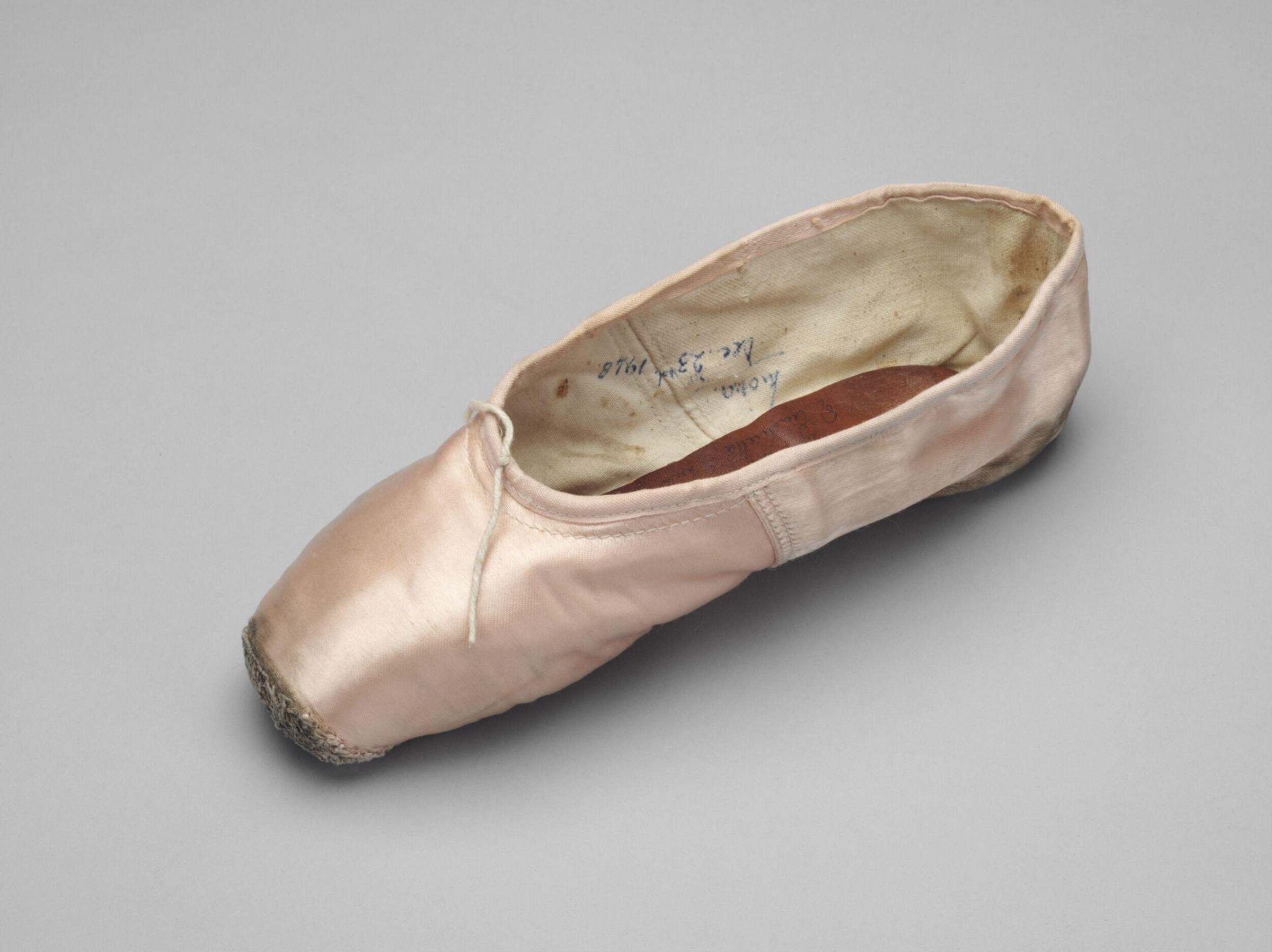
A single pale pink satin pointe shoe lies against a neutral grey background, angled diagonally to show the three-dimensional form. The shoe is captured in full detail: the satin exterior in a soft rose tone, the reinforced toe box slightly worn from use, the drawstring visible at the throat, and the leather sole and heel pad in warm tan. The interior is exposed, revealing a cream-coloured lining and a handwritten inscription in blue or dark ink. The shoe casts a subtle shadow, emphasizing its volume and tactile quality. This is a working tool of dance, not a display or ceremonial object—the visible wear on the tip of the box and the scuff marks around the heel tell of actual use at the barre and on stage.
The dancing
This is not a figure study but a material object—there are no bodies or bodies in motion. What we see instead is evidence of embodied practice: the compression and slight deformation of the toe box from the dancer's weight over the metatarsal heads, the shaped vamp that conforms to an individual foot's geometry, the flexed form of the shoe at rest. The drawstring and throat opening suggest how the dancer would secure and fit the shoe. The worn sole and worn patch at the tip indicate how pointe work deforms the shoe—the dancer stands, rises, rolls through the foot in a way that the material records.
The dance depicted
This is a ballet pointe shoe, the specialized footwear that enables the distinctive technique of standing and moving on the tip of the toe—a defining characteristic of classical ballet. The shoe itself does not dance, but it is inseparable from the ballet dancer's body and training. Frederick Freed was a legendary maker of pointe shoes; his shoes were worn by professional dancers from the 1920s onward, and his workshop in London became one of the most respected in the world. The inscription inside this shoe, though partly illegible in the photograph, likely records the dancer's name or the date of making. That Freed preserved or catalogued this single shoe suggests it belonged to a notable dancer or marked a significant commission.
How it was made
This is a photograph of a physical object—a hand-stitched pointe shoe made from satin fabric, leather, and internal reinforcement materials (likely burlap and glue, though internal construction is not visible). The photograph is a studio documentation shot, well-lit and precisely focused to record the object's form and condition. The neutral background and careful positioning are typical of museum or archive photography, designed to make the object legible rather than beautiful. This approach treats the shoe as a historical artifact and primary source rather than as a commodity or fashion object.
About this work
This is a single pointe shoe by Frederick Freed, the pre-eminent British maker whose shoes defined professional ballet practice for much of the twentieth century. The shoe is not a work of art in itself, but a tool and a historical document: it records the size, shape, and preferences of an individual dancer, bears the marks of that dancer's work, and carries an inscription that connects it to a specific moment and person. As an object in an archive or collection, it serves a different purpose than a painting or sculpture would—it does not represent dance; it is part of dance's material infrastructure. Yet it also invites reflection on the labour, craft, and individual customization that lie behind the apparent simplicity of a classical ballet performance.
How to look at it
Look first at the wear patterns: the compressed toe box, the darkened patch where the dancer's weight lands on pointe, the slight creasing along the vamp. These marks are not flaws but evidence of labor. Then examine the construction: the neat stitching along the edges, the careful shaping of the heel counter, the reinforced throat. The interior inscription connects the object to a specific person and moment—a small detail that transforms it from a generic shoe into a historical artifact. Finally, consider the care required to preserve something so fragile: satin tears, leather dries and cracks, and the shoe's value lies partly in its rarity and its age.
The artist
Frederick Freed (1905–1981) was a British maker of pointe and soft ballet shoes who established his workshop in London and became the preferred supplier for many of Britain's leading dancers and the Royal Ballet. He pioneered methods of customizing shoes to individual dancers' feet and preferences, working closely with dancers to refine fit and support. Freed's business expanded internationally and his shoes remained in use by professional companies for decades; the brand Freed of London continues today. He treated shoe-making as a craft and a partnership with the dancer, not a mass-production business.
The period
In 1948, when this shoe was made, classical ballet was undergoing a period of consolidation and professionalization in post-war Britain. The Royal Ballet had been established in 1946, and British ballet was asserting itself as a major cultural force under the direction of Ninette de Valois and Frederick Ashton. Pointe work was by then a fully established and standardized technique with a century of refinement behind it, and the shoes themselves had evolved into highly specialized, individually fitted objects. Freed's reputation was at its height during this period; his shoes were sought by dancers across Europe and North America. The inscription and preservation of this single shoe reflect a moment when professional ballet was valued enough to document its material culture.
Where it lives
The catalogue record indicates the holding is the Victoria & Albert Museum (va). The shoe is catalogued as a single object within the museum's collections; the handwritten inscription on the interior is part of the museum's documentation and may be original to the shoe or added at accession.
Dance in this work
Questions about this work
Why is this shoe in an art museum?
Pointe shoes document the history of dance technique, fashion, and craftsmanship. As a bespoke object made by a celebrated craftsman and worn by a professional dancer, it is a primary source for understanding twentieth-century ballet practice. Museums collect such objects to preserve the material culture of dance and to make it available to researchers, dancers, and the public.
Can I read the name inside the shoe?
The inscription is partially legible in the photograph but not entirely clear. It likely records the dancer's name or initials and possibly a date. The museum's documentation record would contain a full transcription.
Why is there only one shoe?
Museums and collectors often preserve a single significant shoe as an artifact, either because one was damaged and discarded, or because the shoe was notable enough to document on its own. Pointe shoes are consumables; a working dancer would wear through many pairs, so a preserved pair is uncommon. This single shoe may have belonged to a distinguished dancer or been commissioned for a significant role.
What does Frederick Freed's reputation rest on?
Freed revolutionized pointe shoe-making by treating each dancer as an individual, working directly with them to customize fit, width, vamp length, and support. His shoes were lighter and more responsive than many competitors', and he maintained high standards of handcraft throughout his career. Dancers associated Freed shoes with professional quality and performance confidence.
More dance artwork





