49 works in this view — arrow keys or swipe to move between them.
Dance in Art
Ballet shoe
Unknown
- Collection:
- Ballet shoe
- Source:
- Victoria and Albert Museum
- Rights:
- Rights vary by item — check the source record before reusing this image. Source record ↗
- Recorded as:
- V&A — check rights per item
Pointe shoes are rarely treated as historical objects worthy of preservation and study, yet they are among the most direct physical traces of how ballet was actually performed. This shoe documents not technique in theory but technique in practice—the accumulated pressure and wear visible on the sole tells a story that no notation or photograph can fully capture. For dancers and historians, it is a reminder that dance history lives in objects.
What you are looking at
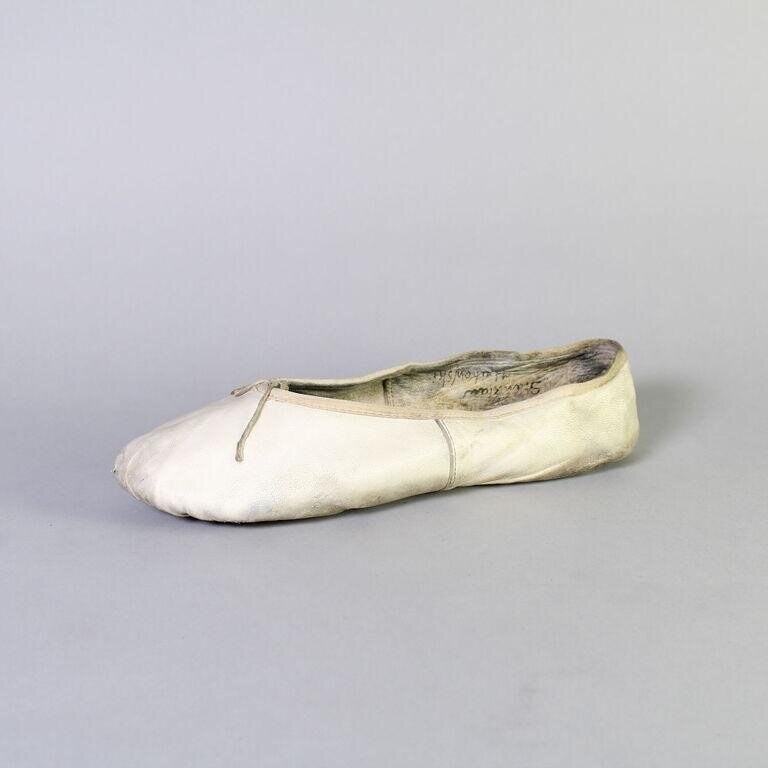
A single soft ballet pointe shoe, photographed against a neutral gray background in three-quarter view. The shoe is made of pale pink or cream-colored satin or similar fabric, with a reinforced box at the toe and a visible drawstring or ribbon closure at the throat. The sole shows signs of wear and use—darkening and creasing along the foot bed—while the upper retains a relatively soft appearance. The shoe is positioned at a slight angle, allowing clear visibility of both the vamp and the profile, which reveals the characteristic gentle curve and taper from the broad toe platform to the narrower heel. The lighting is even and clinical, typical of museum documentation, which emphasizes the three-dimensional form and material texture.
The dancing
This is a costume object rather than a depiction of a dancing body. The shoe itself conveys the dancer's presence through its form: the hardened, squared-off toe box speaks to weight and pressure applied during performance, while the worn insole suggests repeated use. The slight asymmetries in the fabric—the way it has molded to an individual foot—carry the implicit trace of the wearer's movement and technique.
The dance depicted
This is a ballet pointe shoe, the fundamental tool of classical and contemporary ballet. The shoe is designed to allow a dancer to rise onto the extreme tip of the toe, distributing body weight across the reinforced platform at the toe. The visible wear pattern—the darkened, creased sole—indicates this shoe was actively used in performance or serious training. The design and construction suggest nineteenth-century or twentieth-century manufacture, placing it in the era when pointe work became the codified center of ballet technique. The shoe itself is the evidence of a dancer's practice.
How it was made
This is a textile artifact: a soft pointe shoe constructed from satin (or similar fabric), with a hardened box formed from layers of glue, burlap, and paste, and a reinforced sole. The shoe was handmade using traditional construction methods that remain largely unchanged since the early 19th century. Objects like this were not created for display; they are functional equipment that acquired their material character through repeated physical use. Its preservation in a museum collection reflects a shift in how dance history is documented—from notation and description to the conservation of the actual tools and costumes that made performance possible.
About this work
This is a single ballet pointe shoe, a primary document of dance practice and technique. It belongs in a dance gallery not as art object but as historical evidence of the body it served: the shoe's shape, wear, and construction record the specific physical demands of ballet and the individual dancer who wore it. Pointe shoes are fundamental to how ballet is understood, yet they are rarely seen as the artifact-witnesses they are. This shoe, preserved and displayed, shifts attention from the abstract concept of 'ballet' to the concrete material reality of how dancers worked—the incremental, damaging labor that pointe technique requires.
How to look at it
Examine the sole closely: the darkening and creasing pattern reveals where the dancer's weight repeatedly pressed and where the shoe flexed during rising and lowering on pointe. Look at the throat of the shoe and the drawstring closure, which shows how the shoe was fitted and secured around the ankle. The slight asymmetries in the satin surface—subtle puckers and color variations—are the marks of individual use, evidence that this was a working shoe fitted to a particular dancer's foot, not a generic object.
The period
Pointe work became standard in ballet during the early nineteenth century, initially as a technique to create an ethereal, weightless effect in Romantic ballet. By the mid-nineteenth century, pointe shoes had evolved from simple satin slippers hardened with paste into specialized equipment requiring significant skill to construct and use safely. The shoe shown here reflects the standardized construction methods that became established by the early-to-mid twentieth century. Ballet pointe shoes have remained largely unchanged in design since the 1920s, making it difficult to date this particular shoe precisely without additional provenance information.
Where it lives
The object is catalogued as held in a collection referenced as 'va' (likely a museum or archive abbreviation); the record provides no accession number, date of acquisition, or donor information. It is documented as an artifact of ballet practice, though the identity of the dancer and the period of use remain unknown.
Dance in this work
Questions about this work
How old is this shoe?
The record does not provide a date. Pointe shoe design has remained relatively stable since the early twentieth century, so the shoe could have been manufactured at any point in the past century or more. The degree of wear, the specific hardening methods used, and construction details might allow an expert conservator to narrow the date, but without additional information the shoe cannot be precisely dated.
How long would a dancer use one pair of pointe shoes?
A professional ballet dancer might wear through a pair of pointe shoes in anywhere from two weeks to two months, depending on the intensity of rehearsal and performance. The visible wear on this shoe suggests significant use. A single pair of pointe shoes is a consumable item, making the survival of any individual pair a matter of chance and deliberate preservation.
Why do ballet dancers use pointe shoes?
Pointe shoes allow a dancer to rise onto the tip of the toe, creating the visual illusion of weightlessness and extending the dancer's line. The hardened box distributes the dancer's full body weight across a small platform, a biomechanically demanding technique that requires years of training to perform safely. The shoe is essential to the aesthetic and technique of classical ballet.
More dance artwork





