49 works in this view — arrow keys or swipe to move between them.
Dance in Art
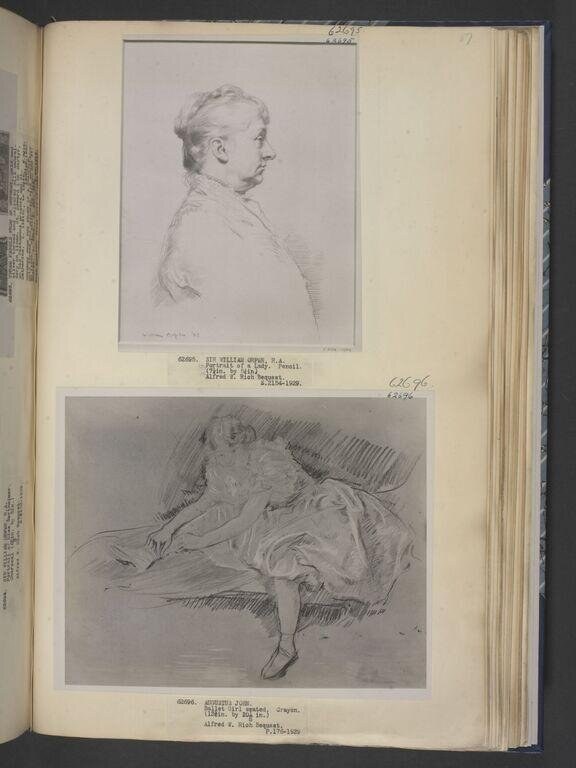
A seated ballet dancer
Unknown
- Collection:
- Drawing
- Source:
- Victoria and Albert Museum
- Rights:
- Rights vary by item — check the source record before reusing this image. Source record ↗
- Recorded as:
- V&A — check rights per item
The sketch demonstrates the artist's interest in ballet as a subject of close physical observation, independent of narrative or spectacle. For dance historians, such studio drawings are primary evidence of how dancers dressed, held themselves, and occupied space during rehearsal and private moments—information rarely captured in the formal theatrical imagery that dominates the period.
What you are looking at
Two sketch studies on a single page, both depicting a solitary female dancer in informal dress. The upper sketch shows a three-quarter profile of a young woman's head and shoulders, rendered in fine pencil with particular attention to the set of her hair and the angle of her gaze downward. The lower, larger study presents a seated or reclining figure in a light, possibly cotton dress, her body weight shifted asymmetrically, one leg extended, the other bent. The pose suggests a moment of rest rather than active performance—the dancer is caught between positions, her posture relaxed and naturalistic rather than formally composed. Both drawings employ loose, economical line work with subtle shading to suggest form; the artist has prioritized capturing the body's ease and the quality of the fabric over precise anatomical definition. The paper is cream-colored, aged to a soft tan.
The dancing
The upper study captures a contemplative downward gaze with the head held at a natural, unstudied angle. The lower figure displays the loose, off-balance posture of a body at rest—weight settled into the seat, one leg extended casually, the torso neither rigidly upright nor theatrically arched. There is no visible turnout or formal positioning of the limbs; the artist has rendered the dancer in a private, unguarded moment rather than in performance attitude. The sketches suggest an artist attentive to how dancers actually occupy space when not executing steps.
The dance depicted
The work depicts ballet in a documentary rather than theatrical register. The subject is almost certainly a professional or serious student dancer of the early 1900s, identifiable as such by her youth, the training implied in her carriage, and the context of the sketch series (the verso shows a second, related study). The absence of pointe shoes, the informal dress, and the relaxed posture suggest studies made in rehearsal or backstage rather than during performance. This is the kind of quick observational drawing made by an artist attending dance studios or theater dressing rooms, capturing the lived physicality of ballet beyond the spectacle of the stage.
How it was made
Pencil on paper, rendered in the rapid but precise technique of studio drawing. The economy of line and the selective use of shading suggest work executed from life or memory without intention of elaborate finish. The handling is consistent with the practice of European academic art schools in the 1880s–1910s, where life drawing from performers was a standard curriculum exercise. The sketches' informality—the absence of a signature or title on the drawings themselves—and their preservation in a bound collection indicate they were kept as private study material or part of an artist's working papers rather than as finished works for sale or exhibition.
About this work
This is a paired study of a ballet dancer at rest, likely made in the early 1900s in a European art studio or theater environment. The two sketches—a portrait head and a full-length figure study—exemplify a particular moment in the documentation of dance: the period when academic artists were increasingly interested in capturing performers' bodies in unguarded, naturalistic poses rather than in formal performance attitude. The work belongs to a broader 19th- and early 20th-century practice of studying dancers as subjects of anatomical and compositional interest, much as artists studied models from other professions. These are the kind of drawings that informed larger works—paintings, sculptures, prints—but also constitute a valuable record in themselves of how dancers actually looked and moved in the studio.
How to look at it
Attend to the artist's choice to draw the dancer at rest rather than in motion. The downward gaze in the upper study and the casual asymmetry of the lower figure suggest an interest in the dancer as a thinking, feeling human being rather than as an abstraction or symbol. Notice how the artist has used the minimum of line to convey weight, support, and the particular quality of fabric against skin. The sketches are economical in means but rich in observation—they reward close looking and reveal an artist's sustained attention to how a young woman's body actually moves and settles into stillness.
The period
In the 1880s–1910s, ballet dancers became increasingly popular subjects for European artists, particularly in France and Britain. This coincided with a broader fascination among academic and avant-garde painters alike with the body in motion, the theater, and modern urban life. Artists such as Edgar Degas had established the practice of studying dancers intensively and repeatedly, often in informal settings; his example inspired generations of followers. At the same time, ballet itself was undergoing change—the Romantic era's ethereal aesthetic was giving way to the more robust, athletic ideal of Petipa's Imperial Ballet. This sketch sits within that moment of transition, when the dancer's body, in all its ordinariness and grace, became a legitimate subject for serious artistic study.
Where it lives
The drawings are held in a bound volume or collection, indicated by the page mount and archival housing visible in the photograph. The source is listed as 'va', likely indicating the Victoria and Albert Museum in London. The sketches appear to be part of a larger body of life-study material, possibly from an artist's working papers or a teaching collection.
Dance in this work
Questions about this work
Is this dancer performing or posing?
Neither, and that is the point. The sketches capture a dancer in a private, off-duty moment—resting, thinking, or waiting. This is documentary observation rather than theatrical representation.
Why are there two studies on one page?
This is a standard practice in life drawing and sketch studies. An artist working from a live model would make multiple quick studies on a single sheet to explore different angles, poses, or aspects of the figure.
Can you identify the dancer?
Not from the image alone. The lack of a signature, inscription, or identifying mark on the sketches themselves makes identification difficult. The catalogue record does not name the subject.
How do you know this is ballet and not another form of dance?
The period, dress, and physical carriage of the figure are consistent with early 1900s European ballet training. The sketches' style and context (held in an art museum collection) suggest academic study rather than other dance traditions.
More dance artwork





