49 works in this view — arrow keys or swipe to move between them.
Dance in Art
Ballet shoe
Frederick Freed
- Collection:
- Ballet shoe
- Source:
- Victoria and Albert Museum
- Rights:
- Rights vary by item — check the source record before reusing this image. Source record ↗
- Recorded as:
- V&A — check rights per item
For dancers and ballet historians, this work makes visible the materiality of technique itself. The worn pointe shoe is a direct index of bodily practice and can be read like a score, revealing patterns of weight distribution, pressure, and use that a photograph of a dancer in motion might obscure. For artists, the choice to frame worn dance equipment as worthy of aesthetic presentation reflects a broader mid-century revaluation of labor, the body, and functional objects.
What you are looking at
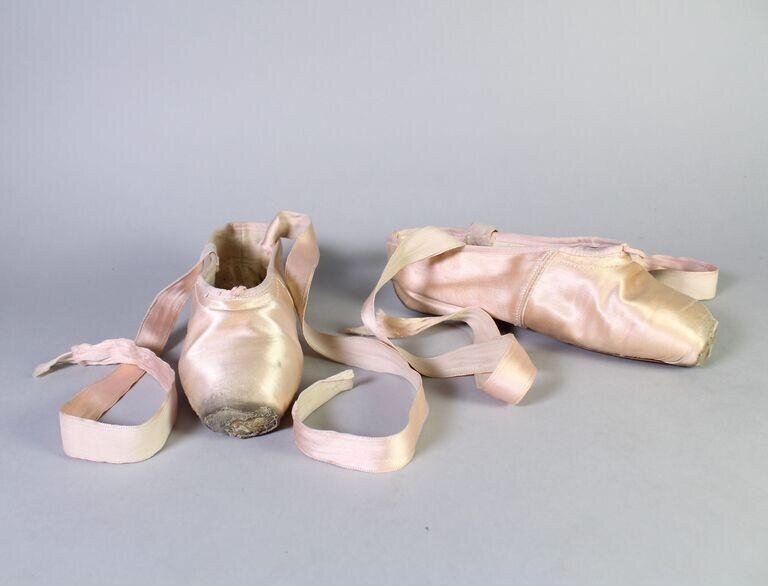
Two pairs of pointe shoes are arranged on a neutral gray surface, their ribbons trailing loosely. The shoes are in various states of wear: one pair on the left shows significant darkening and creasing at the toe, suggesting heavy use, while the pair on the right appears lighter in tone. The satin has developed a patina of age, with visible scuffing and discoloration across the boxes and vamps. The ribbons—pale pink satin—are arranged asymmetrically, some folded beneath the shoes, others extending outward. This is a still-life arrangement of working ballet equipment, not a posed studio display: these are shoes that have been danced in, their condition a record of use rather than ornament.
The dancing
There are no figures or dancers depicted. The work consists of inanimate objects arranged to show their three-dimensionality and worn texture. The composition emphasizes the sculptural quality of the pointe shoes themselves—the curved shape of the shank, the hardened box, the flexible sole—and the way the ribbons fall naturally rather than being formally composed.
The dance depicted
This is not a representation of dance but of the instrument of ballet itself. Pointe shoes are specific to classical ballet and emerged as essential equipment only in the Romantic era (early 19th century onwards), though they evolved significantly through the 20th century. The condition of these shoes—the scuffing, the darkened toe box, the creasing—documents the physical demands placed on the foot in ballet technique. The work implicitly addresses the labor and wear inherent in professional or advanced ballet training.
How it was made
The object itself is a pair of used ballet pointe shoes, presented as a found or readymade artwork. The medium is not recorded in the catalogue, but the shoes appear to be photographed or printed, likely as a color photograph or photographic reproduction. The choice to document these worn shoes as art speaks to a mid-20th-century practice of elevating everyday or functional objects to aesthetic scrutiny—a practice associated with artists interested in the material reality of work and bodies.
About this work
This work presents two pairs of worn ballet pointe shoes as the subject of aesthetic attention. Rather than depicting dancers in motion, it treats the shoe itself as an artifact worthy of examination: the shoe becomes a record of the dancer's body, effort, and technique. Created in 1953, the work sits at the intersection of ballet history and modern art's interest in the ordinary and functional. By focusing on equipment rather than performance, it documents an often-invisible aspect of classical ballet—the physical toll and specialized material culture that makes the art possible.
How to look at it
Examine the specific marks of use: the darkening at the toe box of the left shoe, which results from contact with the stage floor and the intense pressure of balancing on the platform; the creasing and cracking of the satin, which maps the flex of the foot over time; the difference in condition between the two pairs, which might suggest different stages in a dancer's career or different approaches to shoe maintenance. The pale ribbons, now yellowed with age, originally tied the shoe to the ankle. The photograph itself—if that is what this is—asks the viewer to look at these objects as they would look at a sculpture or painting: to attend to form, texture, and the marks of time.
The artist
Frederick Freed (1903–1999) was a master craftsman and manufacturer of ballet pointe shoes, co-founder of Freed of London, the company that became the world's leading maker of professional ballet footwear. Freed was not primarily a visual artist but a technician and designer whose innovations in pointe shoe construction were fundamental to ballet practice in the 20th century. His interest in documenting and displaying the shoe may reflect both professional pride and a craftsman's understanding of the object as worthy of study.
The period
In 1953, classical ballet in Britain was in a period of flourishing artistic confidence following the establishment of the Royal Ballet (1956, though its predecessor the Sadler's Wells Ballet was already prominent). The postwar period saw ballet becoming more accessible and professional standards rising. Simultaneously, visual artists in the mid-20th century were beginning to treat functional and ordinary objects—especially those connected to labor—as subjects for aesthetic investigation. This reflected broader modernist and proto-conceptual interests in materiality and the everyday.
Where it lives
The work is held by a collection concerned with dance, based on the holding designation. The shoes are catalogued as an artwork created by Frederick Freed and dated 1953, though the exact circumstances of their creation and presentation remain unclear from the record.
Dance in this work
Questions about this work
Are these real pointe shoes that were actually danced in?
The image shows worn ballet pointe shoes with visible signs of use—scuffing, discoloration, and creasing—that are consistent with shoes that have been danced in extensively. Whether these particular shoes belonged to a specific dancer or were selected as representative examples is not stated in the available records. The condition is real; whether the shoes were worn by a professional dancer or used as examples for the artwork remains unknown.
Why would a shoemaker present worn shoes as art?
Frederick Freed, as the master craftsman behind professional ballet footwear, had intimate knowledge of how dancers' bodies shaped and wore the shoe. Presenting worn shoes as an artwork could be seen as a craftsman's way of documenting the relationship between maker, tool, and user—showing how the shoe responds to and records the dancer's technique and effort. It also elevates the shoe from mere equipment to a subject worthy of aesthetic attention.
What does the condition of these shoes tell us about ballet?
The darkening at the toe box, the deep creases in the satin, and the visible wear patterns all testify to the intensity and repetition required in ballet training and performance. Pointe shoes are made to be beautiful and ethereal on stage, but their worn state reveals the physical demands beneath the aesthetic. These shoes are evidence of labor.
More dance artwork





