49 works in this view — arrow keys or swipe to move between them.
Dance in Art
Ballet shoe
Frederick Freed
- Collection:
- Ballet shoe
- Source:
- Victoria and Albert Museum
- Rights:
- Rights vary by item — check the source record before reusing this image. Source record ↗
- Recorded as:
- V&A — check rights per item
For dancers and historians, the worn pointe shoe is an honest record of what the practice looks like: not the fantasy of the stage performance, but the grinding repetition and physical cost of training and performing. The photograph captures a moment when contemporary artists were beginning to treat dance itself—not dancers, but the conditions and materials of dance—as a worthy subject for serious artistic attention.
What you are looking at
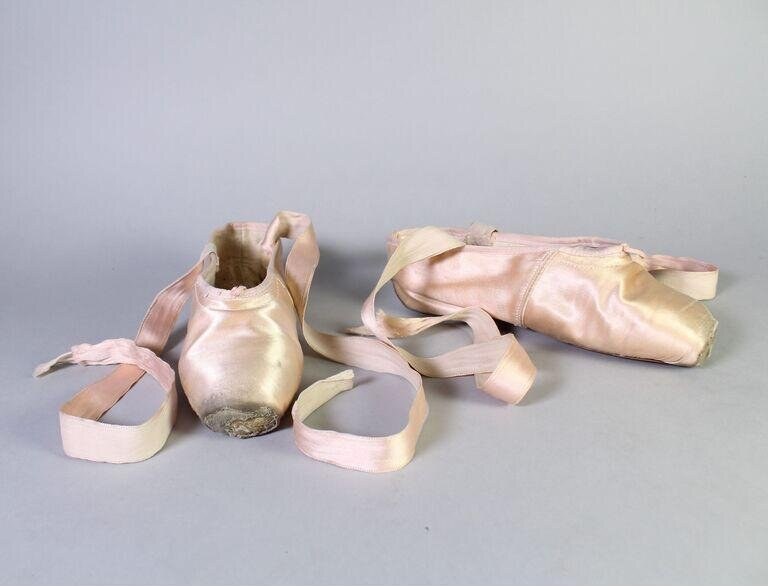
Two soft pink pointe shoes are arranged on a neutral gray background, photographed from above in clear studio light. Both shoes show the characteristic wear and soiling of stage use: the satin is creased and darkened, particularly around the box and sole. One shoe lies on its side with its ribbon extended, the other is tilted to show the underside of the sole. The shoes are worn, fragile objects—neither displays the pristine finish of a new shoe—suggesting these are working dancer's shoes, possibly from an actual performance or extended rehearsal period. The arrangement is intimate and documentary rather than decorative, presenting the shoes as artifacts of labor.
The dancing
These are not figures but the tool of the ballet dancer's art. The pointe shoes themselves communicate through their state of use: the boxes are compressed and darkened from pressure en pointe, the soles are marked and worn, the satin shows creasing consistent with the foot's articulation and landing. No dancer is visible, but the shoes' condition tells us of repeated jumping, sustained balance, and the mechanical stress of professional-level ballet training and performance.
The dance depicted
These are ballet pointe shoes, the specialized footwear that enables a dancer to rise onto the very tip of the toes and maintain that position. The shoes belong to theatrical ballet, likely classical ballet training or performance. The wear patterns suggest sustained use in jumps (plié and rebound) and sustained positions (en relevé or the full relevé of pointe work). Pointe shoes were developed in the early 19th century and became essential to Romantic ballet; by the 20th century they were fundamental to all classical ballet training and performance. The artist has chosen to document the shoe as a spent object, emphasizing the physical toll of the practice.
How it was made
The catalogue does not record a medium. The image is a photograph, likely color slide or print film, showing accurate color rendering and detail capture consistent with mid-20th-century color photography practice. The photograph is documentary in intention, using studio lighting and neutral background to isolate and examine the object without sentiment. Photography allowed the artist to record the precise condition, wear, and material texture of the shoes with a directness that drawing or painting would soften.
About this work
This is a photograph of a pair of used ballet pointe shoes, presented as a discrete artwork object rather than as a dancer in performance. The work belongs to the tradition of depicting dance through its material culture—the tools and costumes that make performance possible. By treating the worn pointe shoe as a subject worthy of sustained visual attention, the artist asks the viewer to read the shoe as evidence of labor, discipline, and the physical price of dance practice. The work sits at the intersection of dance documentation, still life, and the investigation of craft that characterized artistic practice in the mid-twentieth century.
How to look at it
Attend to the state of the shoes as text: the compressed box, the darkened satin, the creased and marked sole all tell you the history of use compressed into these two objects. Notice how the artist has arranged them to show both the exterior—what the audience sees—and the sole—what the dancer feels and the floor receives. The photograph is asking you to read wear as beauty, necessity as truth.
The artist
Frederick Freed (1905–1999) was a London-based bootmaker who became the most celebrated maker of pointe shoes in the mid-twentieth century. His shop in Fitzroy Street supplied British ballet companies, and his innovation in pointe shoe design and manufacture influenced the development of the shoe as ballet moved into the modern era. Freed shoes became the instrument of choice for dancers trained in the Cecchetti method and for many classical ballet companies. The photograph may document his own work or be a study of the shoe as a manufactured object and artistic tool.
The period
In 1953, ballet was undergoing a transformation. The post-war years saw the expansion of classical ballet training and the international touring of companies like the Royal Ballet (then the Sadler's Wells Ballet). The mid-century also brought a new critical and artistic interest in documenting dance through photography and film, moving beyond narrative illustration toward documentation of the dancer's body and the material conditions of performance. In visual art, the still life of industrial and handmade objects was beginning to attract serious attention as both craft history and as a subject for conceptual investigation.
Where it lives
The work is held in the V&A (Victoria and Albert Museum), London. The V&A's collection includes design and craft objects, textiles, and materials culture; the inclusion of this photograph places it within that framework of documenting the material and technical basis of cultural practice.
Dance in this work
Questions about this work
Why would a pointe shoe be considered art?
The photograph asks you to look at the pointe shoe not as a functional object but as a document of human labor, discipline, and material transformation. By framing it as a subject worthy of sustained aesthetic attention, the artist invites you to read the damage and wear as evidence of skill and commitment. This practice—elevating craft objects and materials culture to the status of fine art—became increasingly important in twentieth-century art practice.
Can you tell from the photograph what style of ballet these shoes were used for?
The shoes show wear consistent with classical ballet training and performance, but the photograph cannot tell you which ballet company, which dancer, or which specific tradition (Cecchetti, Vaganova, Ballets Russes lineage, etc.). What you can read is the intensity and type of use: the compression and darkening of the box suggests sustained work en pointe and frequent jumping. The shoes are professional-grade, not amateur practice shoes.
Why did Frederick Freed, a bootmaker, create or photograph this?
Freed was proud of his craft and the technical innovation in his pointe shoe design. The photograph may have been made as documentation of his product, as evidence of how well his shoes held up under professional use, or simply as a study of the object he had devoted his career to perfecting. For dancers and ballet companies, it would serve as testimony to the quality and durability of Freed shoes.
More dance artwork





