49 works in this view — arrow keys or swipe to move between them.
Dance in Art
Ballet shoe
Elmina
- Collection:
- Ballet shoe
- Source:
- Victoria and Albert Museum
- Rights:
- Rights vary by item — check the source record before reusing this image. Source record ↗
- Recorded as:
- V&A — check rights per item
Worn pointe shoes are primary documents of dance practice—they show us how the body actually worked, where it bore weight, and how long dancers persisted in movement. A pair of shoes in this condition reveals not a moment of performance but a relationship with technique built over months or years of daily use. For historians of dance technology, for dancers studying the evolution of footwear, and for anyone trying to understand what twentieth-century ballet training actually demanded of the body, these shoes are direct material evidence.
What you are looking at
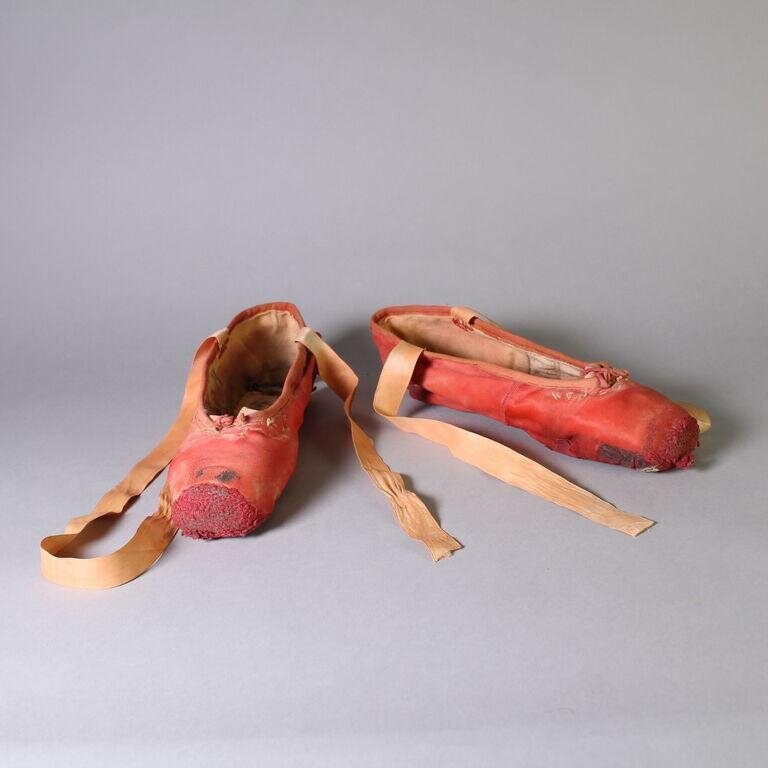
Two worn pointe shoes are displayed against a neutral grey background, positioned at slight angles to one another. The shoes are crafted from a coral-pink satin material that shows significant age and use: the fabric is darkened, stained, and creased throughout, with visible wear at the toe boxes and along the seams. Each shoe retains its pale peach-coloured ribbon ties, now faded and somewhat frayed, which would have been sewn to the sides and wrapped around the dancer's ankle. The shoes are photographed in a documentary style typical of museum collection photography, with clear overhead lighting that casts subtle shadows and reveals the three-dimensional form and deterioration of the objects. This is plainly archival material: the shoes are presented as historical artifacts rather than objects in use.
The dancing
There are no figures or bodies in this image. The photograph documents the shoes themselves as objects, not dancers wearing them or in motion. The composition emphasizes the worn condition of the shoes' toe boxes—the hardened, reinforced area where a dancer's weight bears down during rises en pointe—and the construction details: the satin upper, the ribbon attachment points, and the way the shoe has shaped itself to past use.
The dance depicted
These are ballet pointe shoes, the specialized footwear that allows dancers to rise onto the tips of their toes and sustain movement in the uppermost register of the body. The extreme wear visible here—darkening of the satin, compression and splitting of the toe box, creasing and separation of the layers—testifies to intensive training and performance use. Pointe shoes of this type and condition are typically preserved as personal records of professional or advanced amateur dancers, marking a specific period in a dancer's career or life. The shoes themselves cannot tell us which dancer wore them, but the quality of manufacture and degree of use suggest serious study.
How it was made
This is a colour photograph of a three-dimensional object (the shoes themselves), presented as a museum collection documentation image. The photograph is lit to reveal form and surface detail, and appears to be shot in daylight or institutional lighting that renders colours accurately without harsh shadows. The choice to photograph the shoes as archival objects—removed from use, displayed without context of body or performance—frames them as historical evidence and personal artifact rather than as ballet costume.
About this work
This photograph documents a pair of used ballet pointe shoes, dated to 1934, held by the V&A (Victoria and Albert Museum). It is an archival record of a material object that embodies the physical practice of classical ballet: the shoes bear direct evidence of the dancer's technique, strength, and intensity through their wear pattern. The shoes are catalogued as a single artwork and collection object, which is unusual—they are preserved not as costume or theatrical property but as a biographical and material document. In the context of dance history, worn pointe shoes function as a form of evidence: they show us where pressure was applied, how long a dancer could sustain work, and what level of training had been achieved. The 1934 date places them in the early twentieth century, when pointe work was still relatively recent technology and when the construction of pointe shoes was less standardized than it would later become.
How to look at it
Observe the toe box first: the darkening, softening, and collapse visible there is where the dancer's weight has repeatedly compressed the layers of the shoe, breaking down the initial stiffness until the shoe molds to the foot. Look at the ribbons and the upper of the shoe: the creasing and darkening show how the foot moved inside it, where sweat and contact stained the satin. The shoe is not shaped like a foot at rest; it is shaped like a foot in use, stressed and adapted by movement. These shoes tell the story of technique made physical.
The artist
The catalogue records only the artist name 'Elmina' and the date 1934. Without further documentation, the identity, training, and career of the dancer who wore these shoes cannot be established from the record. The V&A's preservation of them suggests they were acquired as notable or representative objects, but the circumstances of that acquisition are not recorded here.
The period
In 1934, ballet in Europe was in a state of rapid change. The Ballets Russes, under Sergei Diaghilev, was at the height of its influence, pushing classical ballet toward modernism while the Imperial Russian technique continued to dominate training in Paris, London, and beyond. Pointe work had been central to ballet technique since the early nineteenth century, but shoes were still largely made by hand or in small workshops, and they varied considerably in construction and durability. By 1934, the shoes would have been hand-lasted and hand-blocked, with the toe box stiffened by layers of paper, burlap, and glue—much softer and less durable than the synthetic materials that came later. The intensive wear visible here reflects both the dancer's dedication and the limitations of the shoe construction of the time.
Where it lives
The shoes are held by the Victoria and Albert Museum, London, catalogued as a collection object. They are described in the catalogue as 'Ballet shoe', with the artist named as 'Elmina' and the date given as 1934. The medium is not recorded in the available documentation.
Dance in this work
Questions about this work
Why are worn-out pointe shoes worth preserving?
Worn pointe shoes are material records of dance practice. The specific patterns of wear—where the toe box has softened, how the satin has creased, where sweat has darkened the fabric—show how an individual dancer's body moved, where pressure was applied, and how intensively the shoes were used. For historians and dancers, they are primary evidence of technique and training that cannot be captured any other way. They also document the construction and durability of pointe shoes at a particular moment in history.
Who was Elmina?
The catalogue record identifies the artist only as 'Elmina', with no additional biographical information available in this documentation. It is not clear whether this is the name of the dancer who wore the shoes or the maker of the shoes. Without further archival research in the V&A's collection records, the identity cannot be established here.
How long would a pair of pointe shoes last in 1934?
The durability of pointe shoes in the early twentieth century depended on the dancer's weight, technique, and intensity of use, but a professional dancer might expect a pair to last anywhere from a few weeks to a few months of regular work. The shoes in this photograph show extreme wear, suggesting either very intensive use or a long career. Modern pointe shoes, with synthetic materials and more consistent manufacturing, typically last somewhat longer, though professional dancers still go through many pairs per year.
How do you dance en pointe?
Dancing en pointe means rising onto the tips of the toes, supported by the rigid structure of the pointe shoe's toe box. This requires years of training to develop the strength in the feet, ankles, and legs, and the technique is foundational to classical ballet. The shoe's construction—layered and hardened—allows the dancer to sustain weight on a very small surface area. The ribbons tie around the ankle to hold the shoe in place during movement.
More dance artwork





