49 works in this view — arrow keys or swipe to move between them.
Dance in Art
Nocturne
Fedorovitch, Sophie
- Collection:
- Costume design
- Source:
- Victoria and Albert Museum
- Rights:
- Rights vary by item — check the source record before reusing this image. Source record ↗
- Recorded as:
- V&A — check rights per item
Fedorovitch was a major figure in mid-twentieth-century British and European theatrical design, and her costume sketches are primary documents of how theatrical bodies were conceived and adorned during the interwar and wartime years. This sketch reveals the collaborative relationship between visual design and performance: the costume's extreme elegance and the carefully considered color palette suggest a specific narrative or emotional tone within a larger production, demonstrating how designers used dress to construct meaning on stage.
What you are looking at
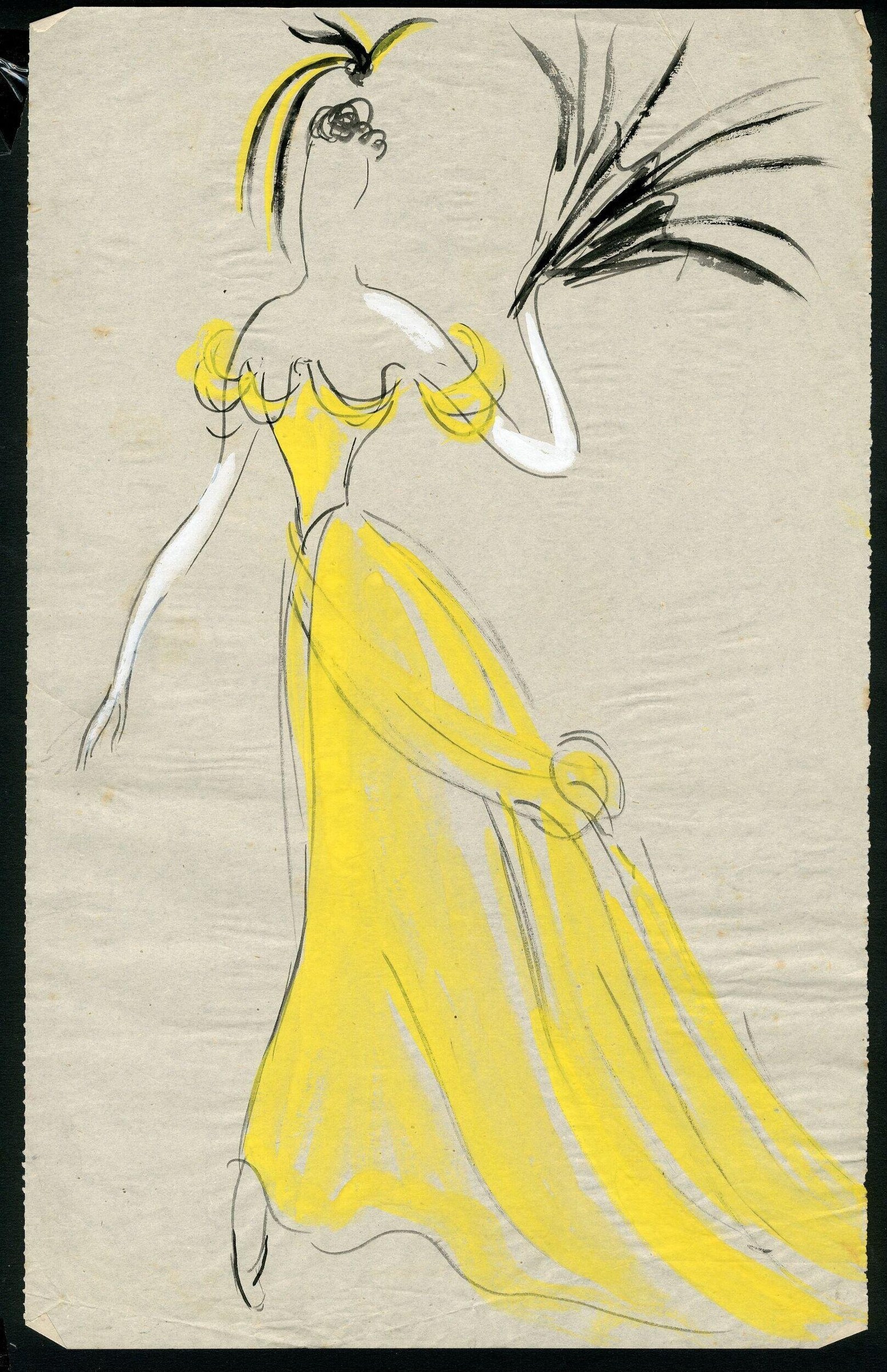
A single female figure in an elegant yellow evening gown stands in a three-quarter pose against a neutral background. She wears a strapless or off-shoulder dress with a fitted bodice detailed in yellow with white highlights, and a voluminous skirt that flows to the ground with graceful folds and draping rendered in pale yellow and white. Her dark hair is styled with a striking upswept arrangement, finished with tall black feathers that rise dramatically from the crown. She holds a large spray of dark feathered plumes—possibly ostrich feathers—in her right hand, positioned at waist height. Her left arm hangs naturally at her side. The figure is rendered with delicate linear drawing in black and gray, with areas of brilliant yellow watercolor or gouache applied to the costume. The pose is elegant and somewhat static, suggesting evening wear display rather than active movement.
The dancing
A single dancer or performer, shown standing with upright posture and weight evenly distributed, in a display or presentation pose rather than mid-movement. The arms are relaxed and asymmetrical—one holding the feather prop, the other at rest. The pose suggests a presentational moment, perhaps the end of a performance or a costume study, rather than active choreography. There is no dynamic line through the body, no sense of weight transfer or momentum.
The dance depicted
This appears to be a costume design for theatrical performance, most likely for ballet or a musical theatre production of the 1930s. The extreme elegance of the gown, the exotic feather headdress, and the formal evening-wear context suggest a 'night scene' or glamorous theatrical moment—consistent with the title *Nocturne*. The figure's static pose and the work's apparent function as a costume design rather than action study make identification of a specific dance style difficult. The formal, ballroom-adjacent silhouette and the emphasis on spectacular costume over movement execution suggest theatrical ballet or musical theatre rather than social dance, though the work prioritizes visual spectacle over choreographic specificity.
How it was made
A mixed-media costume design sketch executed in pencil or black ink outlines with selective hand-coloring in yellow watercolor or gouache. The technique allows rapid visualization of the costume's color and line while leaving the figure lightly indicated, typical of theatrical design practice. The white highlighting applied over the yellow creates volume and dimension in the skirt folds. This approach was standard for professional costume designers working for theatre companies in the 1930s, enabling quick communication of design intent to costume makers and directors without requiring full representational finish.
About this work
This is a costume design by Sophie Fedorovitch for a theatrical production titled *Nocturne*, dated 1936. It depicts an elegant evening gown in brilliant yellow with feathered accessories, rendered as a mixed-media sketch in ink and watercolor. Fedorovitch was a distinguished Russian-born designer working in London during the 1930s, creating costumes and sets for major ballet and theatre companies. The work exemplifies the luxury and glamour of high-society theatrical design in the interwar period, where exotic evening wear and ornamental feathering were markers of elegance and sophistication. The costume's emphasis on spectacle and visual impact situates it within the tradition of theatrical ballet or musical theatre rather than modern concert dance.
How to look at it
Attend to the deliberate choice of yellow—a bold, non-naturalistic choice that reads as pure theatrical spectacle rather than realistic evening wear. The feathered headdress and the large feather prop are the costume's signature elements; they establish the figure as a performer in a fantasy or stylized world rather than a realistic dramatic character. The sketch technique itself is instructive: notice how much information is conveyed through line (the silhouette, the architecture of the gown) and how the strategic application of color creates dimension and confirms the designer's vision without over-finishing. The static pose is typical of costume design practice—it prioritizes the garment over the body's movement potential, suggesting this was made for initial concept approval rather than as a record of actual choreography.
The artist
Sophie Fedorovitch (1893–1977) was a Russian-born designer and painter who became one of the most influential costume and set designers for British ballet and theatre in the mid-twentieth century. Working extensively with the Ballets Russes and later with British companies including the Sadler's Wells Ballet, she was known for her sophisticated use of color, architectural understanding of costume construction, and ability to balance luxury with theatrical clarity. Her designs bridged the worlds of high fashion and stage spectacle, often drawing on contemporary couture aesthetics to create costumes that were both visually sumptuous and choreographically functional.
The period
In 1936, European theatrical design was at a peak of cosmopolitan sophistication. The Ballets Russes tradition of lavish spectacle remained influential, and designers like Fedorovitch brought haute couture sensibilities to the stage. The mid-1930s saw a renewed interest in glamorous evening-wear aesthetics in both fashion and theatre, partly as a response to the economic recovery after the Depression and partly as an affirmation of elegance and culture amid growing political instability. Nocturne as a title evokes the Romantic ballet tradition (with its association with night scenes, dreams, and ethereal beauty) while the costume's modernity and frank glamour situate the work in the contemporary theatrical moment.
Where it lives
This work is held as part of a costume design collection (catalogued as 'Costume design' in the holding institution). It is a working design sketch created for theatrical production, likely part of a larger archive of Fedorovitch's designs for a specific production or company.
Dance in this work
Questions about this work
Who was Sophie Fedorovitch?
Fedorovitch was a Russian-born designer (1893–1977) who became one of the most celebrated costume and set designers for British ballet and theatre. She worked with the Ballets Russes, Sadler's Wells Ballet, and numerous London theatres, known for her sophisticated color sense and ability to merge fashion-forward design with theatrical spectacle. Her work bridged Russian avant-garde design traditions and mid-century British theatrical practice.
What is a costume design sketch and how is it used?
A costume design sketch is a preliminary drawing made by a designer to communicate a costume concept to directors, producers, and costume makers. It typically includes the silhouette, color, key decorative details, and sometimes fabric suggestions. These sketches were essential for approval before expensive costume construction began and served as blueprints for the costume workshop. Mixed-media sketches like this one—combining precise line work with selective watercolor—are typical of professional practice because they convey both structure and color efficiently.
What is a 'Nocturne' in theatrical terms?
In nineteenth-century Romantic ballet tradition, a nocturne typically refers to a scene or tableau set at night, often with dreamlike, ethereal, or magical qualities. The term also appears in musical composition (Chopin's Nocturnes) with associations of melancholy and introspection. In this theatrical costume, the title suggests a sophisticated evening scene, and the glamorous gown and exotic feathering establish a fantasy or dream-world aesthetic rather than realistic drama.
More dance artwork





