49 works in this view — arrow keys or swipe to move between them.
Dance in Art
Nocturne
Fedorovitch, Sophie
- Collection:
- Costume design
- Source:
- Victoria and Albert Museum
- Rights:
- Rights vary by item — check the source record before reusing this image. Source record ↗
- Recorded as:
- V&A — check rights per item
This work matters because it documents the collaborative visual culture of early twentieth-century theatrical dance and the crucial role of costume design in defining a dancer's role and the work's visual identity. Sophie Fedorovitch was an influential and prolific designer whose work shaped the aesthetics of major ballet and theatre productions, and her designs for *Nocturne* represent the formal evening-wear vocabulary of a specific historical moment in European dance theatre.
What you are looking at
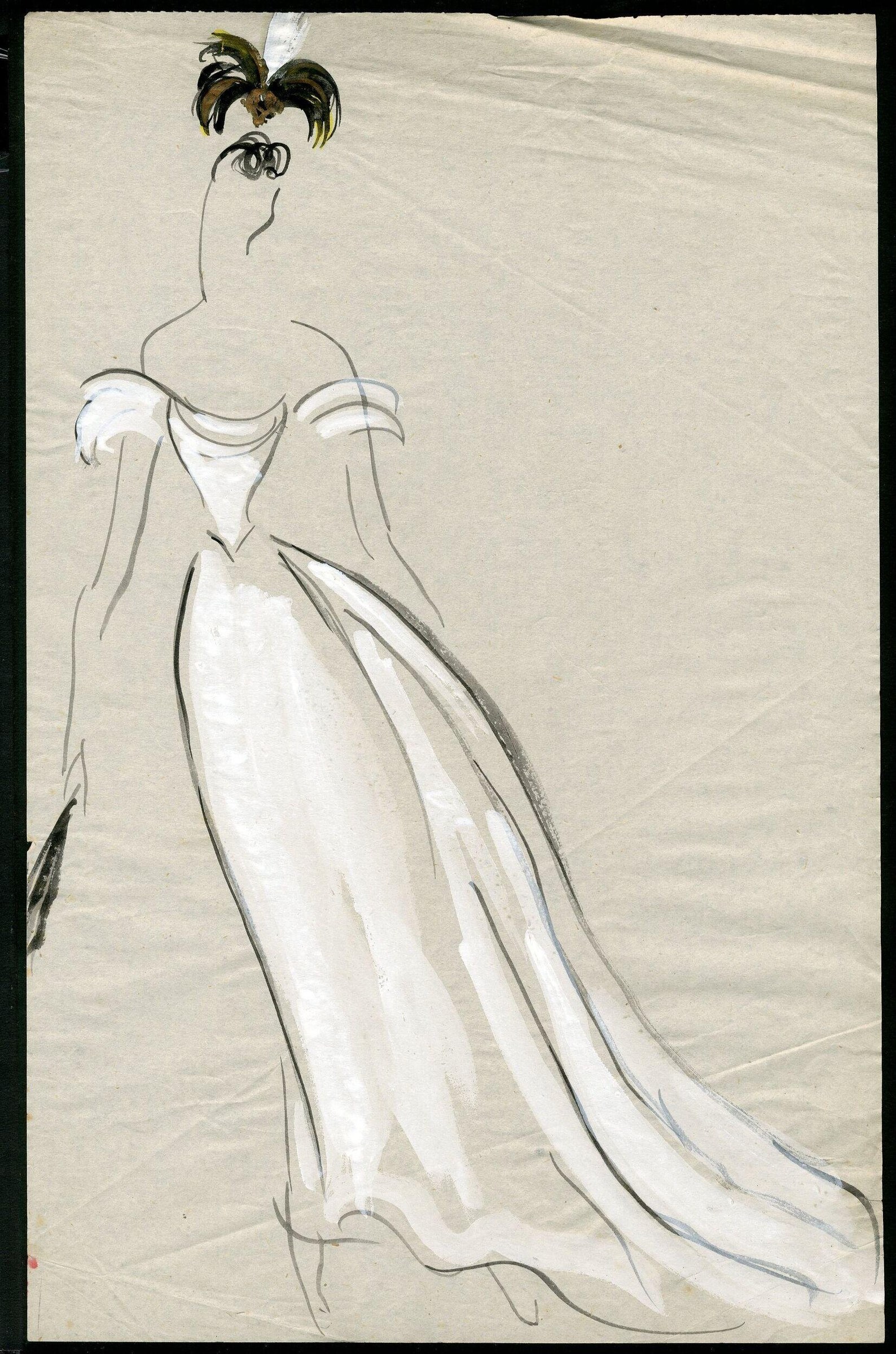
A single female figure stands in three-quarter view against a plain background, her body rendered in delicate pencil line with selective white and grey wash. She wears a strapless or off-shoulder bodice of white fabric with a draped, sculptural quality, and a floor-length skirt or gown of pale fabric with significant trained length that pools and unfolds behind her. Her hair is styled high and dark, crowned with what appears to be an elaborate dark headdress or feathered ornament with upright curved elements. The figure's pose is frontal and relatively still, with arms held softly at the sides. The entire composition emphasizes verticality and elegant elongation; the minimal setting and muted palette focus attention entirely on the costume and the figure's silhouette. This is plainly a costume design study rather than a record of an actual dance moment.
The dancing
A single standing female figure with upright posture and minimal dynamic gesture. The arms hang naturally, neither gesturing nor framing a partner. There is no indication of weight shift, turnout, or the flexion associated with active dancing—the pose is calm and presentational. The elongated proportions and the way the figure is drawn suggest a fashion or costume design document rather than a study of movement or technique.
The dance depicted
The work is titled *Nocturne*, which in the context of early twentieth-century theatre design typically refers to a romantic or ethereal dance scene, often set to music. The costume—a floor-length gown with dramatic train and ornate headdress—is consistent with theatrical or balletic evening wear of the 1930s, but the figure's stillness and the graphic treatment suggest this is a costume design rather than choreographic notation. The standing pose, though formal, offers no clear evidence of a specific dance style or movement vocabulary. The garment itself appears designed for a solo female dancer in a theatrical work, but without additional documentation or identification of the original production, the precise choreographic identity remains uncertain.
How it was made
This is a mixed-media work on paper: pencil line drawing with selective application of white and grey wash or watercolour. The technique is characteristic of theatrical costume design of the early-to-mid twentieth century—economical, with emphasis on silhouette and fabric effect rather than anatomical precision. The selective use of wash creates volume and texture in the fabric while leaving much of the form to elegant line. This method was standard for professional costume design circulation among theatres, allowing rapid production and clear communication of form and color intent to pattern makers and seamstresses.
About this work
This is a costume design by Sophie Fedorovitch for a theatrical work titled *Nocturne*, dated 1936. The drawing documents a formal evening gown for a female dancer or performer: a strapless or draped bodice and trained skirt in pale fabric, topped with an elaborate headdress. The work belongs to the tradition of professional theatre design documents that record the visual vocabulary of costume rather than choreographic movement. Fedorovitch was a significant Russian-born costume and set designer working in British and European theatre in the 1930s and 1940s, and this work exemplifies the elegance and restraint of her design aesthetic.
How to look at it
Observe the economy of means: the designer has used only pencil line and selective wash to convey the weight, volume, and texture of expensive fabric. Notice how the skirt is suggested primarily by outline and fold, not filled in—this is the language of professional design, where the eye of the theatre professional would complete the picture. The headdress is rendered more fully, suggesting its importance to the character or role. The stillness of the pose is notable: this is not a moment of movement but a presentation of costume, a visual statement of what will be worn and how it will look on stage.
The artist
Sophie Fedorovitch (1893–1982) was a Russian-born painter, costume designer, and set designer who became a major figure in British and European theatrical design from the 1920s onwards. She trained in Paris and worked extensively for Sergei Diaghilev's Ballets Russes and later for British ballet companies and theatres. Her designs are characterized by elegance, restraint, and an understanding of how fabric moves on the dancing body. She was renowned for her ability to create both fantastical and deeply practical designs, and her work appeared in hundreds of productions across dance, opera, and theatre.
The period
In 1936, European theatre design was at a peak of sophisticated integration between visual art and dance. The influence of the Ballets Russes, which had pioneered collaboration between avant-garde artists and dancers, was still strong, but the market for theatre design was increasingly professionalized and commercialized. Evening-wear for theatrical performances of the 1930s maintained the romantic and idealized silhouettes of the 1920s while incorporating new simplifications and modernist principles. The formal gown depicted here reflects both the lingering influence of Romantic ballet aesthetics and the streamlined elegance that design of the decade favoured.
Where it lives
The work is held as part of a costume design collection, catalogued as coming from the V&A (Victoria and Albert Museum), the major British repository of theatrical and fashion design materials. Fedorovitch's papers and designs are widely distributed among institutional collections in Britain and Europe, reflecting both her productivity and her influence.
Dance in this work
Questions about this work
Is this a painting or a sketch?
It is a mixed-media work on paper—primarily a pencil drawing with added wash or watercolour. This was the standard professional method for theatre costume design of the era. It was created as a design document for production, not as a finished artwork for exhibition.
What was *Nocturne*?
The catalogue record identifies this as costume design for a work titled *Nocturne*, dated 1936, but does not specify which production, choreographer, or company commissioned it. In theatrical terminology of the period, a Nocturne typically denoted an evening scene, often romantic or ethereal, usually set to lyrical music. Further research would be needed to identify the specific premiere or production.
What does the headdress tell us about the role?
The elaborate upright headdress—with its curved, feathered or sculptural form—suggests a character role of some formality or fantasy. It is far more ornate than simple evening wear and indicates a theatrical or balletic character rather than a naturalistic one. The ornament is typical of 1930s theatrical fancy-dress design.
Who was Sophie Fedorovitch?
Fedorovitch (1893–1982) was a Russian-born designer who became one of the most influential costume and set designers of early twentieth-century European theatre and dance. She worked for the Ballets Russes and many other major companies and is remembered for her ability to create designs that were both visually stunning and deeply practical for the dancer's body.
More dance artwork





