49 works in this view — arrow keys or swipe to move between them.
Dance in Art
Nocturne
Fedorovitch, Sophie
- Collection:
- Costume design
- Source:
- Victoria and Albert Museum
- Rights:
- Rights vary by item — check the source record before reusing this image. Source record ↗
- Recorded as:
- V&A — check rights per item
Costume design drawings are archives of theatrical practice; they record not only what was worn but how an artist understood the relationship between cloth, body, and movement in a specific dance work. Fedorovitch's designs are recognized as significant documents of mid-20th-century theatrical dance, particularly in ballet and modernist theater. This drawing is evidence of what *Nocturne* looked like, and of how a designer of the period conceived the female dancer's body as a vehicle for elegance and theatrical presence.
What you are looking at
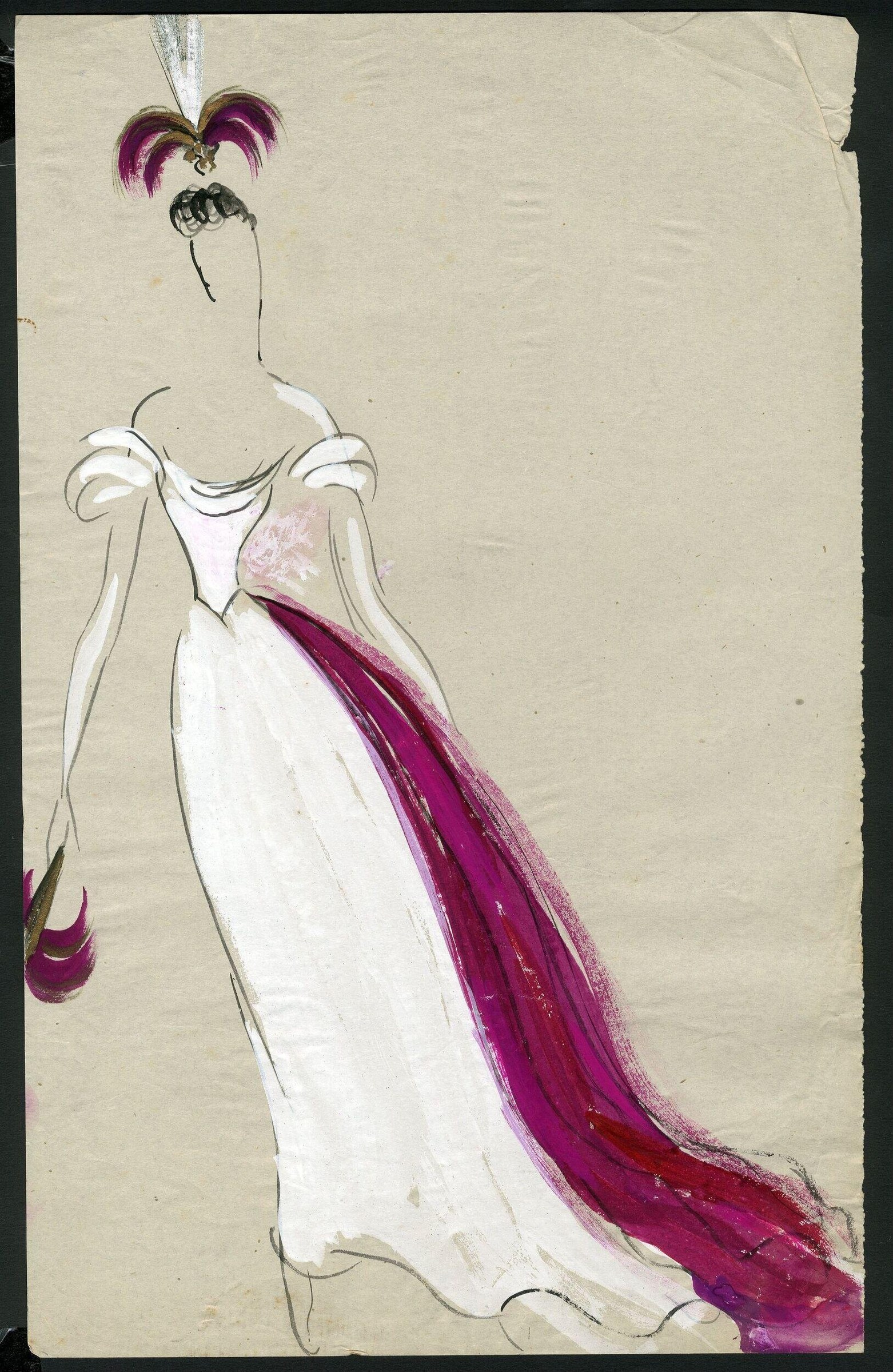
A single female figure stands in a graceful, elongated pose against a cream background. She wears a draped white gown with long flowing sleeves arranged in elegant curves. The dress falls in soft folds to the floor, where purple-magenta fabric—apparently a train or overskirt—pools dramatically behind her. Her head is rendered in fine black line, inclined slightly downward in a contemplative attitude. At the crown of her head, an ornament of purple feathers or plumes rises upward, adorned with what appears to be a small jeweled or beaded clasp. The figure is compressed vertically; the proportions are highly stylized, with an extremely long neck and attenuated limbs that emphasize elegance and otherworldly quality. A white ribbon or cord descends from the ornament at the top of the frame. The pose suggests a moment of stillness rather than active movement—the figure appears poised rather than dancing, though the gathering of the train and the sweep of the drapery imply potential for motion.
The dancing
A single dancer is depicted in a vertical, frontal orientation with arms extended downward and slightly away from the body in a languid, open position. The neck is exaggerated in length, contributing to an art-deco elegance. The body weight appears centered and upright; there is no suggestion of weight shift or traveling movement. The styling of the hair, the delicate line work for the face and limbs, and the studied arrangement of the drapery all suggest a professional theatrical presentation rather than naturalistic portraiture. The figure does not appear to be executing a specific step or technical movement.
The dance depicted
This is a costume design rather than a representation of a dancer in action. The theatrical context—the studied drape, the ornamental headdress, the elegant train—places this firmly within early 20th-century theatrical costume practice. The work titled *Nocturne* with a date of 1936 suggests a connection to ballet or theatrical dance of the interwar period, when nocturne-themed works were part of the modernist ballet repertoire. The extreme stylization and the emphasis on the silhouette of the costume rather than on body mechanics or classical ballet vocabulary suggest this may be costume design for a work in a more contemporary or modernist idiom than classical ballet, though the elegance of the line and the sophistication of the color palette are consistent with high theatrical practice of the 1930s. Without additional context on the work itself or the commissioning choreographer, the specific dance identity cannot be confirmed.
How it was made
This is a costume design drawing executed in mixed media: the figure is outlined in black ink, with selective application of watercolor or gouache in white (for the gown) and deep purple-magenta (for the train and plume ornament). The paper is cream-colored and has aged to a slightly darker, more mottled tone. The technique is that of a working costume design—economical, gestural, and focused on communicating the essential silhouette and color scheme to a costumer or stage director rather than on pictorial finish. The linear drawing of the face and limbs is rendered with confidence and delicacy; the color is applied in relatively flat fields, allowing the form to be read at a distance. This was a practical document for theatrical production, likely created in consultation with a choreographer and intended for the costume shop.
About this work
Fedorovitch's drawing is a costume design for a theatrical production titled *Nocturne*, dated 1936. It presents a single female figure in an elegantly draped white gown with a dramatic purple train and feathered headdress, rendered in a highly stylized, elongated idiom characteristic of modernist theatrical design in the 1930s. The work is held as a costume design, which establishes its primary purpose as a practical guide for stage production rather than as an autonomous artwork. The drawing demonstrates Fedorovitch's sophisticated understanding of how costume reads on stage—the compression of the figure vertically, the emphasis on the silhouette, and the strategic use of color all serve the practical demands of theatrical visibility and elegance. This is a record of how dance was to be clothed and presented to an audience at a specific historical moment.
How to look at it
Attend first to the silhouette and how it reads against the cream ground: the white gown is almost neutral, allowing the purple train to read as the primary visual accent. Notice how the train gathers and pools—this tells you how the costume was engineered to move. The elongated vertical proportions of the figure are deliberate and stylized; this is not realism but theatrical idealization. Look at the fineness of the line work in the face and limbs and contrast it with the broad, flat application of color; this is how Fedorovitch conveyed both human delicacy and theatrical presence. The feathered ornament at the crown reads as a focal point; in performance, this would draw the eye upward and contribute to the elegance of the silhouette. The downward tilt of the head suggests an emotional or narrative content that the design alone cannot fully convey.
The artist
Sophie Fedorovitch (1893–1977) was a Russian-born stage designer and costumier who became a central figure in British ballet and theatrical design from the 1920s onward. She designed costumes and scenery for the Ballets Russes, for Frederick Ashton's early works with the Ballet Rambert and what became the Royal Ballet, and for theater and opera across her long career. Her approach was marked by an understanding of how costume moves with the dancer's body, a sophisticated use of color and texture, and an elegant, often modernist sensibility. She was particularly valued for her ability to realize a choreographer's vision through costume in a way that enhanced rather than impeded movement. Her working drawings—like this one—are characterized by confident line, economy of means, and a clear sense of how the design would function on stage.
The period
In 1936, European ballet was at a threshold. The Ballets Russes, which had dominated the artistic landscape of the 1910s and 1920s, was in decline; Diaghilev had died in 1929. British ballet was emerging as a significant cultural force, with Frederick Ashton beginning his ascendancy as a choreographer and English dancers coming forward. The late 1930s were a moment of modernism in theatrical design—the influence of Constructivism, of the decorative arts, and of a new sobriety in stage practice all shaped costume design. The simplification of color, the emphasis on silhouette, and the sophisticated use of drape seen in Fedorovitch's drawing are all consistent with this historical moment. *Nocturne* was likely a chamber work or a vehicle for a principal dancer rather than a large ensemble piece; the solitary figure and the intimacy of the design vocabulary suggest an inward-looking, lyrical work.
Where it lives
This drawing is held in the V&A's costume design collection, one of the world's largest archives of theatrical costume documentation. It is catalogued as a costume design object, which is its primary identity; it is a working document for theatrical production rather than a fine art drawing, though it was created by a recognized artist and has historical and aesthetic significance.
Dance in this work
Questions about this work
Who was Sophie Fedorovitch?
Fedorovitch (1893–1977) was a Russian-born designer who became one of the most important costume and scenic designers for British ballet from the 1920s to the 1970s. She designed for the Ballets Russes, the Ballet Rambert, and the Royal Ballet, and was known for creating costumes that enhanced rather than hindered dance movement. Her designs are celebrated for their elegance, sophistication, and practical understanding of how fabric moves on stage.
What is *Nocturne* and who danced it?
Without further documentation, the specific ballet or dance work titled *Nocturne* (1936) cannot be conclusively identified here. The title suggests a lyrical or intimate work, possibly a solo or pas de deux. Additional research in ballet records and Fedorovitch's design archives would be required to confirm the choreographer, the dancer(s), and the premiere or first performance date.
Why was this drawing created?
This is a working costume design—a practical blueprint for the costume shop to use in constructing the actual garment. It communicates the silhouette, the color scheme, the ornamental details, and the overall visual effect of the costume on stage. Fedorovitch would have made such drawings in consultation with the choreographer, and they would have been used by tailors and seamstresses to execute the design.
How do you know what technique was used to make this?
The appearance of the object itself indicates the materials and technique: the cream paper, the black ink line, and the watercolor or gouache washes in white and purple are all visible. The style of execution—economical, gestural, focused on silhouette and color rather than texture or detail—is consistent with mid-20th-century costume design practice. The condition and aging of the paper confirm its age and archival handling.
More dance artwork





