49 works in this view — arrow keys or swipe to move between them.
Dance in Art
Nocturne
Fedorovitch, Sophie
- Collection:
- Costume design
- Source:
- Victoria and Albert Museum
- Rights:
- Rights vary by item — check the source record before reusing this image. Source record ↗
- Recorded as:
- V&A — check rights per item
Fedorovitch's costume designs are historically significant documents of how dancers were conceived and dressed in mid-twentieth-century ballet and modern theatre, and this work shows her characteristic integration of dramatic idea with elegant line and economy of means. For dancers and choreographers, the design offers insight into how silhouette, drapery, and ornament were used to create character and atmosphere in an era that valued both theatrical spectacle and modernist restraint. The survival of such designs also documents the collaborative creative process between designer, choreographer, and performer that shaped the visual language of dance in this period.
What you are looking at
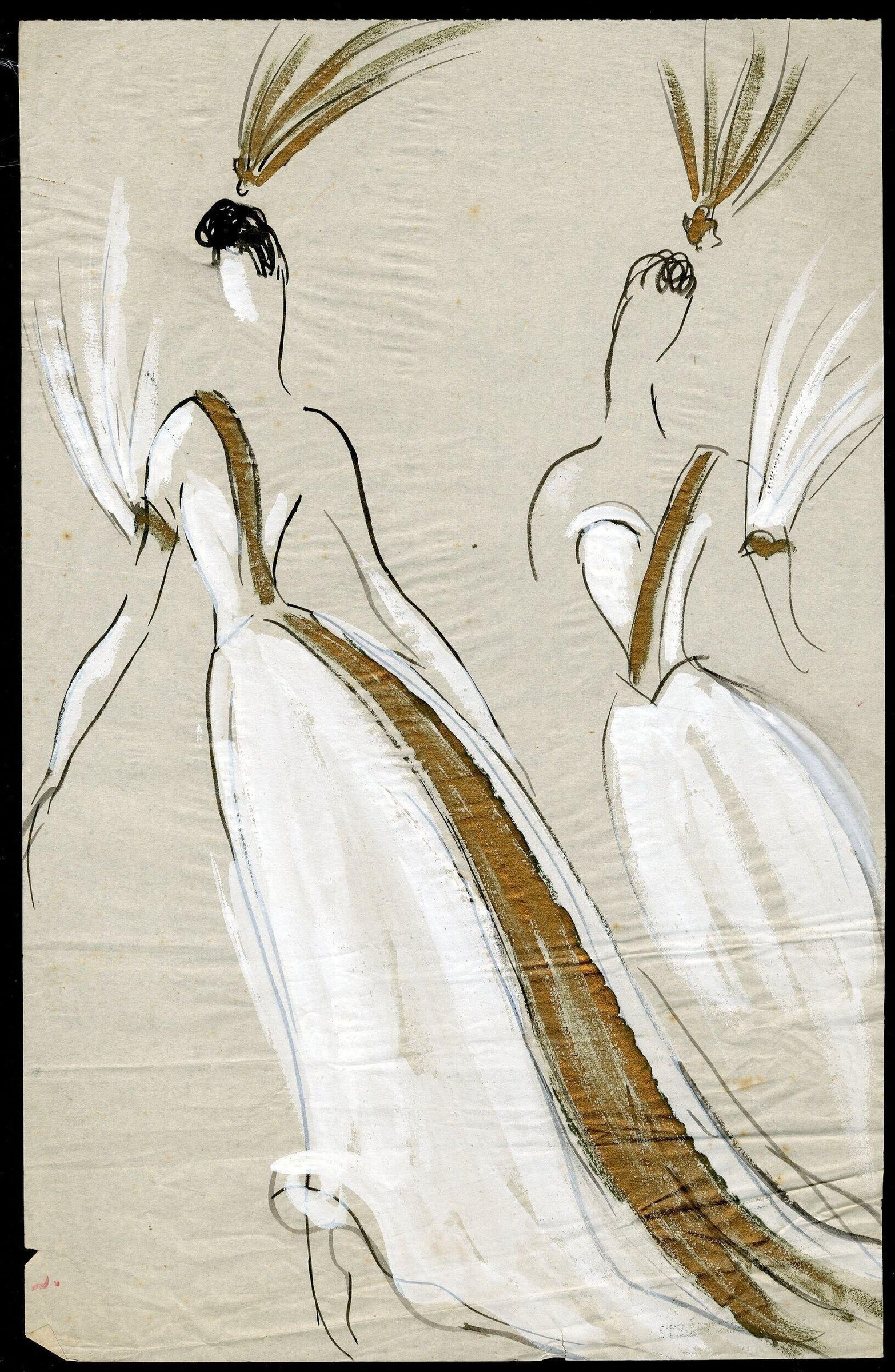
The image shows a costume design for a soloist, rendered in watercolor and ink on cream paper. A single tall figure dominates the composition, dressed in a flowing white garment with an emphasis on vertical line and silhouette. The dancer wears what appears to be a long, gently draped skirt or robe with a deep tan or golden-brown stripe running down the center front, creating a strong axial emphasis. At the shoulders and neckline, the fabric gathers into delicate pleats or knife folds that extend upward, and the arms are suggested by thin, expressive ink lines that extend gracefully away from the body. The upper portion of the costume features elaborate headdress or hair ornament rendered in tan and olive tones, with long strands radiating outward in a burst pattern that suggests movement or drama. Four smaller costume studies surround the central figure—simplified sketches showing the headdress and shoulder arrangement from different angles, each with similar radiating line work at the top. The overall aesthetic is one of elongation and flowing verticality, with a palette of whites, tans, and soft ochres set against the pale ground.
The dancing
The central figure is depicted with remarkable verticality and restraint. The body is suggested by the white drapery rather than explicitly drawn; the artist conveys form through the fall and gathering of fabric. The arms are rendered as delicate, almost calligraphic ink lines that gesture outward and slightly downward from the shoulder area, with no visible hands but an implied extension of the limbs into space. The stance appears grounded, with the weight distributed evenly, and there is no suggestion of active step work or turned-out positions. The smaller studies suggest the artist was investigating the headdress construction and the relationship of the hair or ornament to the shoulder line and upper back.
The dance depicted
The work is a costume design, most likely for a theatrical work from the mid-1930s, possibly a ballet or modern dance piece. The title 'Nocturne' suggests an evening or night-time setting, and the dreamlike quality of the rendering—with its emphasis on fluid drapery and ethereal line—is consistent with the aesthetic vocabulary of Romantic or contemporary ballet of that period. The construction of the design, with its emphasis on the vertical axis, the gathered shoulders, and the elaborate headdress, suggests a character of ethereal or otherworldly quality. Without identification of the specific work, it is difficult to say more, but the restraint and elegance of the design suggest a principal or soloist role rather than an ensemble dancer.
How it was made
This is a watercolor and ink drawing on paper, executed with considerable delicacy and control. The artist has used translucent washes of tan, ochre, and pale green for the headdress and shoulder area, allowing the paper ground to show through and creating a luminous effect. The white of the costume is achieved through the reserved paper itself, outlined in faint graphite or ink, while the central stripe is rendered in a warm brown pigment applied with precision. The thin, gestural ink lines that suggest the arms show the artist's confidence in line drawing and an understanding of how to suggest movement and extension without explicit anatomical detail. The technique is typical of mid-twentieth-century costume design practice, where watercolor studies allowed the designer to explore color, drape, and silhouette quickly and communicate ideas to the design team and dancers.
About this work
This is a costume design by Sophie Fedorovitch for a theatrical dance work titled 'Nocturne', dated 1936. Fedorovitch was a prominent Russian-born designer who worked extensively in British theatre and ballet from the 1920s onward, and this drawing exemplifies her refined, economical approach to costume design. The work shows a single soloist in a flowing white costume with an emphasis on vertical line, gathered shoulders, and an elaborate headdress, suggesting a character of ethereal or Romantic sensibility. The design is composed with considerable elegance and restraint, using the white paper ground to maximum effect and relying on delicate watercolor washes and ink line to convey form and movement. It belongs in a gallery of dance imagery as both a finished design object and a window into the collaborative practice of theatrical dance in the early twentieth century, when costume design was inseparable from choreography and interpretation.
How to look at it
Attend to how Fedorovitch has used the white paper ground as an active material rather than a passive surface—the white of the costume is not colored in but revealed, which creates a luminous, ethereal quality that could not be achieved by painting white over a darker ground. Notice the precision of the central brown stripe and how it anchors the figure vertically, and observe how the gathered shoulders and radiating headdress lines suggest movement and energy despite the stillness of the pose. The small studies around the main figure are not secondary but integral to the design process—they show the designer thinking through the headdress from multiple angles and refining the proportion of the ornament to the body. The expressive ink lines of the arms are a masterclass in economy: with just a few strokes, Fedorovitch suggests both the extension of the limb and its integration with the flowing drapery.
The artist
Sophie Fedorovitch (1893–1977) was a Russian-born costume and set designer who became a central figure in British theatre and ballet after her emigration in the early 1920s. Working closely with the Ballets Russes and later with British ballet companies, including the Ballet Club and the Royal Ballet, Fedorovitch developed a distinctive style that combined modernist simplicity with dramatic theatricality. Her designs were characterized by an emphasis on line, silhouette, and the interplay of light and shadow on fabric, and she was respected for her ability to enhance rather than obscure the dancers' bodies. She designed for choreographers including Frederick Ashton, Antony Tudor, and others, and her work shaped the visual aesthetic of British ballet in the mid-twentieth century.
The period
In 1936, European theatrical dance was at a moment of formal and ideological transition. The Ballets Russes, which had dominated the previous two decades, was in decline, and both classical ballet and modern dance were being reassessed and renewed in different national contexts. In Britain, where Fedorovitch was based, ballet was becoming institutionalized and indigenized, with the formation of the Ballet Club (1930) and the eventual foundation of major companies. The aesthetic of costume design was shifting away from the ornate, colorful exoticism associated with Diaghilev toward a more restrained, architecturally precise approach that integrated costume with the body's line and movement. At the same time, modern dance was emerging as a parallel tradition, with artists exploring abstraction, austerity, and the expressive possibilities of the body itself, and some theatrical works of the period blended classical and modern vocabularies. The 'Nocturne' design sits within this moment of stylistic pluralism and refinement.
Where it lives
This work is held in a costume design collection, indicating that it is a working design object rather than a fine art drawing. Such designs typically remain in the archives of theatrical companies or designers' estates and are preserved for their historical and practical value rather than as artworks. The attribution to Fedorovitch and the title 'Nocturne' come from the holding collection's records.
Dance in this work
Questions about this work
Is this a finished design or a sketch?
It is a finished design study in the sense that it clearly communicates the complete costume concept—silhouette, color, ornament, and character—to the choreographer, dancer, and production team. However, it is not a painting made for exhibition; it is a working document created as part of the design and production process. Costume designers of this period often executed watercolor studies at this level of refinement to explore color and drape while remaining ready to adjust details based on rehearsal and the dancer's body.
Who was Sophie Fedorovitch?
She was a Russian-born designer (1893–1977) who became one of the most influential costume and set designers in British theatre and ballet. She worked with the Ballets Russes, the Ballet Club, and the Royal Ballet, and designed for many of the era's major choreographers. Her style was characterized by elegant simplicity, careful attention to silhouette, and an understanding of how costume enhances rather than obscures the dancer's line and movement.
What dance is 'Nocturne'?
The catalogue record does not identify a specific ballet or dance work by that title and date. Fedorovitch designed costumes for many works across her long career, and without further documentation or a matching title in dance records, it is not possible to confirm which work this design was created for. If you have additional information about the work, the holding collection may be able to provide more context.
How was this design used?
After approval by the choreographer and director, this design would have served as a reference for the dressmaker or costume shop, guiding the construction of the actual garment. The dancer would have worn the finished costume in rehearsal and performance. The design itself would be kept in the company's archives as a record of the production and a reference for any future revival or reconstruction of the work.
More dance artwork





